*/

Since launching the online, part-time Master of Laws in International Commercial and Technology Law in 2022, The University of Manchester has seen its graduates build specialist skills at the intersection of technology and commerce, progressing their careers and forming connections with academics and professionals across the world. This global network is already opening up new opportunities for those ready to lead in a rapidly evolving digital landscape.
Course Director Dr Joseph Lee Nazzini, Reader in Corporate and Financial Law, explains why the course is essential for modern legal practice: ‘The use of genAI, utilisation of digital assets and digital trade, proliferation of online platforms and virtual economies – these technologies are transcending physical boundaries. Lawyers should have the ability to identify the risks, but also act as enablers, for realising social and economic goals. Our course is created by experts in this field and we regularly engage with policymakers, multinational companies, the tech sectors and with the government agencies.’
Course Lecturer Dr Fiona Brimblecombe highlights the growing demand for lawyers who can navigate these shifts: ‘Our LLM is at the forefront of the most prevalent legal [challenges] facing lawyers. There’s a real need for legal practitioners with the sort of skills that we’re building from this online master’s; an increased awareness of the issues that AI and other technological innovations are presenting [to] the courts and law more generally.’
The course concludes with an in-depth dissertation, giving students the chance to explore a topic that aligns with their professional interests. For recent graduate Mark Farrell, this meant focusing on digital identity. ‘Because no one had examined digital identity through the combined financial law and data protection lens, I had to build the analysis from the ground up. It pushed me to integrate sources in new ways and gave me the confidence to approach complex, emerging issues with original thinking.’
Mark’s dissertation placed him at the forefront of a developing field. As a direct result, he progressed from Senior Case Officer at the Information Commissioner’s Office to Data Protection Consultant at Data Protection People and was invited to join the Cambridge Centre for Alternative Finance as a part-time intern.
Another recent graduate, Hilda Wehbi, is a senior lawyer whose day-to-day role involves advising on technology, media and FinTech contracts, including digital transformation projects. ‘I believe in continuous learning and development and wanted an LLM programme that would equip me with the tools to navigate the new digital era and gain specialist skills,’ Hilda says. ‘I had been looking into postgraduate studies for some time but never found a programme that I felt targeted my specific areas of interest or that would truly add value to my professional development – until I came across this LLM. The courses offered are a well curated mix of law and technology and address the most topical legal issues in the digital era.
‘I chose The University of Manchester due to its reputation as a world class research institution. I also found the link between The University of Manchester and Alan Turing, an AI pioneer, quite symbolic.’
Flexibility is central to the online format and students can study from anywhere while managing work and personal commitments. The course has already strengthened Hilda’s professional practice. ‘It certainly has given me a deeper understanding of the pertinent issues relating to emerging technologies and the interplay with existing legal frameworks. I feel more prepared to tackle emerging technological challenges and to support entities that I advise to mitigate these challenges in a more imaginative manner.
‘I would recommend this LLM. We are in the midst of a technological revolution, and it is imperative that we are prepared for dealing with the legal challenges as well as opportunities that lie ahead.’
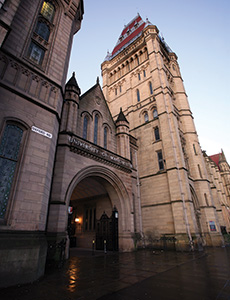
‘Studying online means I can study at my own pace fitting my studies around my personal and work commitments.’ Hilda Wehbi
The University of Manchester’s online, part-time Master of Laws in International Commercial and Technology Law explores online privacy, financial law, business law and intellectual property, examining how technologies such as AI, blockchain, fintech and digital assets are transforming international legal frameworks.
Gain the knowledge and confidence to navigate these shifts and to help shape the future of digital regulation. Find out more about the course on Manchester’s website: www.manchester.ac.uk/techlaw

Since launching the online, part-time Master of Laws in International Commercial and Technology Law in 2022, The University of Manchester has seen its graduates build specialist skills at the intersection of technology and commerce, progressing their careers and forming connections with academics and professionals across the world. This global network is already opening up new opportunities for those ready to lead in a rapidly evolving digital landscape.
Course Director Dr Joseph Lee Nazzini, Reader in Corporate and Financial Law, explains why the course is essential for modern legal practice: ‘The use of genAI, utilisation of digital assets and digital trade, proliferation of online platforms and virtual economies – these technologies are transcending physical boundaries. Lawyers should have the ability to identify the risks, but also act as enablers, for realising social and economic goals. Our course is created by experts in this field and we regularly engage with policymakers, multinational companies, the tech sectors and with the government agencies.’
Course Lecturer Dr Fiona Brimblecombe highlights the growing demand for lawyers who can navigate these shifts: ‘Our LLM is at the forefront of the most prevalent legal [challenges] facing lawyers. There’s a real need for legal practitioners with the sort of skills that we’re building from this online master’s; an increased awareness of the issues that AI and other technological innovations are presenting [to] the courts and law more generally.’
The course concludes with an in-depth dissertation, giving students the chance to explore a topic that aligns with their professional interests. For recent graduate Mark Farrell, this meant focusing on digital identity. ‘Because no one had examined digital identity through the combined financial law and data protection lens, I had to build the analysis from the ground up. It pushed me to integrate sources in new ways and gave me the confidence to approach complex, emerging issues with original thinking.’
Mark’s dissertation placed him at the forefront of a developing field. As a direct result, he progressed from Senior Case Officer at the Information Commissioner’s Office to Data Protection Consultant at Data Protection People and was invited to join the Cambridge Centre for Alternative Finance as a part-time intern.
Another recent graduate, Hilda Wehbi, is a senior lawyer whose day-to-day role involves advising on technology, media and FinTech contracts, including digital transformation projects. ‘I believe in continuous learning and development and wanted an LLM programme that would equip me with the tools to navigate the new digital era and gain specialist skills,’ Hilda says. ‘I had been looking into postgraduate studies for some time but never found a programme that I felt targeted my specific areas of interest or that would truly add value to my professional development – until I came across this LLM. The courses offered are a well curated mix of law and technology and address the most topical legal issues in the digital era.
‘I chose The University of Manchester due to its reputation as a world class research institution. I also found the link between The University of Manchester and Alan Turing, an AI pioneer, quite symbolic.’
Flexibility is central to the online format and students can study from anywhere while managing work and personal commitments. The course has already strengthened Hilda’s professional practice. ‘It certainly has given me a deeper understanding of the pertinent issues relating to emerging technologies and the interplay with existing legal frameworks. I feel more prepared to tackle emerging technological challenges and to support entities that I advise to mitigate these challenges in a more imaginative manner.
‘I would recommend this LLM. We are in the midst of a technological revolution, and it is imperative that we are prepared for dealing with the legal challenges as well as opportunities that lie ahead.’
‘Studying online means I can study at my own pace fitting my studies around my personal and work commitments.’ Hilda Wehbi
The University of Manchester’s online, part-time Master of Laws in International Commercial and Technology Law explores online privacy, financial law, business law and intellectual property, examining how technologies such as AI, blockchain, fintech and digital assets are transforming international legal frameworks.
Gain the knowledge and confidence to navigate these shifts and to help shape the future of digital regulation. Find out more about the course on Manchester’s website: www.manchester.ac.uk/techlaw

The Chair of the Bar reports back
Susie Griffin on the admin that keeps barristers from billable work
Clement Cowley, Partner at The Penny Group, explains how global events can influence the performance of pensions and ISAs, and why taking a long-term approach to investing is often the most effective strategy
Mário Barroso, Head of R&D and Method Development at AlphaBiolabs, discusses what family law professionals need to know about hallucinogens, from the main hallucinogenic drugs encountered in family proceedings, to their effects and the testing options available
Harmony Christian Ministries is the latest charity to benefit from a £500 donation from AlphaBiolabs via the company’s Giving Back initiative
By David Green
At the start of her term, Chair of the Bar 2026 Kirsty Brimelow KC set out a series of priorities for the year ahead. One of those priorities was children in the justice system
As the world becomes more digital, Barbara Vinagre Mota examines international research into the mental health consequences of judges’ exposure to graphic and immersive evidence, highlighting the importance of support systems
In an era of patient-centred care and growing concern over misconduct in medical settings, why do women still lack the right to choose women consultants for examination and treatment? Charles Davey investigates
Reviewed by Daniel Barnett
James McNeill Whistler at Tate Britain until 27 September Rothko in Florence at Palazzo Strozzi until 23 August Reviewed by Stephen Cragg KC