*/
Review by Daniel Barnett

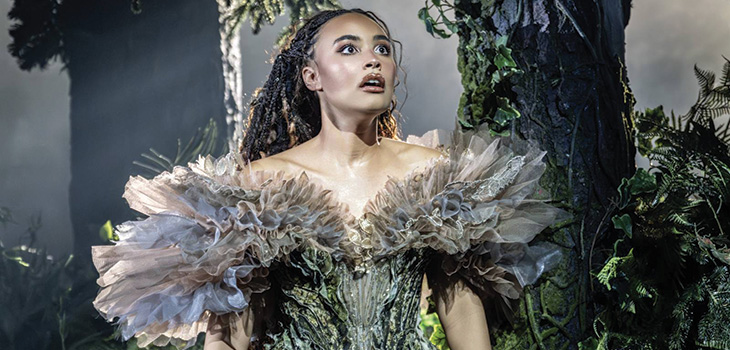
Into the Woods at the Bridge Theatre is a thoughtful revival of Stephen Sondheim and James Lapine’s 1986 musical, which was turned into a film with an all-star cast Meryl Streep, James Corden and Johnny Depp in 2014.
The story opens with a baker and his wife, desperate for a child, who are striving to overturn a witch’s curse that has left them childless. To do so, they need to go into the woods and find four ingredients: a red cape (Red Ridinghood – not a typo – that’s how it’s spelled in the score), a milky-white cow (Jack), golden hair (Rapunzel) and a glass slipper (I know you know that one). Each of the respective fairytale characters has their own individual quest somewhere in the woods, all of which overlap and collide in the first half until the characters come together to defeat Jack’s giant in the second half. Early ensemble numbers are brisk and clear, which helps you learn who the characters are and what slightly surreal subplots they each follow.
The cast features Jamie Parker as the Baker and Katie Brayben as the Baker’s Wife, Kate Fleetwood as the Witch, Chumisa Dornford-May as Cinderella, Bella Brown as Rapunzel, Jo Foster as Jack, Michael Gould as the Narrator, and strong support from Geoffrey Aymer, Jennifer Hepburn, Hana Ichijo and Julie Jupp. The Bridge Theatre’s space is used to pull you into the story, so characters enter and exit from all sides and scenes shift fluidly around you.
Jamie Parker (the original Harry Potter in Harry Potter and the Cursed Child, the original Benjamin Button in… well, you get the point) is one of my favourite male musical theatre actors. His Baker begins as practical and cautious, voice and stance tight with worry, and grows into someone more pessimistic and accountable as the pressure rises and the deaths mount. Fleetwood’s Witch is magnetic without grandiosity. She blends bitterness and craving for control in a way that makes her more compelling than typical pantomime witches (this is very far from a panto, by the way; the show is grim and dark with a few comical moments). But her key solo, ‘Children Will Listen’, felt a little anticlimactic because the audience was anticipating it during the whole show; then there’s a bit of a ‘Oh, was that it?’ moment.
Sondheim’s lyrics and Lapine’s book are sharp, as you would expect. The text’s playfulness in the first half gives way to a harder edge in the second. A familiar refrain about being careful what you wish for is woven through the evening, and the ending is not a happy one.
I have to give a shout-out to the lighting, which slices the woods into shadows and beams that hint at unseen threats. It’s really impressive. Sound design keeps Sondheim’s notoriously tricky lyrics clear so you do not miss the clever turns of phrase that carry the show.
This show is technically brilliant and beautifully performed. And it’s so clever, with a fast-moving plot and an outstanding ability to keep the audience on the edge of their seat for the next twist. Personally, I go to most Sondheim’s with high expectations and always leave feeling a little cheated. You can appreciate the brilliance of his writing but doesn’t every Sondheim sound a bit… samey? Possibly because his music follows a fast paced speech rhythm, and his melodies prioritise non-linear structures with angular leaps, chromatic inflections, and unresolved contours. But saying that would make me sound a bit pretentious (moi?). So let’s just say, they’re all a bit ‘samey’.
For a bit of dazzle, this is a great show. But Sondheim is not for a first-time theatre-goer, just because of the complexity. Still, the fairytale plots make it wonderfully nostalgic and a fun evening out.

Daniel Barnett practises from Outer Temple Chambers and presents the legal hour on LBC Radio.
Into the Woods at the Bridge Theatre is a thoughtful revival of Stephen Sondheim and James Lapine’s 1986 musical, which was turned into a film with an all-star cast Meryl Streep, James Corden and Johnny Depp in 2014.
The story opens with a baker and his wife, desperate for a child, who are striving to overturn a witch’s curse that has left them childless. To do so, they need to go into the woods and find four ingredients: a red cape (Red Ridinghood – not a typo – that’s how it’s spelled in the score), a milky-white cow (Jack), golden hair (Rapunzel) and a glass slipper (I know you know that one). Each of the respective fairytale characters has their own individual quest somewhere in the woods, all of which overlap and collide in the first half until the characters come together to defeat Jack’s giant in the second half. Early ensemble numbers are brisk and clear, which helps you learn who the characters are and what slightly surreal subplots they each follow.
The cast features Jamie Parker as the Baker and Katie Brayben as the Baker’s Wife, Kate Fleetwood as the Witch, Chumisa Dornford-May as Cinderella, Bella Brown as Rapunzel, Jo Foster as Jack, Michael Gould as the Narrator, and strong support from Geoffrey Aymer, Jennifer Hepburn, Hana Ichijo and Julie Jupp. The Bridge Theatre’s space is used to pull you into the story, so characters enter and exit from all sides and scenes shift fluidly around you.
Jamie Parker (the original Harry Potter in Harry Potter and the Cursed Child, the original Benjamin Button in… well, you get the point) is one of my favourite male musical theatre actors. His Baker begins as practical and cautious, voice and stance tight with worry, and grows into someone more pessimistic and accountable as the pressure rises and the deaths mount. Fleetwood’s Witch is magnetic without grandiosity. She blends bitterness and craving for control in a way that makes her more compelling than typical pantomime witches (this is very far from a panto, by the way; the show is grim and dark with a few comical moments). But her key solo, ‘Children Will Listen’, felt a little anticlimactic because the audience was anticipating it during the whole show; then there’s a bit of a ‘Oh, was that it?’ moment.
Sondheim’s lyrics and Lapine’s book are sharp, as you would expect. The text’s playfulness in the first half gives way to a harder edge in the second. A familiar refrain about being careful what you wish for is woven through the evening, and the ending is not a happy one.
I have to give a shout-out to the lighting, which slices the woods into shadows and beams that hint at unseen threats. It’s really impressive. Sound design keeps Sondheim’s notoriously tricky lyrics clear so you do not miss the clever turns of phrase that carry the show.
This show is technically brilliant and beautifully performed. And it’s so clever, with a fast-moving plot and an outstanding ability to keep the audience on the edge of their seat for the next twist. Personally, I go to most Sondheim’s with high expectations and always leave feeling a little cheated. You can appreciate the brilliance of his writing but doesn’t every Sondheim sound a bit… samey? Possibly because his music follows a fast paced speech rhythm, and his melodies prioritise non-linear structures with angular leaps, chromatic inflections, and unresolved contours. But saying that would make me sound a bit pretentious (moi?). So let’s just say, they’re all a bit ‘samey’.
For a bit of dazzle, this is a great show. But Sondheim is not for a first-time theatre-goer, just because of the complexity. Still, the fairytale plots make it wonderfully nostalgic and a fun evening out.
Review by Daniel Barnett

The Chair of the Bar reports back
Susie Griffin on the admin that keeps barristers from billable work
Clement Cowley, Partner at The Penny Group, explains how global events can influence the performance of pensions and ISAs, and why taking a long-term approach to investing is often the most effective strategy
Mário Barroso, Head of R&D and Method Development at AlphaBiolabs, discusses what family law professionals need to know about hallucinogens, from the main hallucinogenic drugs encountered in family proceedings, to their effects and the testing options available
Harmony Christian Ministries is the latest charity to benefit from a £500 donation from AlphaBiolabs via the company’s Giving Back initiative
By David Green
At the start of her term, Chair of the Bar 2026 Kirsty Brimelow KC set out a series of priorities for the year ahead. One of those priorities was children in the justice system
As the world becomes more digital, Barbara Vinagre Mota examines international research into the mental health consequences of judges’ exposure to graphic and immersive evidence, highlighting the importance of support systems
In an era of patient-centred care and growing concern over misconduct in medical settings, why do women still lack the right to choose women consultants for examination and treatment? Charles Davey investigates
Reviewed by Daniel Barnett
James McNeill Whistler at Tate Britain until 27 September Rothko in Florence at Palazzo Strozzi until 23 August Reviewed by Stephen Cragg KC