*/
Marie Law, Director of Toxicology at AlphaBiolabs, outlines the drug and alcohol testing options available for family law professionals, and how a new, free guide can help identify the most appropriate testing method for each specific case
Drug and alcohol misuse is a common feature in family court proceedings, with implications for safeguarding, contact, and parenting capacity. Laboratory testing provides vital evidence, but only when the right test is selected.
Different testing methods detect different substances over varying timeframes. A test that’s too specific, too broad, or poorly matched to the case may miss key information or lead to misinterpretation. For legal professionals, understanding which testing method to instruct in a given context is key to building a robust evidential picture and supporting safe, timely decisions in the best interests of children or other vulnerable people.
AlphaBiolabs offers the UK’s most comprehensive portfolio of drug and alcohol testing services for family law professionals.
Our laboratory can test sample types including hair, nails, oral fluid, urine, blood, and breath. We also offer SCRAM Continuous Alcohol Monitoring® (SCRAM CAM®).
Each testing method differs by:
Choosing the right test depends on the substances involved, the sample types available, and the evidence required by the court.
Drug and alcohol tests fall broadly into two categories: narrow-window and wide-window testing, based on how far back substance use can be detected.
Narrow-window tests detect recent or very recent use, from a few hours to several days, and are ideal for point-of-care/pre-contact checks, unannounced testing, or short-term compliance.
Wide-window tests detect longer-term patterns of use, and are useful for assessing abstinence, long-term behaviour, or chronic misuse.
Choosing between narrow-window and wide-window methods depends on what the court needs to establish. In many cases, a combination of test types offers the most in-depth picture.
Selecting the right test involves more than just timeframe. Other key factors include the reason for the test, sample availability, court requirements, and whether repeat testing is needed.
Matching the method to the case ensures results are relevant, reliable, and court admissible.
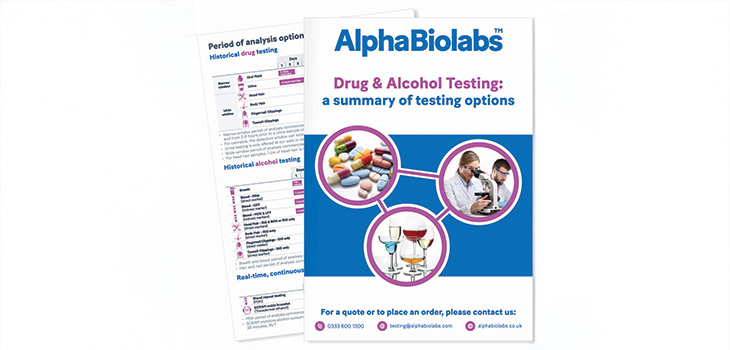
At AlphaBiolabs, we recognise that the wide range of testing options available can be confusing, and that selecting the most appropriate test for a particular scenario is not always straightforward. We have therefore developed a new, free reference guide specifically for family law professionals: Drug & Alcohol Testing: a summary of testing options.
This user-friendly and highly practical resource includes:

Drug and alcohol misuse is a common feature in family court proceedings, with implications for safeguarding, contact, and parenting capacity. Laboratory testing provides vital evidence, but only when the right test is selected.
Different testing methods detect different substances over varying timeframes. A test that’s too specific, too broad, or poorly matched to the case may miss key information or lead to misinterpretation. For legal professionals, understanding which testing method to instruct in a given context is key to building a robust evidential picture and supporting safe, timely decisions in the best interests of children or other vulnerable people.
AlphaBiolabs offers the UK’s most comprehensive portfolio of drug and alcohol testing services for family law professionals.
Our laboratory can test sample types including hair, nails, oral fluid, urine, blood, and breath. We also offer SCRAM Continuous Alcohol Monitoring® (SCRAM CAM®).
Each testing method differs by:
Choosing the right test depends on the substances involved, the sample types available, and the evidence required by the court.
Drug and alcohol tests fall broadly into two categories: narrow-window and wide-window testing, based on how far back substance use can be detected.
Narrow-window tests detect recent or very recent use, from a few hours to several days, and are ideal for point-of-care/pre-contact checks, unannounced testing, or short-term compliance.
Wide-window tests detect longer-term patterns of use, and are useful for assessing abstinence, long-term behaviour, or chronic misuse.
Choosing between narrow-window and wide-window methods depends on what the court needs to establish. In many cases, a combination of test types offers the most in-depth picture.
Selecting the right test involves more than just timeframe. Other key factors include the reason for the test, sample availability, court requirements, and whether repeat testing is needed.
Matching the method to the case ensures results are relevant, reliable, and court admissible.
At AlphaBiolabs, we recognise that the wide range of testing options available can be confusing, and that selecting the most appropriate test for a particular scenario is not always straightforward. We have therefore developed a new, free reference guide specifically for family law professionals: Drug & Alcohol Testing: a summary of testing options.
This user-friendly and highly practical resource includes:
Marie Law, Director of Toxicology at AlphaBiolabs, outlines the drug and alcohol testing options available for family law professionals, and how a new, free guide can help identify the most appropriate testing method for each specific case

The Chair of the Bar reports back
Susie Griffin on the admin that keeps barristers from billable work
Clement Cowley, Partner at The Penny Group, explains how global events can influence the performance of pensions and ISAs, and why taking a long-term approach to investing is often the most effective strategy
Mário Barroso, Head of R&D and Method Development at AlphaBiolabs, discusses what family law professionals need to know about hallucinogens, from the main hallucinogenic drugs encountered in family proceedings, to their effects and the testing options available
Harmony Christian Ministries is the latest charity to benefit from a £500 donation from AlphaBiolabs via the company’s Giving Back initiative
By David Green

The golden age of advocacy? David Langwallner pays homage to the filmic if contentious barrister Sir Edward Carson and some of his contemporaries
Leah Arthur, a pupil, and her second seat supervisor, John Goss, share their perspectives on building a productive pupil-supervisor relationship
Henry Fingerhut outlines what the Bar Standards Board AI guidance means for early career barristers
The Ministry of Justice will match-fund up to 100 criminal pupillages, with grants available to criminal chambers across England and Wales. Similar to the COIC scheme, the grants will match-fund pupillages additional to those otherwise offered without government funding
Not yet, says Jacob Turner. Regulation, unlike the technology itself, is a domain the legal profession can still control