*/
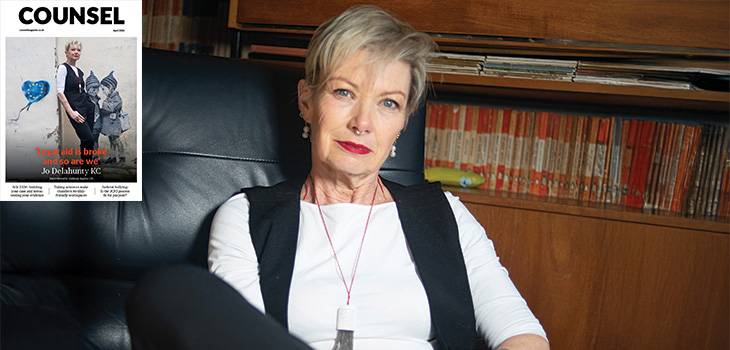
In this wide-ranging interview, Professor Jo Delahunty KC, Family Law KC of the Year, talks to Anthony Inglese CB about the values that shaped her, the moment she found her vocation and, in an intensely personal call to arms, why time is running out for the legal aid Bar
Professor Jo Delahunty KC and I meet in her chambers at 4PB, soon after the passing of Sir James Munby, former President of the Family Division. ‘I want to start by acknowledging how much we all benefit from the kindness of strangers at critical moments,’ she says. ‘James had been part of my life for 25 years. As a raw junior appearing before him, he saw something in me that he believed warranted encouragement. He was endlessly personally supportive and a titan of intellectual creativity. He made law live and breathe with purpose for me. He was as kind as he was clever. I found that charismatic.’ A word that is often used about Delahunty.
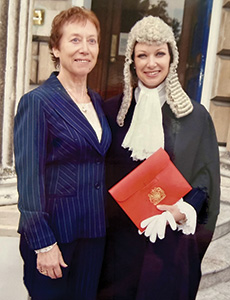
When, in 2006, she passed on the news to Sir James – one of her silk referees – that she was to be appointed as Queen’s Counsel, Delahunty knew she fell far from the ‘traditional silk’ in terms of background, style and attitude.
‘So I asked him: “What do I do now?” He said: “Don’t change. Do what you have been doing – you have been chosen because of it. Just use this to be bigger and braver.” And so I did.’
Delahunty was recently named Family Law KC of the Year in the Family Law Awards 2025. The judges called her ‘a formidable presence in every sense – an advocate of extraordinary intellect, courage and compassion… a mentor, educator and champion of inclusion’.
‘I have embraced the message that being given the mantle of silk comes with responsibility,’ she says. ‘Silks aren’t anonymous. We are chosen to lead and that’s as important outside of the courtroom as within it. Silk is a gift. We must use it for change, not just for personal advancement. We have the status and ability to make a difference, to challenge accepted norms that are outdated or unjust, to effect change, to support others. When James received his pre-publication copy of We Set The Bar, he was straight online to me, revelling in and celebrating its raw energy and anger. I last spoke with him just before Christmas. We laughed about how, rather than softening with age, our corners had become sharper! His passing is a huge loss not just to me but to family lawyers far and wide. He touched many lives. I miss him very much.’
Delahunty was born in 1963 in East London ‘within the sound of Bow Bells, I think’. Her father had abandoned her mother while she was pregnant with Delahunty. ‘He didn’t send any maintenance. Mum was left to bring me up as a single mum when that was a thing of shame. She had to work long hours to support us, holding down three jobs a day for years: cleaner, typist then home piece worker.’
Her mother single-handedly improved their ‘station’ in life. ‘Mum was one of the first women in the UK to get a mortgage in her own name.’ She bought a house in Mill Hill – previously they had rented in East Finchley – and Delahunty’s grandparents came to live with them. ‘Mum and I had the first floor, Nan and Grandad the ground. The house was full of books but it was all Mills and Boon romance or thrillers. Nothing highbrow. Mum subscribed to Reader’s Digest as a learning tool to literature.
‘Nan and Grandad were everything to me and the family we all came from shaped me. Nan was one of eight. Her generation, my mum’s and mine, all rented within streets of one another. Our local was the working men’s club. My family worked hard to play hard. They never owed anybody any money and were the first to put their hands in their pocket at the bar. They were Second World War survivors who stayed put in London through the Blitz. They taught me the waltz, darts and snooker. I was seeing grown-ups being loud and merry. I learnt to hold my drink and to hold my own in debate or song when with adults! I was as a child expected to live up to the adults’ pace. I was the only girl among my many cousins. I, like my family, was noisy, fierce and feisty.’
Delahunty attended the local comprehensive, Copthall School, as one of its first intake of non-streamed pupils. ‘I used to get into trouble for speaking up at school. I was beaten up a couple of times for stepping in to prevent trouble when I saw bullying. I was known as being gobby, as having “attitude”.
‘Mum was my best careers adviser. No one else in our family had stayed at school beyond the age of 15. I stayed on to do A levels.’ Delahunty won a national competition for A level students. ‘The prize was three weeks in China. It was 1981. China was still a closed communist country. Another winner was Jonathan, the man who is now my husband, the love of my life. I was 17, he was 18. We’ve been together since we met.
‘Mum wanted me to go to university, the first in my whole family. I fancied doing PPE or English. She said, “No, there’s no job at the end.” She wanted security of income, respectability and stability for me. For her this meant my becoming a solicitor.’
Delahunty won a place at St Anne’s College, Oxford University to study law. ‘I was not interested in law as such, but in what I could do with it. Jonathan soon assessed me as unemployable! We began to think about my being self-employed, about being a barrister. But Mum was scared. She made me sit down with Nan and one of my aunties to take me down a peg or two. They knew the pitfalls of having no money. The Bar was risky. We had no contacts. No “professionals” in the family. The Bar “wasn’t for the likes of me”. Wasn’t I “getting above my station?”. But by now I was listening to Jonathan. He had given me the confidence to go for it.’
Delahunty breaks the history line to tell me that her mother ‘came round in the end, but it wasn’t easy for her. Her fears for me were very real and grounded in the prejudice she had suffered.’ After Delahunty’s silk ceremony, at the private family gathering held in Sir James Munby’s room, Sir James quietly spoke with her mother, who was by now showing signs of Alzheimer’s, about why she should be proud of her daughter. It became an even more profound moment as ‘Mum died just a few months later. She was 67.’
We track back. ‘I became political at university. Thatcher radicalised me. It was the 80s. I was arrested on marches. Give me a mike and a crowd and I’d use it! I had no interest in family law. I didn’t even do it at Bar school. I was a loud and proud feminist (still am). I didn’t want to be pigeonholed into a “women’s subject”.’
Called in 1986, she won a paid 12-month pupillage at a planning set. ‘It was the only way I could get my foot in the door. The clerks used to sing “The Red Flag” when I came through the door – kindly. I got on with them better than with the barristers. The clerks came from my background. The barristers didn’t. Their banter made me feel at home. Planning wasn’t for me. The clerks room looked after me. After six months the senior clerk helped me move to John Hendy’s set at 15 Old Square. In those days there wasn’t an equal opportunity policy of any note – for once I benefited from that. I knew I wanted to do trade union law, common law, especially crime. I became part of a left-wing legal community. I got a tenancy at Michael Mansfield’s chambers at Took’s Court. I felt at home. We were a truly mixed set; straight and gay, white and GEM [global ethnic majority], equal numbers of men and women.
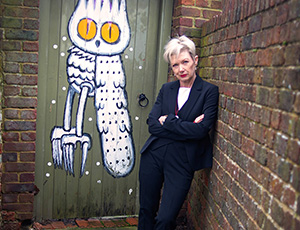
‘I only started to do family because I was skint. Back then you could do domestic violence injunctions ex parte and be guaranteed a return date and a quick fee turnaround. Beyond the rent money, beyond my prejudices, I found my vocation! I gave my heart and soul to it. It was all legal aid. But there were no female role models for people like me. In my early days I wore eye liner, red lipstick and had dyed blond hair (I still do). With my politics, look and accent I had nothing in common with the pearls and twinset brigade. I haven’t mellowed. I’ve just added tattoos and piercings to add some edge to the bleach and red lipstick!’
Delahunty has been a Recorder since 2009. ‘On hot days when I allow jackets to be removed, witnesses see the tattoos on my arms and become discombobulated. I like the subversiveness of it.’ Ever thought of being a judge? ‘I’d be suffocated on the bench. How could I speak freely!’ A politician? ‘I’ve been approached but it’s not for me. I am deeply shocked that this government has advanced plans to restrict jury trials. That is not the core problem. There has been a systematic lack of investment in the courts for decades.’
Delahunty is proud to be a family lawyer but says: ‘You should never become so specialised that you operate in a silo. No family exists in a siloed world. Crime, human rights, immigration and housing are all part of a family practice.’ She would add inquests to the list, having appeared as one of eight silks representing 77 families at the Hillsborough inquests. ‘Lots of the families still stay in touch. As a lawyer I need to remember always that my impact on a client and their life doesn’t end when the case ends. I inevitably leave a legacy. I must ensure it’s a good one. At minimum I must leave them feeling they have been heard and respected.’
Which cases is she most attracted to? ‘Where there is maximum to lose for a client. Where the evidence is at its highest against them on paper: that’s where I go into battle. And I win. I’m competitive. I constantly re-run my cross-examination in my head. I don’t sleep well. There is a personal library of snuff movies imprinted on my brain on auto-repeat. I’ve lectured on this when I was a professor at Gresham College. I went online as part of the Strong, Not Silent campaign to destigmatise mental health problems.’
She shows me the image used. ‘You can see how grim I looked. That’s the legacy of the work I do. You can’t understand how a child died unless you re-tred their path from life to until the moment of death. You have got to go towards that pain. That’s what makes the difference between understanding clients and just processing a case routinely. And there’s nothing like being a non-medical expert cross-examining a medical expert. It’s David and Goliath stuff. We do it every day at the family Bar and many of us live and breathe the research to do it well.
‘The scales are already tipped against parents in NAI [non-accidental injury] cases. Only in family work do we have to have a court-appointed joint expert for all parties. But I hold onto the fact that any witness who comes to court has but a few jigsaw pieces to try to picture what happened. They may not have the full picture on the box and pushed pieces into it to fit what they think they see. I have more pieces than they do. The stakes are high for us, the responsibility immense, the task lonely. But it’s delicious when, too late, the witness comes to realise that their imagined picture on the box doesn’t match the family’s jigsaw.’
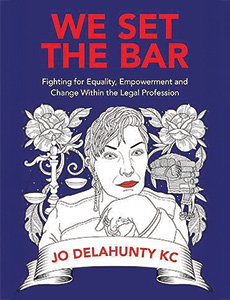
Delahunty has two books coming out in 2026, one on domestic abuse, an issue she is passionate about and the other is We Set the Bar, which Delahunty describes as her ‘love letter to the legal aid Bar’. One reviewer called it ‘an important, personal, angry, informative paeon of praise for the legal aid system and a passionate argument for equity at the Bar’. Delahunty explains: ‘It’s an intensely personal call to arms. I don’t expect agreement, but I do expect debate. I want the Bar to be a better place. When I spoke out against sexual harassment and judicial bullying some years ago, before it became an openly acknowledged issue, I was surrounded by tumbleweed. This mustn’t happen now. Legal aid is the fourth emergency service.’
Delahunty says ‘legal aid is broke and so are we’. She points out the Bar Council’s recent System Overload report on family legal aid, her practice field. Since 1996 counsel are working twice as long for half the fee on rates of pay that are derisory compared to privately paid family law. The pressures are having a detrimental effect on their health.
‘We were crushed by decades of underfunding and then came last year’s data hack of the Legal Aid Agency which has dragged some of us towards bankruptcy or leaving the Bar’. The report carries the chilling warning: ‘Many people would leave in a heartbeat if they could.’ The financial reward is insufficient to sustain a practice. Delahunty says: ‘If someone mentions “wellbeing” to me again, I may shatter the decibel level with my screams. It is meaningless!’
As someone who for decades has actively visited state academies to expand the students’ professional aspirations, using her personal and professional trajectory as an example, she thinks time is running out for the legal aid Bar and says she is not going to be complicit by silence while that is happening. ‘Legal aid – it’s a commitment to give back to the community that created me, it’s part of my political and professional DNA. I know all the arguments against doing it. Yet here I am still. My family taught me well: when others stand back or stand still, you go forward to the front and link arms to fight!’
Chambers and Partners 2025 – DEI Outstanding Contribution – Finalist

Anthony Inglese CB was head of legal in five Government Legal Departments over a 38-year career, most recently as General Counsel and Solicitor to HM Revenue & Customs. A Bencher of Gray’s Inn, he now trains and mentors lawyers.
Professor Jo Delahunty KC and I meet in her chambers at 4PB, soon after the passing of Sir James Munby, former President of the Family Division. ‘I want to start by acknowledging how much we all benefit from the kindness of strangers at critical moments,’ she says. ‘James had been part of my life for 25 years. As a raw junior appearing before him, he saw something in me that he believed warranted encouragement. He was endlessly personally supportive and a titan of intellectual creativity. He made law live and breathe with purpose for me. He was as kind as he was clever. I found that charismatic.’ A word that is often used about Delahunty.
When, in 2006, she passed on the news to Sir James – one of her silk referees – that she was to be appointed as Queen’s Counsel, Delahunty knew she fell far from the ‘traditional silk’ in terms of background, style and attitude.
‘So I asked him: “What do I do now?” He said: “Don’t change. Do what you have been doing – you have been chosen because of it. Just use this to be bigger and braver.” And so I did.’
Delahunty was recently named Family Law KC of the Year in the Family Law Awards 2025. The judges called her ‘a formidable presence in every sense – an advocate of extraordinary intellect, courage and compassion… a mentor, educator and champion of inclusion’.
‘I have embraced the message that being given the mantle of silk comes with responsibility,’ she says. ‘Silks aren’t anonymous. We are chosen to lead and that’s as important outside of the courtroom as within it. Silk is a gift. We must use it for change, not just for personal advancement. We have the status and ability to make a difference, to challenge accepted norms that are outdated or unjust, to effect change, to support others. When James received his pre-publication copy of We Set The Bar, he was straight online to me, revelling in and celebrating its raw energy and anger. I last spoke with him just before Christmas. We laughed about how, rather than softening with age, our corners had become sharper! His passing is a huge loss not just to me but to family lawyers far and wide. He touched many lives. I miss him very much.’
Delahunty was born in 1963 in East London ‘within the sound of Bow Bells, I think’. Her father had abandoned her mother while she was pregnant with Delahunty. ‘He didn’t send any maintenance. Mum was left to bring me up as a single mum when that was a thing of shame. She had to work long hours to support us, holding down three jobs a day for years: cleaner, typist then home piece worker.’
Her mother single-handedly improved their ‘station’ in life. ‘Mum was one of the first women in the UK to get a mortgage in her own name.’ She bought a house in Mill Hill – previously they had rented in East Finchley – and Delahunty’s grandparents came to live with them. ‘Mum and I had the first floor, Nan and Grandad the ground. The house was full of books but it was all Mills and Boon romance or thrillers. Nothing highbrow. Mum subscribed to Reader’s Digest as a learning tool to literature.
‘Nan and Grandad were everything to me and the family we all came from shaped me. Nan was one of eight. Her generation, my mum’s and mine, all rented within streets of one another. Our local was the working men’s club. My family worked hard to play hard. They never owed anybody any money and were the first to put their hands in their pocket at the bar. They were Second World War survivors who stayed put in London through the Blitz. They taught me the waltz, darts and snooker. I was seeing grown-ups being loud and merry. I learnt to hold my drink and to hold my own in debate or song when with adults! I was as a child expected to live up to the adults’ pace. I was the only girl among my many cousins. I, like my family, was noisy, fierce and feisty.’
Delahunty attended the local comprehensive, Copthall School, as one of its first intake of non-streamed pupils. ‘I used to get into trouble for speaking up at school. I was beaten up a couple of times for stepping in to prevent trouble when I saw bullying. I was known as being gobby, as having “attitude”.
‘Mum was my best careers adviser. No one else in our family had stayed at school beyond the age of 15. I stayed on to do A levels.’ Delahunty won a national competition for A level students. ‘The prize was three weeks in China. It was 1981. China was still a closed communist country. Another winner was Jonathan, the man who is now my husband, the love of my life. I was 17, he was 18. We’ve been together since we met.
‘Mum wanted me to go to university, the first in my whole family. I fancied doing PPE or English. She said, “No, there’s no job at the end.” She wanted security of income, respectability and stability for me. For her this meant my becoming a solicitor.’
Delahunty won a place at St Anne’s College, Oxford University to study law. ‘I was not interested in law as such, but in what I could do with it. Jonathan soon assessed me as unemployable! We began to think about my being self-employed, about being a barrister. But Mum was scared. She made me sit down with Nan and one of my aunties to take me down a peg or two. They knew the pitfalls of having no money. The Bar was risky. We had no contacts. No “professionals” in the family. The Bar “wasn’t for the likes of me”. Wasn’t I “getting above my station?”. But by now I was listening to Jonathan. He had given me the confidence to go for it.’
Delahunty breaks the history line to tell me that her mother ‘came round in the end, but it wasn’t easy for her. Her fears for me were very real and grounded in the prejudice she had suffered.’ After Delahunty’s silk ceremony, at the private family gathering held in Sir James Munby’s room, Sir James quietly spoke with her mother, who was by now showing signs of Alzheimer’s, about why she should be proud of her daughter. It became an even more profound moment as ‘Mum died just a few months later. She was 67.’
We track back. ‘I became political at university. Thatcher radicalised me. It was the 80s. I was arrested on marches. Give me a mike and a crowd and I’d use it! I had no interest in family law. I didn’t even do it at Bar school. I was a loud and proud feminist (still am). I didn’t want to be pigeonholed into a “women’s subject”.’
Called in 1986, she won a paid 12-month pupillage at a planning set. ‘It was the only way I could get my foot in the door. The clerks used to sing “The Red Flag” when I came through the door – kindly. I got on with them better than with the barristers. The clerks came from my background. The barristers didn’t. Their banter made me feel at home. Planning wasn’t for me. The clerks room looked after me. After six months the senior clerk helped me move to John Hendy’s set at 15 Old Square. In those days there wasn’t an equal opportunity policy of any note – for once I benefited from that. I knew I wanted to do trade union law, common law, especially crime. I became part of a left-wing legal community. I got a tenancy at Michael Mansfield’s chambers at Took’s Court. I felt at home. We were a truly mixed set; straight and gay, white and GEM [global ethnic majority], equal numbers of men and women.
‘I only started to do family because I was skint. Back then you could do domestic violence injunctions ex parte and be guaranteed a return date and a quick fee turnaround. Beyond the rent money, beyond my prejudices, I found my vocation! I gave my heart and soul to it. It was all legal aid. But there were no female role models for people like me. In my early days I wore eye liner, red lipstick and had dyed blond hair (I still do). With my politics, look and accent I had nothing in common with the pearls and twinset brigade. I haven’t mellowed. I’ve just added tattoos and piercings to add some edge to the bleach and red lipstick!’
Delahunty has been a Recorder since 2009. ‘On hot days when I allow jackets to be removed, witnesses see the tattoos on my arms and become discombobulated. I like the subversiveness of it.’ Ever thought of being a judge? ‘I’d be suffocated on the bench. How could I speak freely!’ A politician? ‘I’ve been approached but it’s not for me. I am deeply shocked that this government has advanced plans to restrict jury trials. That is not the core problem. There has been a systematic lack of investment in the courts for decades.’
Delahunty is proud to be a family lawyer but says: ‘You should never become so specialised that you operate in a silo. No family exists in a siloed world. Crime, human rights, immigration and housing are all part of a family practice.’ She would add inquests to the list, having appeared as one of eight silks representing 77 families at the Hillsborough inquests. ‘Lots of the families still stay in touch. As a lawyer I need to remember always that my impact on a client and their life doesn’t end when the case ends. I inevitably leave a legacy. I must ensure it’s a good one. At minimum I must leave them feeling they have been heard and respected.’
Which cases is she most attracted to? ‘Where there is maximum to lose for a client. Where the evidence is at its highest against them on paper: that’s where I go into battle. And I win. I’m competitive. I constantly re-run my cross-examination in my head. I don’t sleep well. There is a personal library of snuff movies imprinted on my brain on auto-repeat. I’ve lectured on this when I was a professor at Gresham College. I went online as part of the Strong, Not Silent campaign to destigmatise mental health problems.’
She shows me the image used. ‘You can see how grim I looked. That’s the legacy of the work I do. You can’t understand how a child died unless you re-tred their path from life to until the moment of death. You have got to go towards that pain. That’s what makes the difference between understanding clients and just processing a case routinely. And there’s nothing like being a non-medical expert cross-examining a medical expert. It’s David and Goliath stuff. We do it every day at the family Bar and many of us live and breathe the research to do it well.
‘The scales are already tipped against parents in NAI [non-accidental injury] cases. Only in family work do we have to have a court-appointed joint expert for all parties. But I hold onto the fact that any witness who comes to court has but a few jigsaw pieces to try to picture what happened. They may not have the full picture on the box and pushed pieces into it to fit what they think they see. I have more pieces than they do. The stakes are high for us, the responsibility immense, the task lonely. But it’s delicious when, too late, the witness comes to realise that their imagined picture on the box doesn’t match the family’s jigsaw.’
Delahunty has two books coming out in 2026, one on domestic abuse, an issue she is passionate about and the other is We Set the Bar, which Delahunty describes as her ‘love letter to the legal aid Bar’. One reviewer called it ‘an important, personal, angry, informative paeon of praise for the legal aid system and a passionate argument for equity at the Bar’. Delahunty explains: ‘It’s an intensely personal call to arms. I don’t expect agreement, but I do expect debate. I want the Bar to be a better place. When I spoke out against sexual harassment and judicial bullying some years ago, before it became an openly acknowledged issue, I was surrounded by tumbleweed. This mustn’t happen now. Legal aid is the fourth emergency service.’
Delahunty says ‘legal aid is broke and so are we’. She points out the Bar Council’s recent System Overload report on family legal aid, her practice field. Since 1996 counsel are working twice as long for half the fee on rates of pay that are derisory compared to privately paid family law. The pressures are having a detrimental effect on their health.
‘We were crushed by decades of underfunding and then came last year’s data hack of the Legal Aid Agency which has dragged some of us towards bankruptcy or leaving the Bar’. The report carries the chilling warning: ‘Many people would leave in a heartbeat if they could.’ The financial reward is insufficient to sustain a practice. Delahunty says: ‘If someone mentions “wellbeing” to me again, I may shatter the decibel level with my screams. It is meaningless!’
As someone who for decades has actively visited state academies to expand the students’ professional aspirations, using her personal and professional trajectory as an example, she thinks time is running out for the legal aid Bar and says she is not going to be complicit by silence while that is happening. ‘Legal aid – it’s a commitment to give back to the community that created me, it’s part of my political and professional DNA. I know all the arguments against doing it. Yet here I am still. My family taught me well: when others stand back or stand still, you go forward to the front and link arms to fight!’
Chambers and Partners 2025 – DEI Outstanding Contribution – Finalist
In this wide-ranging interview, Professor Jo Delahunty KC, Family Law KC of the Year, talks to Anthony Inglese CB about the values that shaped her, the moment she found her vocation and, in an intensely personal call to arms, why time is running out for the legal aid Bar

The Chair of the Bar reports back
Susie Griffin on the admin that keeps barristers from billable work
Clement Cowley, Partner at The Penny Group, explains how global events can influence the performance of pensions and ISAs, and why taking a long-term approach to investing is often the most effective strategy
Mário Barroso, Head of R&D and Method Development at AlphaBiolabs, discusses what family law professionals need to know about hallucinogens, from the main hallucinogenic drugs encountered in family proceedings, to their effects and the testing options available
Harmony Christian Ministries is the latest charity to benefit from a £500 donation from AlphaBiolabs via the company’s Giving Back initiative
By David Green
At the start of her term, Chair of the Bar 2026 Kirsty Brimelow KC set out a series of priorities for the year ahead. One of those priorities was children in the justice system
As the world becomes more digital, Barbara Vinagre Mota examines international research into the mental health consequences of judges’ exposure to graphic and immersive evidence, highlighting the importance of support systems
In an era of patient-centred care and growing concern over misconduct in medical settings, why do women still lack the right to choose women consultants for examination and treatment? Charles Davey investigates
Reviewed by Daniel Barnett
James McNeill Whistler at Tate Britain until 27 September Rothko in Florence at Palazzo Strozzi until 23 August Reviewed by Stephen Cragg KC