*/
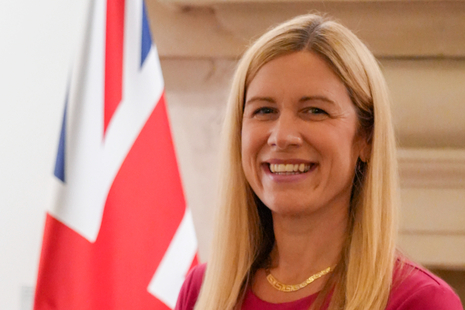
‘I am really pleased to serve as Solicitor General in this Labour government. I have spent most of my working life striving to achieve justice for ordinary people. When in Opposition I co-wrote our Green Paper for halving violence against women and girls. Producing strategies in Opposition is one thing, but I can now I can start to change things in government. That is my number one priority as Solicitor General.’
I am with Ellie Reeves KC, Solicitor General since September 2025 and MP for Lewisham West and East Dulwich.
Ellie Reeves leads for the Law Officers in overseeing the Crown Prosecution Service. ‘I am constantly trying to drive up standards of work in relation to violence against women and girls. I recently announced a major expansion of the Victim’s Right to Review pilot. This initiative allows victims of rape and other serious sexual offences to request an independent review of a decision to drop their case by a senior prosecutor before the decision is formally finalised. We piloted it in the West Midlands. I visited the area to discuss with the staff how the pilot was working. I see everywhere in the CPS people who believe in public service. I came away with the belief that we were ready to roll it out. I have now extended it to Yorkshire and Humberside, the North West and Wales. In all these areas a senior prosecutor will conduct the review.’ She is optimistic that a national roll out will follow.
Reeves is clear that ‘victims must be at the heart of all our policies’. She is intent on driving up standards in communications from the CPS to victims. ‘I have asked the CPS to improve the quality of their letters to victims, to ensure both legal accuracy and empathy.’ The CPS is already offering an enhanced service to victims of rape and serious sexual offences (RASSO) including the offer of a pre-trial meeting with the prosecution team. Victim liaison officers are now embedded in RASSO units. Reeves wants to see that extended to victims of domestic abuse in the Crown Court. She has secured £5 million of additional funding so that in three pilot areas domestic abuse victims will also be offered a pre-trial meeting with the prosecution and more victim liaison offices for domestic abuse can be recruited. ‘I am determined that the Crown Prosecution Service does everything it can to support victims of these appalling crimes,’ says Reeves.
With the Attorney General in the Lords, Reeves takes all Commons’ Parliamentary Questions, which happen every five weeks. She also leads on whether to refer a sentence to the Court of Appeal on the grounds of undue leniency. ‘Requests under this scheme come in to me every day – over 1,500 last year. I check whether it’s one of the offences within scope under the legislation – for example, rape, murder, manslaughter – and I get advice from my staff and the CPS when needed.’ Around 60% of references result in an increased sentence. ‘I am pleased to be able to play a part in helping victims of the most abhorrent crimes to receive justice.’
She also sits on a lesser known but highly significant ministerial group, the Parliamentary Business and Legislation Committee. It meets frequently to clear all proposals for government legislation. Issues which will typically occupy her attention include retrospectivity and the framing of criminal offences. ‘It means that I get across all the legislation before it can be introduced. It’s one of the many things I like about my role: the mix of law and politics.’
She chairs the Attorney General’s pro bono committee. ‘We bring together supporters and practitioners of pro bono work from across the country. MPs tell us that many people who write to them for help are more in need of a lawyer than an MP, so we are launching a guide for Parliamentarians on how to access the pro bono world for their constituents.’
A South East Londoner, Reeves was born in Beckenham in 1980 and grew up in Sydenham. Her parents were both teachers and placed great value on education. She went to Adamsrill Primary School in Sydenham then Cator Park School in Penge. She recalls that conditions were tough, with lessons in portacabins and not enough textbooks. ‘I joined the Labour Party at 15,’ Reeves says. ‘I thought to myself, “I can either moan or join.” The week of the 1997 General Election I told my teachers I wouldn’t be coming to school as I would be out campaigning. No one seemed to mind.’
Reeves didn’t know any lawyers growing up and it wasn’t something she had ever given much thought. She remembers a teacher encouraging her: ‘My form teacher knew I liked arguing and encouraged me to think about law. She knew a barrister and arranged for me to have work experience in their chambers. It was a really eye-opening week, including two days in an employment tribunal. I remember chatting with my Dad afterwards and saying, ‘I’m not sure that people like me go into law, and from schools like mine.’ He replied. ‘If you don’t go for it, Ellie, how will that ever change?’
Reeves went on to study law at St Catherine’s College, Oxford. She remembers ‘the first time I met our law professor he told our cohort that provided we got a 2.1 we would be guaranteed a place at a magic circle law firm. I didn’t know much about City law firms but I knew that wasn’t why I was studying law – I wanted to be able to make a difference to people’s lives.’
Reeves remained politically active throughout university – often to the despair of her tutors who encouraged her to spend more time focused on her degree. Labour was then in government. ‘In my final year I was elected to be the chair of Labour Students, the student wing of the Labour Party, so after graduating I spent a year working in Labour HQ running our student organisation which was a fantastic opportunity.’
It was while she was doing that job that she applied for the Bar Vocational Course at the Inns of Court School of Law. She recalls: ‘I saw the Bar as the place to go to if you didn’t want to go to a City firm. I was delighted to get a major scholarship from the Inner Temple. I enjoyed my year studying for my Bar finals much more than Oxford. For one thing it was more diverse. These days I try to play my part in increasing diversity in the profession. I enjoy speaking to cohorts of people who want to become lawyers.’
She was called in 2004. ‘I made lots of applications and had quite a few interviews. The successful one was at 12KBW. A silk who interviewed me there lived quite close to my secondary school and knew its reputation. He said to me afterwards, “Anyone who went there and got into Oxford deserves a pupillage.” I did a lot of personal injury and some employment and industrial disease. I always preferred the employment; it was where I felt I could make the most difference, but there wasn’t that much of it in our chambers. I knew I wanted to focus on employment and trade union rights. So when I wasn’t offered a tenancy I decided not to go for a third six but instead went to work at OH Parsons Solicitors who at that time specialised in representing trade unions and their members.’
She joined in the middle of the ‘Gate Gourmet’ dispute – one of the biggest industrial relations cases of the 2000s, involving hundreds of low paid catering staff at Heathrow Airport. ‘We were representing the workers. It was a pretty significant first case to be involved in – I don’t think that experience will ever leave me – and a very steep learning curve.’ After a few years there she moved to leading trade union law firm, Thompsons Solicitors. There she recalls her work on Williams & Others v British Airways, a Supreme Court case which determined how holiday pay should be calculated for those working in the aviation sector where allowances made up a high proportion of their income. Later she returned to OH Parsons where she became a partner and jointly ran the employment rights team. There she represented construction workers in the Construction Industry Vetting Group Litigation – a landmark High Court action in relation to blacklisting that took place in the 70s, 80s and 90s. Reeves says ‘the blacklisting of construction workers simply for standing up for their rights devastated lives and is a stain on our industrial relations history. I was pleased to be able to lead the fight for justice for UCATT members (the former construction workers union).’
By the time Reeves was elected to Parliament in 2017 she had been an employment rights lawyer for 12 years and at the time was running her own legal consultancy as a direct access barrister, providing advice and advocacy to women facing maternity and sex discrimination.
Reeves joined the Justice Select Committee soon after becoming an MP. ‘At the time the Conservatives had introduced fees for Employment Tribunals and I wanted to fight back against that, which is why I joined the Committee. But it was through the work on that committee that I got really interested in the criminal justice system and regularly spoke out in Parliament about improvements that were needed.’ Given her background it was no surprise then that when Keir Starmer became leader of the Labour Party in 2020 she was appointed shadow Solicitor General and then a shadow justice minister 18 months later. Her campaigning skills and experience led to her joining the shadow cabinet in 2023 as Labour Party Deputy National Campaign Coordinator. After the General Election landslide, she sat in the cabinet as Chair of the Labour Party until being appointed Solicitor General in September 2025.
What is the most difficult aspect of her job? ‘Hearing the often-horrific experiences of victims of rape, serious sexual violence and domestic abuse. I am proud of this government’s ambition to halve violence against women and girls in a decade and of our landmark cross-government strategy that we launched in December to achieve this. Now we have to get on and deliver it, which is my number one priority as Solicitor General. I went into both law and politics to make a difference and that is what I am determined to do.’

Anthony Inglese CB was head of legal in five Government Legal Departments over a 38-year career, most recently as General Counsel and Solicitor to HM Revenue & Customs. A Bencher of Gray’s Inn, he now trains and mentors lawyers.
‘I am really pleased to serve as Solicitor General in this Labour government. I have spent most of my working life striving to achieve justice for ordinary people. When in Opposition I co-wrote our Green Paper for halving violence against women and girls. Producing strategies in Opposition is one thing, but I can now I can start to change things in government. That is my number one priority as Solicitor General.’
I am with Ellie Reeves KC, Solicitor General since September 2025 and MP for Lewisham West and East Dulwich.
Ellie Reeves leads for the Law Officers in overseeing the Crown Prosecution Service. ‘I am constantly trying to drive up standards of work in relation to violence against women and girls. I recently announced a major expansion of the Victim’s Right to Review pilot. This initiative allows victims of rape and other serious sexual offences to request an independent review of a decision to drop their case by a senior prosecutor before the decision is formally finalised. We piloted it in the West Midlands. I visited the area to discuss with the staff how the pilot was working. I see everywhere in the CPS people who believe in public service. I came away with the belief that we were ready to roll it out. I have now extended it to Yorkshire and Humberside, the North West and Wales. In all these areas a senior prosecutor will conduct the review.’ She is optimistic that a national roll out will follow.
Reeves is clear that ‘victims must be at the heart of all our policies’. She is intent on driving up standards in communications from the CPS to victims. ‘I have asked the CPS to improve the quality of their letters to victims, to ensure both legal accuracy and empathy.’ The CPS is already offering an enhanced service to victims of rape and serious sexual offences (RASSO) including the offer of a pre-trial meeting with the prosecution team. Victim liaison officers are now embedded in RASSO units. Reeves wants to see that extended to victims of domestic abuse in the Crown Court. She has secured £5 million of additional funding so that in three pilot areas domestic abuse victims will also be offered a pre-trial meeting with the prosecution and more victim liaison offices for domestic abuse can be recruited. ‘I am determined that the Crown Prosecution Service does everything it can to support victims of these appalling crimes,’ says Reeves.
With the Attorney General in the Lords, Reeves takes all Commons’ Parliamentary Questions, which happen every five weeks. She also leads on whether to refer a sentence to the Court of Appeal on the grounds of undue leniency. ‘Requests under this scheme come in to me every day – over 1,500 last year. I check whether it’s one of the offences within scope under the legislation – for example, rape, murder, manslaughter – and I get advice from my staff and the CPS when needed.’ Around 60% of references result in an increased sentence. ‘I am pleased to be able to play a part in helping victims of the most abhorrent crimes to receive justice.’
She also sits on a lesser known but highly significant ministerial group, the Parliamentary Business and Legislation Committee. It meets frequently to clear all proposals for government legislation. Issues which will typically occupy her attention include retrospectivity and the framing of criminal offences. ‘It means that I get across all the legislation before it can be introduced. It’s one of the many things I like about my role: the mix of law and politics.’
She chairs the Attorney General’s pro bono committee. ‘We bring together supporters and practitioners of pro bono work from across the country. MPs tell us that many people who write to them for help are more in need of a lawyer than an MP, so we are launching a guide for Parliamentarians on how to access the pro bono world for their constituents.’
A South East Londoner, Reeves was born in Beckenham in 1980 and grew up in Sydenham. Her parents were both teachers and placed great value on education. She went to Adamsrill Primary School in Sydenham then Cator Park School in Penge. She recalls that conditions were tough, with lessons in portacabins and not enough textbooks. ‘I joined the Labour Party at 15,’ Reeves says. ‘I thought to myself, “I can either moan or join.” The week of the 1997 General Election I told my teachers I wouldn’t be coming to school as I would be out campaigning. No one seemed to mind.’
Reeves didn’t know any lawyers growing up and it wasn’t something she had ever given much thought. She remembers a teacher encouraging her: ‘My form teacher knew I liked arguing and encouraged me to think about law. She knew a barrister and arranged for me to have work experience in their chambers. It was a really eye-opening week, including two days in an employment tribunal. I remember chatting with my Dad afterwards and saying, ‘I’m not sure that people like me go into law, and from schools like mine.’ He replied. ‘If you don’t go for it, Ellie, how will that ever change?’
Reeves went on to study law at St Catherine’s College, Oxford. She remembers ‘the first time I met our law professor he told our cohort that provided we got a 2.1 we would be guaranteed a place at a magic circle law firm. I didn’t know much about City law firms but I knew that wasn’t why I was studying law – I wanted to be able to make a difference to people’s lives.’
Reeves remained politically active throughout university – often to the despair of her tutors who encouraged her to spend more time focused on her degree. Labour was then in government. ‘In my final year I was elected to be the chair of Labour Students, the student wing of the Labour Party, so after graduating I spent a year working in Labour HQ running our student organisation which was a fantastic opportunity.’
It was while she was doing that job that she applied for the Bar Vocational Course at the Inns of Court School of Law. She recalls: ‘I saw the Bar as the place to go to if you didn’t want to go to a City firm. I was delighted to get a major scholarship from the Inner Temple. I enjoyed my year studying for my Bar finals much more than Oxford. For one thing it was more diverse. These days I try to play my part in increasing diversity in the profession. I enjoy speaking to cohorts of people who want to become lawyers.’
She was called in 2004. ‘I made lots of applications and had quite a few interviews. The successful one was at 12KBW. A silk who interviewed me there lived quite close to my secondary school and knew its reputation. He said to me afterwards, “Anyone who went there and got into Oxford deserves a pupillage.” I did a lot of personal injury and some employment and industrial disease. I always preferred the employment; it was where I felt I could make the most difference, but there wasn’t that much of it in our chambers. I knew I wanted to focus on employment and trade union rights. So when I wasn’t offered a tenancy I decided not to go for a third six but instead went to work at OH Parsons Solicitors who at that time specialised in representing trade unions and their members.’
She joined in the middle of the ‘Gate Gourmet’ dispute – one of the biggest industrial relations cases of the 2000s, involving hundreds of low paid catering staff at Heathrow Airport. ‘We were representing the workers. It was a pretty significant first case to be involved in – I don’t think that experience will ever leave me – and a very steep learning curve.’ After a few years there she moved to leading trade union law firm, Thompsons Solicitors. There she recalls her work on Williams & Others v British Airways, a Supreme Court case which determined how holiday pay should be calculated for those working in the aviation sector where allowances made up a high proportion of their income. Later she returned to OH Parsons where she became a partner and jointly ran the employment rights team. There she represented construction workers in the Construction Industry Vetting Group Litigation – a landmark High Court action in relation to blacklisting that took place in the 70s, 80s and 90s. Reeves says ‘the blacklisting of construction workers simply for standing up for their rights devastated lives and is a stain on our industrial relations history. I was pleased to be able to lead the fight for justice for UCATT members (the former construction workers union).’
By the time Reeves was elected to Parliament in 2017 she had been an employment rights lawyer for 12 years and at the time was running her own legal consultancy as a direct access barrister, providing advice and advocacy to women facing maternity and sex discrimination.
Reeves joined the Justice Select Committee soon after becoming an MP. ‘At the time the Conservatives had introduced fees for Employment Tribunals and I wanted to fight back against that, which is why I joined the Committee. But it was through the work on that committee that I got really interested in the criminal justice system and regularly spoke out in Parliament about improvements that were needed.’ Given her background it was no surprise then that when Keir Starmer became leader of the Labour Party in 2020 she was appointed shadow Solicitor General and then a shadow justice minister 18 months later. Her campaigning skills and experience led to her joining the shadow cabinet in 2023 as Labour Party Deputy National Campaign Coordinator. After the General Election landslide, she sat in the cabinet as Chair of the Labour Party until being appointed Solicitor General in September 2025.
What is the most difficult aspect of her job? ‘Hearing the often-horrific experiences of victims of rape, serious sexual violence and domestic abuse. I am proud of this government’s ambition to halve violence against women and girls in a decade and of our landmark cross-government strategy that we launched in December to achieve this. Now we have to get on and deliver it, which is my number one priority as Solicitor General. I went into both law and politics to make a difference and that is what I am determined to do.’

The Chair of the Bar reports back
Susie Griffin on the admin that keeps barristers from billable work
Clement Cowley, Partner at The Penny Group, explains how global events can influence the performance of pensions and ISAs, and why taking a long-term approach to investing is often the most effective strategy
Mário Barroso, Head of R&D and Method Development at AlphaBiolabs, discusses what family law professionals need to know about hallucinogens, from the main hallucinogenic drugs encountered in family proceedings, to their effects and the testing options available
Harmony Christian Ministries is the latest charity to benefit from a £500 donation from AlphaBiolabs via the company’s Giving Back initiative
By David Green

At the start of her term, Chair of the Bar 2026 Kirsty Brimelow KC set out a series of priorities for the year ahead. One of those priorities was children in the justice system
As the world becomes more digital, Barbara Vinagre Mota examines international research into the mental health consequences of judges’ exposure to graphic and immersive evidence, highlighting the importance of support systems
In an era of patient-centred care and growing concern over misconduct in medical settings, why do women still lack the right to choose women consultants for examination and treatment? Charles Davey investigates
Reviewed by Daniel Barnett
James McNeill Whistler at Tate Britain until 27 September Rothko in Florence at Palazzo Strozzi until 23 August Reviewed by Stephen Cragg KC