*/

Oliver Lewis spotlights an overlooked yet rapidly evolving area of law – coercive and controlling behaviour within care contexts
England and Wales became the first jurisdiction in the world to criminalise coercive and controlling behaviour, under s 76 of the Serious Crime Act 2015. The maximum sentence of five years’ imprisonment is widely regarded by domestic abuse campaigners as inadequate, given the devastation the offence inflicts on victims.
Coercive control is a form of abuse characterised by a pattern of restrictive regulation in a relationship, by instilling fear and maintaining dominance through micro-management of everyday life, threats, psychological manipulation, economic abuse, technology-facilitated control, stalking, and physical and/or sexual violence. Coercive control may persist after separation, including through institutional, legal, and economic mechanisms.
The offence is heavily gendered. In the year ending March 2025, 832 of 853 offenders convicted under s 76 were male (97.5%). Although there are no prevalence data specific to coercive control and disability, disabled people aged 16 and over are more than twice as likely as non-disabled people to experience domestic abuse.
Media coverage tends to focus on intimate partner relationships and on criminal cases. But coercive control arises across a far wider range of relationships, particularly where care is part of the dynamic. At what point does a person’s support for their ageing parent tip from caring into controlling? When a disabled child reaches adulthood, what happens if their parent cannot relinquish decision-making? When does involvement in a disabled sibling’s life become undue influence?
The care sector depends heavily on family members and undervalued professional carers. The language of ‘burden’ pervades caregiving, and disabled people can internalise such attitudes, becoming resigned to substandard care, concluding that poor care is preferable to no care, or to placement in a care home. Where a stranger enters a person’s life offering friendship, care, or romance, the offer can be difficult to resist. Where the potential abuser is already known, family dynamics may shift through ageing, cognitive decline, or sudden illness such as stroke, leaving the disabled person without the capacity to resist control they might previously have challenged. The impact of that control can then be severe.
Given the array of different types of informal care arrangements, social workers face significant challenges assessing whether a person is expressing their authentic wishes when a ‘friend’ has apparently blocked contact with family, assumed control of finances, obtained a lasting power of attorney, or become a beneficiary under the person’s will.
For those assessed as lacking capacity to make decisions about care, finances, or contact with others (or other decisions), the Court of Protection provides an accessible forum in which evidence can be evaluated and decisions taken in the person’s best interests.
Where a capacity assessment cannot be carried out (because the controlling person is blocking access by health or social care professionals) a local authority could make an application under the inherent jurisdiction of the High Court. A Judge of the Family Division can make a protective order where the court finds the adult is ‘vulnerable’. This concept was developed by Munby J (as he then was) in Re SA (Vulnerable Adult with Capacity: Marriage) [2005] EWHC 2942 (Fam).
There, Munby J held that ‘the inherent jurisdiction can be exercised in relation to a vulnerable adult who, even if not incapacitated by mental disorder or mental illness’ but who is believed to be ‘(i) under constraint or (ii) subject to coercion or undue influence or (iii) for some other reason deprived of the capacity to make the relevant decision, or disabled from making a free choice, or incapacitated or disabled from giving or expressing a real and genuine consent.’ His formulation has become embedded in the legal landscape, notwithstanding its entirely non-statutory foundation.
Orders under the inherent jurisdiction are, in essence, a rescue operation from the perpetrator. However, they can also protect a person from themselves where the state’s duty to protect an adult overrides that person’s stated wishes. The broader aim is to create conditions in which the victim of coercive control can recover their autonomy and make uncoerced decisions, for example, whether to end the relationship, seek a non-molestation order, or pursue trauma therapy.
When representing a victim/survivor of coercive control, lawyers should expect to encounter the effects of trauma, and should understand what that means in practice. Expecting a client to provide a coherent chronological account of the pattern of abuse is unrealistic.
Coercive control cases in the Court of Protection present particular complexity. First, the client will have, in the language of the Mental Capacity Act 2005, an underlying ‘impairment of, or disturbance in the functioning of, the mind or brain’, such as learning disabilities, a mental health condition, or dementia. Second, their decision-making may be constrained by the coercion, so that in conference, the client gives the answers coached by the abuser. Even in the abuser’s absence, the client may give answers they believe their abuser would want.
Thirdly, the impairment and coercion intersect with the effects of trauma. Control over another person is established through prolonged experiences that are shameful, frightening, degrading, and sometimes violent. Victims of coercive control therefore typically present with complex trauma which disrupts their ability to recall and recount events. Traumatic memory differs fundamentally from ordinary memory: trauma does not preserve facts to be reassembled like a jigsaw, but shatters experience into scattered fragments of sensation, emotion, and behaviour.
The victim may not be able to recall events at all. The case of Re CA [2024] EWCOP 64 is illustrative: when a psychiatric expert asked Mrs CA about incidents in which her daughter had controlled her and thrown food over her, she replied simply, ‘It’s so traumatic that I can’t even remember what happened now.’
While most lawyers describe themselves as trauma-informed, many have yet to properly grapple with what trauma does to memory and client presentation. Legal aid pressures mean that firms routinely send different, often junior, staff to successive meetings with the client, a practice that runs counter to trauma-informed lawyering. Building the safety and trust necessary to take proper instructions takes time and cannot be achieved in a single meeting or through a revolving cast of representatives. A change of personnel risks triggering feelings of abandonment.
Trust is relational and must be maintained through consistent, proactive engagement. Consistency of solicitor and counsel should therefore be treated as a priority. Where the court is reluctant to accommodate lawyers’ availability, it is counsel’s responsibility to make the case for continuity by explaining why it matters, with reference to the impact on this particular client.
In Re DL [2012] EWCA Civ 253, the Court of Appeal acknowledged the difficulty in defining and delineating the group of vulnerable adults to whom protection under the inherent jurisdiction may be afforded. The judiciary has since shown little appetite for specifying how vulnerability is to be measured, or for examining the purpose of the categorisation itself. Vulnerability remains central to the inherent jurisdiction, yet its meaning and utility remain underexamined.
Beyond the law, vulnerability is seen as a relational concept, not an inherent characteristic. A disabled person may depend on others’ cooperation to exercise their autonomy. The carer-abuser exploits that dependence, withholding medication, restricting community access or claiming to know best. They masterfully intertwine care with control. But the cause of abuse is not the victim’s vulnerability: a person becomes a victim of abuse because the perpetrator decides to abuse them. Framing victims through the lens of vulnerability risks loading onto them an additional burden of shame and stigma, on top of the harm already suffered and the ordeal of legal proceedings.
Although the court cannot impose psychotherapy or direct public bodies to commission unavailable services, lawyers can take practical steps to address trauma and reverse harm. These include: inviting the court to permit instruction of an independent expert to advise on presentation, appropriate therapeutic modalities, prognosis and available provision; ensuring access to specialist domestic abuse services; arranging retrieval of the victim’s possessions still held by the controlling person; supporting the victim to re-establish relationships severed by the abuser; advising on reporting criminal offences to the police; and advising on a civil claim against the perpetrator.
Coercive control unfolds behind closed doors. It can fall to lawyers to bring this insidious form of domestic abuse into the light.
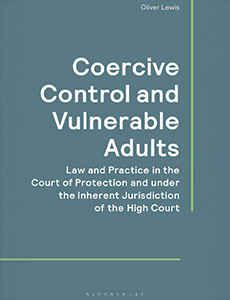
Coercive Control and Vulnerable Adults: Law and Practice in the Court of Protection and under the Inherent Jurisdiction of the High Court by Oliver Lewis (Bloomsbury Professional: 2026). This book is a guide for lawyers and safeguarding professionals, from capacity assessments in the context of coercion, through to injunctive relief and trauma therapy. Three practical chapters suggest trauma-aware approaches for lawyers representing each party: the local authority, the victim/survivor and the perpetrator.

Oliver Lewis is a barrister at Doughty Street Chambers practising in healthcare, disability, and public law, with a focus on the Court of Protection. Oliver is the author of Coercive Control and Vulnerable Adults (Bloomsbury: 2026).
England and Wales became the first jurisdiction in the world to criminalise coercive and controlling behaviour, under s 76 of the Serious Crime Act 2015. The maximum sentence of five years’ imprisonment is widely regarded by domestic abuse campaigners as inadequate, given the devastation the offence inflicts on victims.
Coercive control is a form of abuse characterised by a pattern of restrictive regulation in a relationship, by instilling fear and maintaining dominance through micro-management of everyday life, threats, psychological manipulation, economic abuse, technology-facilitated control, stalking, and physical and/or sexual violence. Coercive control may persist after separation, including through institutional, legal, and economic mechanisms.
The offence is heavily gendered. In the year ending March 2025, 832 of 853 offenders convicted under s 76 were male (97.5%). Although there are no prevalence data specific to coercive control and disability, disabled people aged 16 and over are more than twice as likely as non-disabled people to experience domestic abuse.
Media coverage tends to focus on intimate partner relationships and on criminal cases. But coercive control arises across a far wider range of relationships, particularly where care is part of the dynamic. At what point does a person’s support for their ageing parent tip from caring into controlling? When a disabled child reaches adulthood, what happens if their parent cannot relinquish decision-making? When does involvement in a disabled sibling’s life become undue influence?
The care sector depends heavily on family members and undervalued professional carers. The language of ‘burden’ pervades caregiving, and disabled people can internalise such attitudes, becoming resigned to substandard care, concluding that poor care is preferable to no care, or to placement in a care home. Where a stranger enters a person’s life offering friendship, care, or romance, the offer can be difficult to resist. Where the potential abuser is already known, family dynamics may shift through ageing, cognitive decline, or sudden illness such as stroke, leaving the disabled person without the capacity to resist control they might previously have challenged. The impact of that control can then be severe.
Given the array of different types of informal care arrangements, social workers face significant challenges assessing whether a person is expressing their authentic wishes when a ‘friend’ has apparently blocked contact with family, assumed control of finances, obtained a lasting power of attorney, or become a beneficiary under the person’s will.
For those assessed as lacking capacity to make decisions about care, finances, or contact with others (or other decisions), the Court of Protection provides an accessible forum in which evidence can be evaluated and decisions taken in the person’s best interests.
Where a capacity assessment cannot be carried out (because the controlling person is blocking access by health or social care professionals) a local authority could make an application under the inherent jurisdiction of the High Court. A Judge of the Family Division can make a protective order where the court finds the adult is ‘vulnerable’. This concept was developed by Munby J (as he then was) in Re SA (Vulnerable Adult with Capacity: Marriage) [2005] EWHC 2942 (Fam).
There, Munby J held that ‘the inherent jurisdiction can be exercised in relation to a vulnerable adult who, even if not incapacitated by mental disorder or mental illness’ but who is believed to be ‘(i) under constraint or (ii) subject to coercion or undue influence or (iii) for some other reason deprived of the capacity to make the relevant decision, or disabled from making a free choice, or incapacitated or disabled from giving or expressing a real and genuine consent.’ His formulation has become embedded in the legal landscape, notwithstanding its entirely non-statutory foundation.
Orders under the inherent jurisdiction are, in essence, a rescue operation from the perpetrator. However, they can also protect a person from themselves where the state’s duty to protect an adult overrides that person’s stated wishes. The broader aim is to create conditions in which the victim of coercive control can recover their autonomy and make uncoerced decisions, for example, whether to end the relationship, seek a non-molestation order, or pursue trauma therapy.
When representing a victim/survivor of coercive control, lawyers should expect to encounter the effects of trauma, and should understand what that means in practice. Expecting a client to provide a coherent chronological account of the pattern of abuse is unrealistic.
Coercive control cases in the Court of Protection present particular complexity. First, the client will have, in the language of the Mental Capacity Act 2005, an underlying ‘impairment of, or disturbance in the functioning of, the mind or brain’, such as learning disabilities, a mental health condition, or dementia. Second, their decision-making may be constrained by the coercion, so that in conference, the client gives the answers coached by the abuser. Even in the abuser’s absence, the client may give answers they believe their abuser would want.
Thirdly, the impairment and coercion intersect with the effects of trauma. Control over another person is established through prolonged experiences that are shameful, frightening, degrading, and sometimes violent. Victims of coercive control therefore typically present with complex trauma which disrupts their ability to recall and recount events. Traumatic memory differs fundamentally from ordinary memory: trauma does not preserve facts to be reassembled like a jigsaw, but shatters experience into scattered fragments of sensation, emotion, and behaviour.
The victim may not be able to recall events at all. The case of Re CA [2024] EWCOP 64 is illustrative: when a psychiatric expert asked Mrs CA about incidents in which her daughter had controlled her and thrown food over her, she replied simply, ‘It’s so traumatic that I can’t even remember what happened now.’
While most lawyers describe themselves as trauma-informed, many have yet to properly grapple with what trauma does to memory and client presentation. Legal aid pressures mean that firms routinely send different, often junior, staff to successive meetings with the client, a practice that runs counter to trauma-informed lawyering. Building the safety and trust necessary to take proper instructions takes time and cannot be achieved in a single meeting or through a revolving cast of representatives. A change of personnel risks triggering feelings of abandonment.
Trust is relational and must be maintained through consistent, proactive engagement. Consistency of solicitor and counsel should therefore be treated as a priority. Where the court is reluctant to accommodate lawyers’ availability, it is counsel’s responsibility to make the case for continuity by explaining why it matters, with reference to the impact on this particular client.
In Re DL [2012] EWCA Civ 253, the Court of Appeal acknowledged the difficulty in defining and delineating the group of vulnerable adults to whom protection under the inherent jurisdiction may be afforded. The judiciary has since shown little appetite for specifying how vulnerability is to be measured, or for examining the purpose of the categorisation itself. Vulnerability remains central to the inherent jurisdiction, yet its meaning and utility remain underexamined.
Beyond the law, vulnerability is seen as a relational concept, not an inherent characteristic. A disabled person may depend on others’ cooperation to exercise their autonomy. The carer-abuser exploits that dependence, withholding medication, restricting community access or claiming to know best. They masterfully intertwine care with control. But the cause of abuse is not the victim’s vulnerability: a person becomes a victim of abuse because the perpetrator decides to abuse them. Framing victims through the lens of vulnerability risks loading onto them an additional burden of shame and stigma, on top of the harm already suffered and the ordeal of legal proceedings.
Although the court cannot impose psychotherapy or direct public bodies to commission unavailable services, lawyers can take practical steps to address trauma and reverse harm. These include: inviting the court to permit instruction of an independent expert to advise on presentation, appropriate therapeutic modalities, prognosis and available provision; ensuring access to specialist domestic abuse services; arranging retrieval of the victim’s possessions still held by the controlling person; supporting the victim to re-establish relationships severed by the abuser; advising on reporting criminal offences to the police; and advising on a civil claim against the perpetrator.
Coercive control unfolds behind closed doors. It can fall to lawyers to bring this insidious form of domestic abuse into the light.
Coercive Control and Vulnerable Adults: Law and Practice in the Court of Protection and under the Inherent Jurisdiction of the High Court by Oliver Lewis (Bloomsbury Professional: 2026). This book is a guide for lawyers and safeguarding professionals, from capacity assessments in the context of coercion, through to injunctive relief and trauma therapy. Three practical chapters suggest trauma-aware approaches for lawyers representing each party: the local authority, the victim/survivor and the perpetrator.
Oliver Lewis spotlights an overlooked yet rapidly evolving area of law – coercive and controlling behaviour within care contexts

The Chair of the Bar reports back
By Kem Kemal, CEO, Henry Dannell
By BSK Financial Planning
Mário Barroso, Head of R&D and Method Development at AlphaBiolabs
Susie Griffin on the admin that keeps barristers from billable work
Clement Cowley, Partner at The Penny Group, explains how global events can influence the performance of pensions and ISAs, and why taking a long-term approach to investing is often the most effective strategy

Kick off your career at the Bar Council’s Pupillage Fair this October – it’s one of the most valuable opportunities for aspiring barristers, says Amelia Clegg
The golden age of advocacy? David Langwallner pays homage to the filmic if contentious barrister Sir Edward Carson and some of his contemporaries
Henry Fingerhut outlines what the Bar Standards Board AI guidance means for early career barristers
The Ministry of Justice will match-fund up to 100 criminal pupillages, with grants available to criminal chambers across England and Wales. Similar to the COIC scheme, the grants will match-fund pupillages additional to those otherwise offered without government funding
Not yet, says Jacob Turner. Regulation, unlike the technology itself, is a domain the legal profession can still control