*/
Reviewed by Daniel Barnett

Michel is having an affair with Alice. So far, so French. The complication is that Alice is married to Paul, Michel’s best friend, while Michel is married to the elegant and watchful Laurence.
The Truth runs as a series of confrontations: Michel and Alice, Michel and Laurence, Michel and Paul, each one tightening the screw a little further. Michel’s working theory is that honesty is crueller than a well-maintained lie, a doctrine that gets harder to sustain as the alibis multiply. Florian Zeller’s (the playwright’s) real trick is that by the end you’re no longer sure whose account to believe. Everyone, it turns out, may have known rather more than they let on.
This revival of a 15-year-old script mines it for every laugh and every wince it contains. The production is fast and clever, let down only by a cast that now and then mistakes hamminess for wit.
The Truth is a comedy of manners about two couples and the affair quietly corroding both. Nominally set in France but portrayed with various UK accents, we meet Michel and Alice having their weekly affair in a hotel room. Alice wants to intensify the affair, and pushes for a weekend away. Michel, who regards honesty as overrated, wants to keep the affair secret.
But given Alice is married to Paul, Michel’s best friend, and Michel is married to Laurence, it’s not going to go well. Laurence’s suspicions mean she’s cross-examining Michel over the dinner table. From there Florian Zeller does what he does best, which is to keep tilting the floor. Each scene hands you a new fact that rearranges everything you thought you understood about who is deceiving whom, until the idea of a single, stable truth starts to look like the silliest fiction in the room.
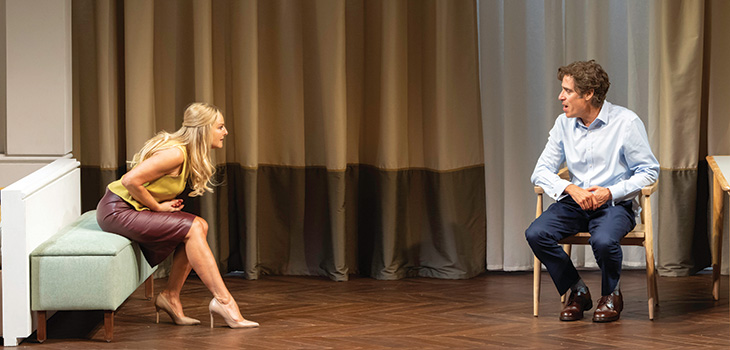
Stephen Mangan (Michel) doesn’t step off stage throughout this 90-minute play. He is highly physical: a bright, busy restlessness, forever reaching for a drink or a deflection, showing he is improvising his lies in real time. When his wife Laurence corners him over a quiet domestic evening, Mangan lets the patter curdle into something close to panic, and the comedy turns cold. Janie Dee, playing Laurence, is his match and arguably his better. She underplays where the others push, and her Laurence holds a stillness that suggests she worked out the truth some time ago and is merely deciding what to do with it. Ardal O’Hanlon brings a wounded, decent warmth to Paul, the friend who may or may not be playing the longest game in the room. Sarah Hadland (Alice) sparkles in the opening exchanges, though her character becomes duller as the scenes progress.
Zeller’s writing runs to extravagance, and the temptation to shout the lines proves hard to resist. In the middle stretch especially, the actors sometimes lean so hard into the absurdity of the situation that the jokes land too heavily. The play is funniest when it trusts its own script, when someone delivers a betrayal as though passing the salt. Push the line too hard and it coarsens into ordinary farce, and we lose the unease running underneath the laughter.
What stops this from mattering much is the astounding writing and, bizarrely, the staging. Lizzie Clachan’s design is the genuine star turn. Whole rooms reassemble themselves in seconds, a hotel dissolving into a sitting room into an office while you are still laughing at the last exit. It dazzles, while shifting the ground beneath the audience as briskly as Michel shifts it beneath everyone he deceives.
The obvious analogy is Pinter’s Betrayal, another elegant anatomy of adultery among the well-spoken. And this show is every bit as good, if not better. Where Pinter ran his affair backwards, Zeller runs his sideways, peeling layer after layer until the friend across the table looks like the most dangerous person in the room. There is even a knowing wink at its own genre, a moment when a character wonders aloud what kind of play this is, a comedy or tragedy; and the honest answer is both.
I laughed a great deal, and I winced more than once at the accuracy of it. The Truth is that rare comedy that flatters your intelligence while insulting your morals, and it sends you home turning over the small fictions that keep your own life civil. See it for Mangan’s velocity, for Dee’s controlled, knowing calm, and for a design that rebuilds the room every few minutes without once losing the thread. A touch less ham and the evening would be flawless. As it stands it is very good indeed, and the kind of night out that ruins you for clumsier comedy.
The Truth is playing at the Apollo Theatre, London until 12 September

Daniel Barnett practises from Outer Temple Chambers and presents the legal hour on LBC Radio.
Michel is having an affair with Alice. So far, so French. The complication is that Alice is married to Paul, Michel’s best friend, while Michel is married to the elegant and watchful Laurence.
The Truth runs as a series of confrontations: Michel and Alice, Michel and Laurence, Michel and Paul, each one tightening the screw a little further. Michel’s working theory is that honesty is crueller than a well-maintained lie, a doctrine that gets harder to sustain as the alibis multiply. Florian Zeller’s (the playwright’s) real trick is that by the end you’re no longer sure whose account to believe. Everyone, it turns out, may have known rather more than they let on.
This revival of a 15-year-old script mines it for every laugh and every wince it contains. The production is fast and clever, let down only by a cast that now and then mistakes hamminess for wit.
The Truth is a comedy of manners about two couples and the affair quietly corroding both. Nominally set in France but portrayed with various UK accents, we meet Michel and Alice having their weekly affair in a hotel room. Alice wants to intensify the affair, and pushes for a weekend away. Michel, who regards honesty as overrated, wants to keep the affair secret.
But given Alice is married to Paul, Michel’s best friend, and Michel is married to Laurence, it’s not going to go well. Laurence’s suspicions mean she’s cross-examining Michel over the dinner table. From there Florian Zeller does what he does best, which is to keep tilting the floor. Each scene hands you a new fact that rearranges everything you thought you understood about who is deceiving whom, until the idea of a single, stable truth starts to look like the silliest fiction in the room.
Stephen Mangan (Michel) doesn’t step off stage throughout this 90-minute play. He is highly physical: a bright, busy restlessness, forever reaching for a drink or a deflection, showing he is improvising his lies in real time. When his wife Laurence corners him over a quiet domestic evening, Mangan lets the patter curdle into something close to panic, and the comedy turns cold. Janie Dee, playing Laurence, is his match and arguably his better. She underplays where the others push, and her Laurence holds a stillness that suggests she worked out the truth some time ago and is merely deciding what to do with it. Ardal O’Hanlon brings a wounded, decent warmth to Paul, the friend who may or may not be playing the longest game in the room. Sarah Hadland (Alice) sparkles in the opening exchanges, though her character becomes duller as the scenes progress.
Zeller’s writing runs to extravagance, and the temptation to shout the lines proves hard to resist. In the middle stretch especially, the actors sometimes lean so hard into the absurdity of the situation that the jokes land too heavily. The play is funniest when it trusts its own script, when someone delivers a betrayal as though passing the salt. Push the line too hard and it coarsens into ordinary farce, and we lose the unease running underneath the laughter.
What stops this from mattering much is the astounding writing and, bizarrely, the staging. Lizzie Clachan’s design is the genuine star turn. Whole rooms reassemble themselves in seconds, a hotel dissolving into a sitting room into an office while you are still laughing at the last exit. It dazzles, while shifting the ground beneath the audience as briskly as Michel shifts it beneath everyone he deceives.
The obvious analogy is Pinter’s Betrayal, another elegant anatomy of adultery among the well-spoken. And this show is every bit as good, if not better. Where Pinter ran his affair backwards, Zeller runs his sideways, peeling layer after layer until the friend across the table looks like the most dangerous person in the room. There is even a knowing wink at its own genre, a moment when a character wonders aloud what kind of play this is, a comedy or tragedy; and the honest answer is both.
I laughed a great deal, and I winced more than once at the accuracy of it. The Truth is that rare comedy that flatters your intelligence while insulting your morals, and it sends you home turning over the small fictions that keep your own life civil. See it for Mangan’s velocity, for Dee’s controlled, knowing calm, and for a design that rebuilds the room every few minutes without once losing the thread. A touch less ham and the evening would be flawless. As it stands it is very good indeed, and the kind of night out that ruins you for clumsier comedy.
The Truth is playing at the Apollo Theatre, London until 12 September
Reviewed by Daniel Barnett


The Chair of the Bar reports back
Susie Griffin on the admin that keeps barristers from billable work
Clement Cowley, Partner at The Penny Group, explains how global events can influence the performance of pensions and ISAs, and why taking a long-term approach to investing is often the most effective strategy
Mário Barroso, Head of R&D and Method Development at AlphaBiolabs, discusses what family law professionals need to know about hallucinogens, from the main hallucinogenic drugs encountered in family proceedings, to their effects and the testing options available
Harmony Christian Ministries is the latest charity to benefit from a £500 donation from AlphaBiolabs via the company’s Giving Back initiative
By David Green
At the start of her term, Chair of the Bar 2026 Kirsty Brimelow KC set out a series of priorities for the year ahead. One of those priorities was children in the justice system
As the world becomes more digital, Barbara Vinagre Mota examines international research into the mental health consequences of judges’ exposure to graphic and immersive evidence, highlighting the importance of support systems
In an era of patient-centred care and growing concern over misconduct in medical settings, why do women still lack the right to choose women consultants for examination and treatment? Charles Davey investigates
Reviewed by Daniel Barnett
James McNeill Whistler at Tate Britain until 27 September Rothko in Florence at Palazzo Strozzi until 23 August Reviewed by Stephen Cragg KC