*/
Not yet, says Jacob Turner. Regulation, unlike the technology itself, is a domain the legal profession can still control
You may have seen headlines claiming that an ‘AI Lawyer’, an ‘AI Law Firm’ or even a ‘Robot’ has just won a case for the first time.
These news stories have all the ingredients for viral clickbait: a world first, technological disruption, and white-collar professionals getting their comeuppance. But strip away the sensationalism and what remains is far less dramatic. The reporting is a triumph of marketing, not technology.
What actually happened is that a law firm deployed an AI system to assist with elements of a debt claim. This may have included disclosure review, drafting and legal research. A human barrister then conducted the trial, addressed the judge and obtained a favourable outcome for the client.
It was not the victory of a robot lawyer. And it was certainly not a world-first.
Law firms and barristers have been using AI tools to assist with litigation for several years. The release of ChatGPT and other freely accessible ‘general purpose’ AI tools from 2022 onwards has massively accelerated this trend, and enabled litigants in person to take advantage of the technology.
Predictive coding, contract analysis, legal research and now the development of strategies and legal arguments have been transformed by AI software. There are now several multi-billion dollar ‘full service’ legal AI companies, and many smaller ones dealing with specific tasks and domains. Kirkland and Ellis, the world’s most profitable law firm, has announced a plan to develop its own proprietary AI with an initial $500m investment.
In 2008, Professor Richard Susskind’s provocative book, The End of Lawyers? was published. It has generated both detraction for its alleged overstatement and praise for its foresight. In recent years, there has been considerably more of the latter. As Susskind rightly points out, his title is phrased not as a statement, or even a prediction, but rather as a question.
There are two barriers to the replacement of human lawyers with AI. The first is technological, the second is regulatory.
As to the technology, the key question is whether an AI system is able to undertake complex tasks as well as or better than the reasonably competent human lawyer.
Before 2010 most computer systems were rules-based, which required the encoding of an ever-more complex series of instructions. Even simple tasks such as reading and classifying documents required a level of computational power and bespoke investment that was out of reach for most. Then, with the release of machine learning AI became able to teach itself rules based on examples and infer ways of achieving complex goals without the need for detailed instructions. Next came generative AI capable of creating novel output including sophisticated legal reasoning. Most recently, agentic AI has enabled a single program to create and execute intricate strategies with minimal human input.
It is an over-simplification to ask whether lawyers will be ‘replaced’ by AI. As with most other professions, the role of a lawyer is multifaceted. But though being a lawyer has always been about more than just reading documents and writing submissions, the areas of work which are incapable of being done by AI are rapidly decreasing. The worldwide legal market is worth, on a conservative view, hundreds of billions of dollars, and on some estimates, over a trillion. It is ripe for disruption and so it is no surprise that there has been considerable interest and investment in replacing lawyers with AI systems.
As the AI tide comes in, lawyers may find themselves standing on an increasingly small and drenched stretch of sand. And just like King Canute who could not reverse the waves, there is little that lawyers can do to halt the technology’s development.
Critics may respond that there have been numerous instances of AI systems hallucinating and making up cases. These examples illustrate the tendency for generative AI to create output which sounds plausible but is inaccurate. But it would be wrong to assume that the technology is fundamentally unsafe, or that it has ceased to improve. To the contrary, the examples of AI mistakes which hit the press are likely to be vastly outweighed by the instances where AI has been successfully used with no fanfare.
This brings us to the second barrier to the replacement of lawyers by AI: regulation. Unlike the development of the technology, regulation is something which the legal profession can control.
As things stand, both the Solicitors Regulation Authority (SRA) and Bar Standards Board (BSB) impose obligations that cannot be contracted out to a machine.
The SRA Principles and BSB Core Duties both require that lawyers must act with independence, honesty, integrity and in a way that upholds public trust and confidence in the profession. Furthermore, barristers are required to take personal responsibility and exercise their own provisional judgement for matters in which they are instructed (rC20) as well as for any outsourcing (rC86).
None of these requirements directly refers to AI, but regulatory guidance, both from the courts and from the regulators make clear that it is a dereliction of a lawyer’s duties to submit documents to court or clients without checking them properly.
In mid-2026 the BSB published guidance which cautiously welcomes the adoption of AI but reiterates that ultimate responsibility remains with the barrister. It follows therefore that the barrister must independently verify points such as references, citations and conclusions in AI-generated materials. The BSB Guidance also makes clear that barristers should be open, frank and honest about their AI usage.
Personal responsibility for legal services is not just a matter of professional regulation. The Solicitors Act 1974 and Legal Services Act 2007 make it a criminal offence for people who are not solicitors or barristers to use those titles. Even if someone avoids protected titles, under the 2007 Act they still cannot carry out reserved legal activities (for example the drafting of certain documents) unless subject to professional regulation.
It follows that a law firm or barrister cannot delegate responsibility for a case to an ‘AI lawyer’. Any other approach would expose those operating an ‘AI law firm’ to professional regulatory consequences if they are lawyers, and potentially to criminal liability if they are not.
Misleading headlines may also encourage lay clients to avoid using lawyers at all and instead place trust in free to use non-specialist AI programs. As recent case law has demonstrated, the use of free AI programs in place of lawyers may lead to time and cost being wasted in dealing with hallucinations. Litigants also risk waiving confidentiality and privilege if they input sensitive documents into a free AI system.
All that said, there is a genuine story here, even if it is not the one being told. AI is changing legal practice – not by replacing lawyers entirely, but by shifting the economics of legal services in ways that have significant consequences for clients, firms, and the profession itself. That is good news for parties who could not previously afford legal assistance, and uncomfortable for the business models of firms whose profitability depended on billing hours spent on drudgery.
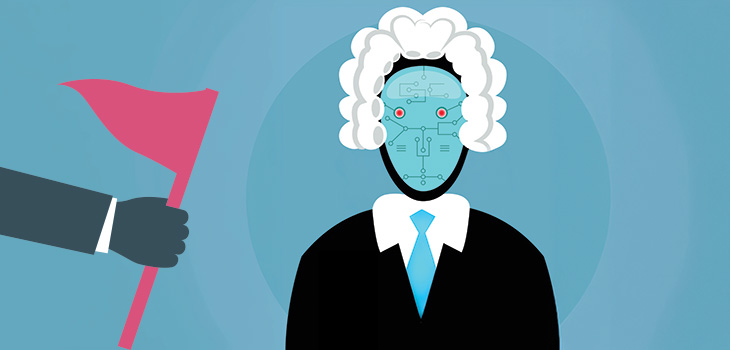
The real question is whether regulation as it stands is fit for purpose. Perhaps the rules requiring human lawyers to oversee certain tasks will come to be seen in the same way as the infamous ‘red flag’ laws of the late 19th century, which required every motor vehicle to be accompanied by a person walking ahead, waiving a red flag to warn other road users. Predictably, the result was that cars were limited to walking pace.
One day, something more plausibly described as an AI lawyer may appear in proceedings and win a case without human oversight. But before that can happen, the legal profession, courts and society as a whole will need to grapple with deep questions of accountability, ethics and what it means to practise law.

Jacob Turner is a barrister at Fountain Court Chambers. He is the author of Robot Rules: Regulating Artificial Intelligence (Palgrave Macmillan: 2018) and a contributor to The Law of Artificial Intelligence (Sweet & Maxwell: 2024).
You may have seen headlines claiming that an ‘AI Lawyer’, an ‘AI Law Firm’ or even a ‘Robot’ has just won a case for the first time.
These news stories have all the ingredients for viral clickbait: a world first, technological disruption, and white-collar professionals getting their comeuppance. But strip away the sensationalism and what remains is far less dramatic. The reporting is a triumph of marketing, not technology.
What actually happened is that a law firm deployed an AI system to assist with elements of a debt claim. This may have included disclosure review, drafting and legal research. A human barrister then conducted the trial, addressed the judge and obtained a favourable outcome for the client.
It was not the victory of a robot lawyer. And it was certainly not a world-first.
Law firms and barristers have been using AI tools to assist with litigation for several years. The release of ChatGPT and other freely accessible ‘general purpose’ AI tools from 2022 onwards has massively accelerated this trend, and enabled litigants in person to take advantage of the technology.
Predictive coding, contract analysis, legal research and now the development of strategies and legal arguments have been transformed by AI software. There are now several multi-billion dollar ‘full service’ legal AI companies, and many smaller ones dealing with specific tasks and domains. Kirkland and Ellis, the world’s most profitable law firm, has announced a plan to develop its own proprietary AI with an initial $500m investment.
In 2008, Professor Richard Susskind’s provocative book, The End of Lawyers? was published. It has generated both detraction for its alleged overstatement and praise for its foresight. In recent years, there has been considerably more of the latter. As Susskind rightly points out, his title is phrased not as a statement, or even a prediction, but rather as a question.
There are two barriers to the replacement of human lawyers with AI. The first is technological, the second is regulatory.
As to the technology, the key question is whether an AI system is able to undertake complex tasks as well as or better than the reasonably competent human lawyer.
Before 2010 most computer systems were rules-based, which required the encoding of an ever-more complex series of instructions. Even simple tasks such as reading and classifying documents required a level of computational power and bespoke investment that was out of reach for most. Then, with the release of machine learning AI became able to teach itself rules based on examples and infer ways of achieving complex goals without the need for detailed instructions. Next came generative AI capable of creating novel output including sophisticated legal reasoning. Most recently, agentic AI has enabled a single program to create and execute intricate strategies with minimal human input.
It is an over-simplification to ask whether lawyers will be ‘replaced’ by AI. As with most other professions, the role of a lawyer is multifaceted. But though being a lawyer has always been about more than just reading documents and writing submissions, the areas of work which are incapable of being done by AI are rapidly decreasing. The worldwide legal market is worth, on a conservative view, hundreds of billions of dollars, and on some estimates, over a trillion. It is ripe for disruption and so it is no surprise that there has been considerable interest and investment in replacing lawyers with AI systems.
As the AI tide comes in, lawyers may find themselves standing on an increasingly small and drenched stretch of sand. And just like King Canute who could not reverse the waves, there is little that lawyers can do to halt the technology’s development.
Critics may respond that there have been numerous instances of AI systems hallucinating and making up cases. These examples illustrate the tendency for generative AI to create output which sounds plausible but is inaccurate. But it would be wrong to assume that the technology is fundamentally unsafe, or that it has ceased to improve. To the contrary, the examples of AI mistakes which hit the press are likely to be vastly outweighed by the instances where AI has been successfully used with no fanfare.
This brings us to the second barrier to the replacement of lawyers by AI: regulation. Unlike the development of the technology, regulation is something which the legal profession can control.
As things stand, both the Solicitors Regulation Authority (SRA) and Bar Standards Board (BSB) impose obligations that cannot be contracted out to a machine.
The SRA Principles and BSB Core Duties both require that lawyers must act with independence, honesty, integrity and in a way that upholds public trust and confidence in the profession. Furthermore, barristers are required to take personal responsibility and exercise their own provisional judgement for matters in which they are instructed (rC20) as well as for any outsourcing (rC86).
None of these requirements directly refers to AI, but regulatory guidance, both from the courts and from the regulators make clear that it is a dereliction of a lawyer’s duties to submit documents to court or clients without checking them properly.
In mid-2026 the BSB published guidance which cautiously welcomes the adoption of AI but reiterates that ultimate responsibility remains with the barrister. It follows therefore that the barrister must independently verify points such as references, citations and conclusions in AI-generated materials. The BSB Guidance also makes clear that barristers should be open, frank and honest about their AI usage.
Personal responsibility for legal services is not just a matter of professional regulation. The Solicitors Act 1974 and Legal Services Act 2007 make it a criminal offence for people who are not solicitors or barristers to use those titles. Even if someone avoids protected titles, under the 2007 Act they still cannot carry out reserved legal activities (for example the drafting of certain documents) unless subject to professional regulation.
It follows that a law firm or barrister cannot delegate responsibility for a case to an ‘AI lawyer’. Any other approach would expose those operating an ‘AI law firm’ to professional regulatory consequences if they are lawyers, and potentially to criminal liability if they are not.
Misleading headlines may also encourage lay clients to avoid using lawyers at all and instead place trust in free to use non-specialist AI programs. As recent case law has demonstrated, the use of free AI programs in place of lawyers may lead to time and cost being wasted in dealing with hallucinations. Litigants also risk waiving confidentiality and privilege if they input sensitive documents into a free AI system.
All that said, there is a genuine story here, even if it is not the one being told. AI is changing legal practice – not by replacing lawyers entirely, but by shifting the economics of legal services in ways that have significant consequences for clients, firms, and the profession itself. That is good news for parties who could not previously afford legal assistance, and uncomfortable for the business models of firms whose profitability depended on billing hours spent on drudgery.
The real question is whether regulation as it stands is fit for purpose. Perhaps the rules requiring human lawyers to oversee certain tasks will come to be seen in the same way as the infamous ‘red flag’ laws of the late 19th century, which required every motor vehicle to be accompanied by a person walking ahead, waiving a red flag to warn other road users. Predictably, the result was that cars were limited to walking pace.
One day, something more plausibly described as an AI lawyer may appear in proceedings and win a case without human oversight. But before that can happen, the legal profession, courts and society as a whole will need to grapple with deep questions of accountability, ethics and what it means to practise law.
Not yet, says Jacob Turner. Regulation, unlike the technology itself, is a domain the legal profession can still control

The Chair of the Bar reports back
Clement Cowley, Partner at The Penny Group, explains how global events can influence the performance of pensions and ISAs, and why taking a long-term approach to investing is often the most effective strategy
Mário Barroso, Head of R&D and Method Development at AlphaBiolabs, discusses what family law professionals need to know about hallucinogens, from the main hallucinogenic drugs encountered in family proceedings, to their effects and the testing options available
Harmony Christian Ministries is the latest charity to benefit from a £500 donation from AlphaBiolabs via the company’s Giving Back initiative
By David Green
Mário Barroso, Head of R&D and Method Development at AlphaBiolabs, examines the forensic science underpinning hair drug testing, its evidential scope and limitations, and why it remains the gold standard for evidencing patterns of drug use in family proceedings
At the start of her term, Chair of the Bar 2026 Kirsty Brimelow KC set out a series of priorities for the year ahead. One of those priorities was children in the justice system
As the world becomes more digital, Barbara Vinagre Mota examines international research into the mental health consequences of judges’ exposure to graphic and immersive evidence, highlighting the importance of support systems
In an era of patient-centred care and growing concern over misconduct in medical settings, why do women still lack the right to choose women consultants for examination and treatment? Charles Davey investigates
Reviewed by Daniel Barnett
James McNeill Whistler at Tate Britain until 27 September Rothko in Florence at Palazzo Strozzi until 23 August Reviewed by Stephen Cragg KC