*/

By David Green
Before I was a barrister, I was (briefly) a management consultant. I didn’t progress very far, but some things from my previous life impressed themselves on me.
There was a relentless emphasis on efficiency – on avoiding unnecessary effort, and maximising output for your time. Reinventing what somebody else had already done was verboten. If you had to do something more than once, you were expected to build – and share – a reusable tool.
And every project ran on Excel – so I started to develop a particularly nerdy hobby of running my own life through spreadsheets.
When I came to the Bar, as a personal injury and employment specialist, I again found repetitive number-work: multipliers, interest, fixed costs, grossing up. But I was staggered to find them being done with pencil, paper and pocket calculator.
I found this approach as mind-numbingly dull as it was time-consuming and error-prone. So I started making little spreadsheets. I built one for interest. Then one for multipliers, and for uprating PSLA awards for inflation.
Things snowballed from there. A couple of calculators grew to around two dozen; an emailed file to a few mates led to a regular email around the whole of Chambers.
I’ve now put my entire curated collection online, for the whole legal community, at www.dgcalculators.co.uk.
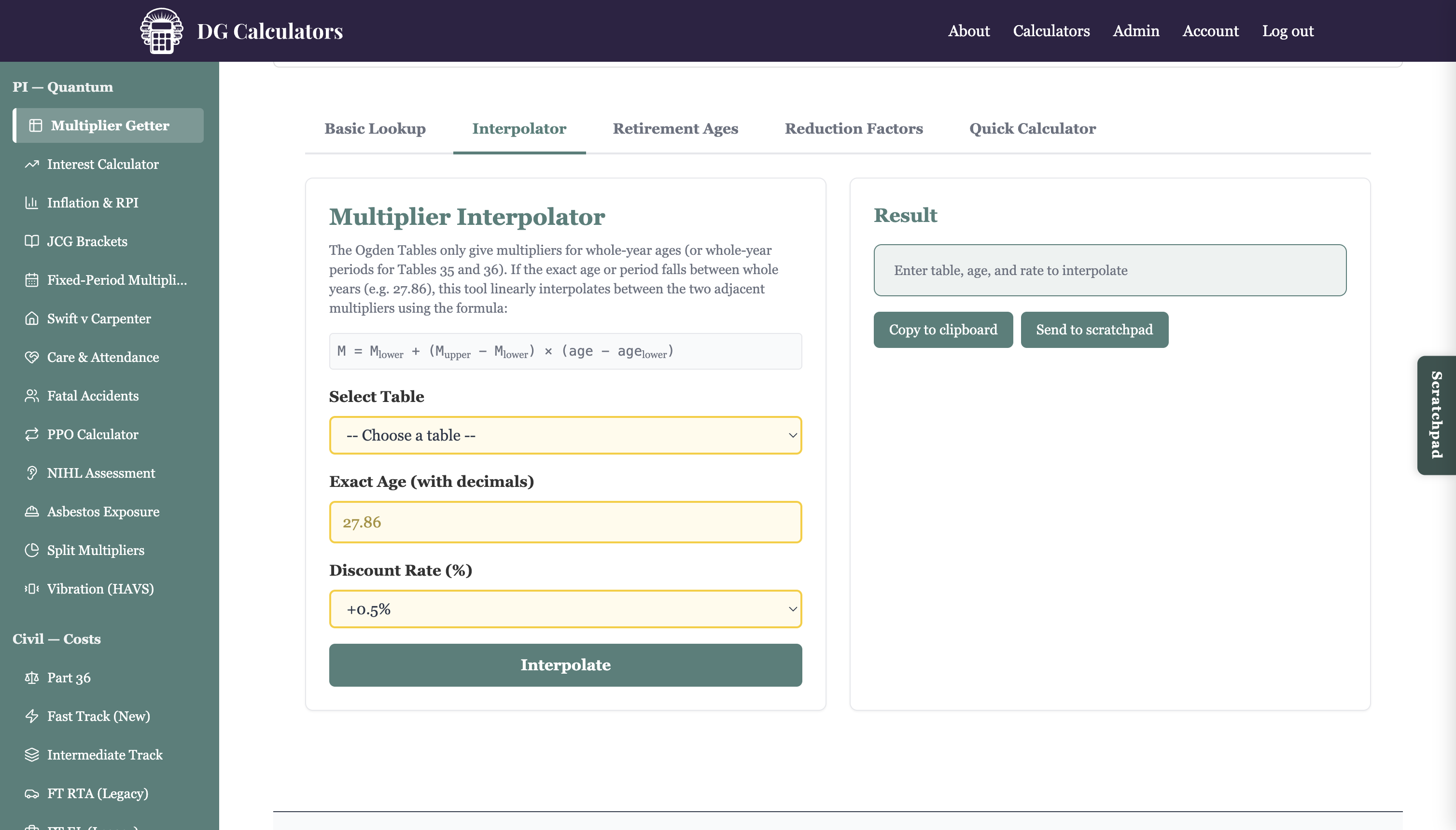
There are 40 calculators on the site now, organised into five areas: personal injury, civil costs, employment, industrial disease, and a small set of general utilities.
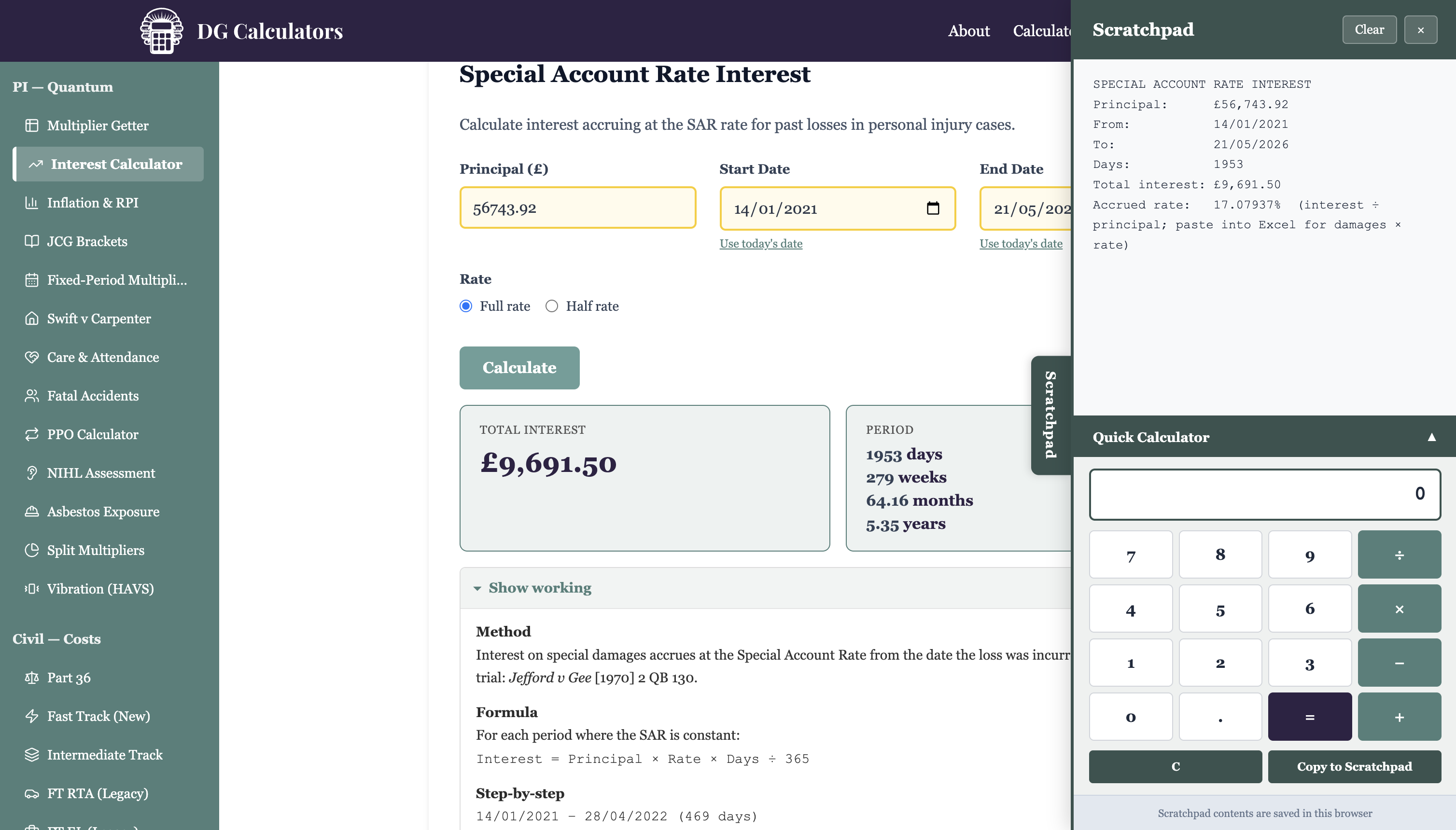
Each does a single, specific task, but quickly, consistently, and correctly. Every calculator has a deliberately simple, intuitive design, so the workflow is obvious for even the biggest technophobe. Every calculator includes a ‘show working’ panel, setting out the computation steps in full. Sources – such as the Ogden Tables, or the ONS’s inflation indices – are directly referenced.
There’s also a ‘scratchpad’ panel, to collect results and notes, and an actual, literal calculator for your one-off calculations.
I’m also adding new calculators all the time. The current collection of 40 individual calculators is just the start. The aim is to serve every need of the busy civil lawyer (or at least, those which can be served mathematically).
I’m currently working on a Schedule Auditor, which should land in a few months: for an additional premium subscription, users can paste lines from the opposing party’s schedule, and the tool assesses it to give a red/amber/green verdict in seconds. There’s a waitlist sign-up at dgcalculators.co.uk/audit.
I was never attracted by the idea of having a tool to build my Schedules for me: I always wanted control of my documents. DG Calculators doesn’t replace the lawyer, it supports them. It’s an indispensable toolbox to have open in a tab, whether you’re drafting a Schedule of Loss, sitting in court, or deep in a contentious settlement meeting. Your analysis and judgement can never be replaced, but routine computation absolutely can be automated.
The site is available for individuals, or for sets, firms and other organisations. Individual subscriptions are £15.99 per month or £159 annually (ex VAT), which is less than Netflix premium. Corporate subscriptions are billed per seat on a tiered model, but the largest organisations can get access for as little as £29 per seat.
Curious lawyers can try one calculator (the basic-lookup ‘multiplier getter’) for free, and sign up for a 14-day, no-commitment trial at dgcalculators.co.uk.

David Green is a personal injury and employment barrister at 12 King's Bench Walk. He is founder of dgcalculators.co.uk.
Before I was a barrister, I was (briefly) a management consultant. I didn’t progress very far, but some things from my previous life impressed themselves on me.
There was a relentless emphasis on efficiency – on avoiding unnecessary effort, and maximising output for your time. Reinventing what somebody else had already done was verboten. If you had to do something more than once, you were expected to build – and share – a reusable tool.
And every project ran on Excel – so I started to develop a particularly nerdy hobby of running my own life through spreadsheets.
When I came to the Bar, as a personal injury and employment specialist, I again found repetitive number-work: multipliers, interest, fixed costs, grossing up. But I was staggered to find them being done with pencil, paper and pocket calculator.
I found this approach as mind-numbingly dull as it was time-consuming and error-prone. So I started making little spreadsheets. I built one for interest. Then one for multipliers, and for uprating PSLA awards for inflation.
Things snowballed from there. A couple of calculators grew to around two dozen; an emailed file to a few mates led to a regular email around the whole of Chambers.
I’ve now put my entire curated collection online, for the whole legal community, at www.dgcalculators.co.uk.
There are 40 calculators on the site now, organised into five areas: personal injury, civil costs, employment, industrial disease, and a small set of general utilities.
Each does a single, specific task, but quickly, consistently, and correctly. Every calculator has a deliberately simple, intuitive design, so the workflow is obvious for even the biggest technophobe. Every calculator includes a ‘show working’ panel, setting out the computation steps in full. Sources – such as the Ogden Tables, or the ONS’s inflation indices – are directly referenced.
There’s also a ‘scratchpad’ panel, to collect results and notes, and an actual, literal calculator for your one-off calculations.
I’m also adding new calculators all the time. The current collection of 40 individual calculators is just the start. The aim is to serve every need of the busy civil lawyer (or at least, those which can be served mathematically).
I’m currently working on a Schedule Auditor, which should land in a few months: for an additional premium subscription, users can paste lines from the opposing party’s schedule, and the tool assesses it to give a red/amber/green verdict in seconds. There’s a waitlist sign-up at dgcalculators.co.uk/audit.
I was never attracted by the idea of having a tool to build my Schedules for me: I always wanted control of my documents. DG Calculators doesn’t replace the lawyer, it supports them. It’s an indispensable toolbox to have open in a tab, whether you’re drafting a Schedule of Loss, sitting in court, or deep in a contentious settlement meeting. Your analysis and judgement can never be replaced, but routine computation absolutely can be automated.
The site is available for individuals, or for sets, firms and other organisations. Individual subscriptions are £15.99 per month or £159 annually (ex VAT), which is less than Netflix premium. Corporate subscriptions are billed per seat on a tiered model, but the largest organisations can get access for as little as £29 per seat.
Curious lawyers can try one calculator (the basic-lookup ‘multiplier getter’) for free, and sign up for a 14-day, no-commitment trial at dgcalculators.co.uk.
By David Green


The Chair of the Bar reports back
Susie Griffin on the admin that keeps barristers from billable work
Clement Cowley, Partner at The Penny Group, explains how global events can influence the performance of pensions and ISAs, and why taking a long-term approach to investing is often the most effective strategy
Mário Barroso, Head of R&D and Method Development at AlphaBiolabs, discusses what family law professionals need to know about hallucinogens, from the main hallucinogenic drugs encountered in family proceedings, to their effects and the testing options available
Harmony Christian Ministries is the latest charity to benefit from a £500 donation from AlphaBiolabs via the company’s Giving Back initiative
By David Green
At the start of her term, Chair of the Bar 2026 Kirsty Brimelow KC set out a series of priorities for the year ahead. One of those priorities was children in the justice system
As the world becomes more digital, Barbara Vinagre Mota examines international research into the mental health consequences of judges’ exposure to graphic and immersive evidence, highlighting the importance of support systems
In an era of patient-centred care and growing concern over misconduct in medical settings, why do women still lack the right to choose women consultants for examination and treatment? Charles Davey investigates
Reviewed by Daniel Barnett
James McNeill Whistler at Tate Britain until 27 September Rothko in Florence at Palazzo Strozzi until 23 August Reviewed by Stephen Cragg KC