*/

A decade of reviews and research has disrupted accepted thinking in the search for causality. Suicides following abuse have overtaken domestic homicides. Is the law keeping up? Professor Susan Edwards KC (Hon) examines recent cases and the obstacles to successful prosecution
‘Can a partner be held criminally responsible for the death of a victim who has taken their own life following a course of domestic abuse?’ asked prosecutor Laura Buchan.
On 2 March 2026, at the High Court in Glasgow, the jury thought so and convicted Lee Milne of ‘culpable homicide’, followed by an eight-year sentence. The prosecution was able to prove that his deliberate and violent abuse of his wife Kimberly was a significant contributory factor in her death. Ms Milne had jumped from a bridge to her death to escape the car that he was driving at her. Other manslaughter trials involving domestic abuse-induced suicide of a partner are pending. Seyhan Assaf awaits trial charged with unlawfully killing his partner Gillian Morand, which he denies. It is alleged that domestic abuse suffered by Ms Morand over a significant period of time contributed to her death by suicide in 2020.
Earlier trials in such circumstances have either secured manslaughter convictions on guilty pleas or else failed to establish causation and defendants were acquitted. In R v Cenci (1989) 11 Cr App R (S) 199, a female partner, in escaping further violence from her boyfriend, smashed a window with an iron and fell to her death. A plea of involuntary manslaughter was accepted and a ten-year sentence of imprisonment was reduced to five years.
In 2017, Nicholas Allen was convicted of the manslaughter of Justene Reece following a guilty plea (see Staffordshire Police statement, ‘Publication of Domestic Homicide Review following the death of Justene Reece’, 18 November 2021).
It was the case of R v Dhaliwal [2006] EWCA Crim 1139, where a wife committed suicide following a husband’s long-term abuse of her, that established a bright line where the Court of Appeal said per curiam:
‘[8] Unlawful violence on an individual with a fragile and vulnerable personality which is proved to be a material cause of death, even if the result of suicide, is arguably capable of amounting to manslaughter ’ (emphasis added).
Legal submissions were constructed around evidence of psychological harm. The court required a higher threshold of psychiatric injury to establish the unlawful act within the meaning of Offences Against the Person Act 1861, ss 18, 20 and 47. The prosecution failed and the court ruled no case to answer, upheld on appeal.
Since then, there have been few contested trials for manslaughter. In January 2025 Ryan Wellings was aquitted of the manslaughter of his partner Kiena Dawes, who took her own life on 22 July 2022. He was sentenced to six years for coercive and controlling conduct and assault. In her suicide note Ms Dawes wrote: ‘Ryan Wellings killed me. He ruined every bit of strength I had left.’ Sentencing, HHJ Altham said that Wellings had repeatedly told Ms Dawes that ‘she may as well kill herself’ and cited horrific examples of Wellings’ actual and threatened violence towards her. He went on to say:
‘... On the jury’s verdict that assault did not cause Ms Dawes’ death... However, from May 2020 until her death you abused, assaulted, exploited, controlled and demeaned her. When she died it is clear that she had begun to believe your lies to the effect that she was deranged, physically disgusting, friendless, worthless and an unfit mother. You had persuaded her that she had no one to turn to. Of course none of what you made her believe was true... ’ (Rex v Ryan Wellings sentencing remarks 16 January 2025)
Prosecutors have charged defendants with lesser offences securing convictions following domestic abuse-induced suicide. Marc Masterton in 2023 received a 41-month sentence after a guilty plea for coercive conduct, following the death of Chloe Holland, who lost her life to domestic abuse-induced suicide. ‘Masterton would routinely control her appearance, assault her, isolate her from friends and family, belittle her, and shockingly tell her to take her own life’ (Hampshire & Isle of Wight Constabulary, 10 October 2023).
On 9 June 2023, Skye Nicholls was found dead by suicide. James Edwards pleaded guilty to two counts of controlling or coercive behaviour and his sentence was reduced to 21 months (R v Edwards (James), 2026 WL 00814619). In text messages he told her to die and said nobody would miss her and that she should kill herself [7]. The roll call goes on.
While coercive control is more widely understood, counterintuitively the false allegation hypothesis endures. On 22 April 2026, a Winchester jury in the trial of Christopher Trybus, whose wife Tarryn Baird ended her life by hanging in November 2017, following 40 hours and eight minutes of deliberations, returned not guilty verdicts on all counts of manslaughter, rape and coercive control. Tom Little KC prosecuting argued that Trybus’s abuse of Ms Baird was a significant contributory factor in her death, submitting evidence that she suffered physical, mental, sexual abuse and controlling conduct documented in reports she had made to police, her GP and a Women’s Aid worker and relayed to family and friends.
The defence claimed the prosecution case was based on ‘false allegations’, ‘a dogma and agenda that when women allege violence and domestic abuse, they must be telling the truth’ and that the bruising she sustained was self-inflicted. Explaining the injuries observed by the GP, Trybus said his wife ‘bruised easily’ and that injury to the neck was caused by consensual ‘kinky sex’. Explaining his wife’s allegations of his violence, Trybus said that she was unstable and ‘probably’ suffered from PTSD following witnessing an armed carjacking incident in South Africa in 2015 and an attempted burglary.
What drives the cognitive process? What orchestrates partiality? Presumably the jury considered the false allegation ‘dogma’ compelling, though any causal thread between Ms Baird witnessing a past carjacking and attempted burglary (without the counterfactual conditional in Trybus’s alleged abuse), her making allegations of his abuse and committing suicide, is fanciful. (‘Husband cleared of manslaughter over wife’s suicide’, BBC News, 22 April 2026.)
While the culpability of a domestic abuse perpetrator in domestic abuse suicide cases may seem overwhelming (contra Trybus), the law on legal causation in manslaughter is less sanguine, requiring evidence of a causal link between the death and the defendant’s conduct which the prosecution must prove to the criminal standard. The conduct need not be the only or principal cause, but it must be more than ‘de minimus’ (R v Hennigen [1971] 3 All ER 133, 135f); more than negligible or minimal (Crown Court Compendium 2026). Littered with equivocal language – ‘proximate’, ‘significant’ (Hooper LJ in Warburton [30]) and ‘operative’ – it is easy to appreciate that causation is devoid of a uniform theory. As Lords Toulson and Hughes in R v Hughes (Michael) [2013] UKSC 56 [20]) said: ‘It is heavily context-specific, and Parliament or the courts may apply different rules in different situations.’
Finding/inferring causation depends on marshalling and selecting facts in a context where there are a number of contributory factors; defence and prosecution focusing on different trajectives. Defence pleadings focus on voluntarism drawing on evidence of suicidality, instability and trauma sufficient to break the chain of causation (see R v Kennedy (No 2) [2007] UKHL 38, R v Wallace [2018] EWCA Crim 690). Where there is a background of domestic abuse/coercion, including gaslighting and psychological abuse, a presumption of voluntarism is ill-founded since the deceased’s act is committed in the absence of free will or capacity under states of inducement and entrapment devoid of a free, voluntary and informed choice (Kennedy [15] – note emphasis on ‘context’, and ‘truly free’ as per Wallace [61]).
The law on this point is yet to be tested further following R v Field [2026] EWCA Crim 413 (not a ‘conventional’ domestic abuse-induced suicide) where the Court of Appeal quashed the murder conviction on the ground that the jury were/may have been improperly directed [64]); directed a retrial [66]; and certified that a point of law of general public importance be considered by the Supreme Court [65] (per s 33(2) Criminal Appeal Act 1968). Benjamin Field was convicted of the murder of Peter Farquhar in 2019 by forcing or deceiving him into taking whisky or medication before his death. Significantly, the Court of Appeal [61] made reference to the cases coming before the courts involving allegations of homicide by causing death where death was the result of suicide following a lengthy period of domestic abuse.
Theories of ‘why suicide?’ influence the search for evidence, determination of what is relevant, direct case building, public policy and preventive strategy. Twentieth century theorisations, dominated by Emile Durkheim’s On Suicide (1897), were rooted in social causes, later superseded by a medical model and psychiatric nosology focusing on prior endogenous instability. While an orchestral gamut of social and psychological factors including grief, bereavement, ‘unhappy marriage’, unemployment, redundancy, betrayal, despondency, despair and mental illness are all considered relevant, no theory or study, until now, has recognised domestic abuse/coercion and entrapment as contributive and causal. In the last ten years suicide has been reimagined by domestic homicide reviews and research disrupting accepted thinking in the search for causality (see J Rowlands, S Dangar, ‘The challenges and opportunities of reviewing domestic abuse-related deaths by suicide in England and Wales’ Journal of Family Violence (2024) 39:723). In 2025, the Domestic Homicide Project recorded 150 suspected suicides in England and Wales following intimate partner abuse, up from 98 in 2024 and 93 in 2023.
At the investigation stage, vital evidence which may otherwise indicate homicide or a suicide induced by another’s violence is lost if a suspected suicide is presumed to follow from endogenous factors. In March, the Liberal Democrat Women and Equality spokesperson Marie Goldman MP (pictured below) tabled an amendment to the Crime and Policing Bill: ‘If there is reasonable suspicion that a death by suicide has been preceded by history of domestic abuse committed against the person by another person the relevant police force must investigate that suicide as if it were a potential homicide.’ (‘UK parliament to debate whether all suicides linked to domestic abuse to be investigated as homicide’, The Guardian, 3 March 2026.)
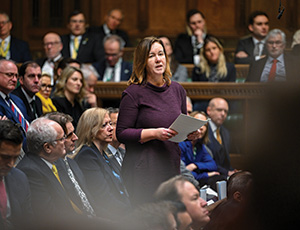
© House of Commons, CC BY-NC-ND 2.0
Significantly, with regard to hanging, updated guidance from the College of Policing directs crime scene investigators to establish the feasibility for a body to have been suspended from where it was discovered or described to have been discovered without making assumptions thereby introducing cognitive bias (Suicide and bereavement response, College of Policing, updated 30 January 2026). This is an important learning and salient reminder of the erroneous presumptions made in the Gilfoyle case. Norman Edward Gilfoyle’s wife, Paula Gilfoyle, was found hanging in the garage of the marital home. Suicide was presumed until expert evidence on the knotting of the ligature concluded that it was impossible to have been tied by the Ms Gilfoyle herself which then led to further investigation of her suicide note, later discovered to have been orchestrated by the actions of the accused. Gilfoyle was later convicted of murder, upheld (R v Norman Edward Gilfoyle [2000] 12 WLUK 609 and R (on the application of Gilfoyle) v Criminal Cases Review Commission [2017] EWHC 3008 (Admin)).
Increasingly, the role of the coroner is pivotal in the process of explanation. In March, senior coroner Samantha Marsh, concerning the death of Joanna Hillard by suicide, recorded:
‘I am concerned that there is a lack of understanding of the effects of controlling and coercive behaviour on a person’s ability to make a decision... people who live in a level of fear (resultant from coercive and controlling behaviour) may have their decision-making abilities negatively affected and the law surrounding capacity, as currently drafted, does not recognise this.' (Joanna Hillard Prevention of future deaths report, 5 March 2026)
Victim’s families are exercising the right to review prosecution and inquest decision-making. Assistant coroner Samantha Broadfoot KC, following a second inquest in July 2023 into the death of Kellie Sutton who took her own life in 2017 after domestic abuse, ruled that she was ‘unlawfully killed’. The first inquest was quashed in July 2020 due to a procedural irregularity in the failure to recognise Steven Gane as an interested party (Kellie Sutton: Prevention of future deaths report, 30 April 2024). Gane, although not charged with manslaughter, was convicted of assault and coercive control in March 2018. HHJ Philip Grey said Gane had ‘driven her to suicide’ (‘Jury concludes that Kellie Sutton was unlawfully killed in self-inflicted death following domestic abuse’, 6 July 2023, Bhatt Murphy).
In R (on the Application of Margaret Hunter and Another) v HM Assistant Coroner for County Durham and Darlington [2024] EWHC 1275 (Admin) a mother brought a successful judicial review application which allowed a change to be made to the original finding about her daughter Roisin Hunter Bennett’s suicide to reflect that: ‘her low mood was the result of an abusive relationship’.
The coroner’s inquest concerning Ms Baird may resume but inquests rarely return a verdict inconsistent with a jury’s verdict and, following the acquittal in Trybus, may be constrained as to what can be said about why Ms Baird took her life. However, in R (Makki) v HM Senior Coroner for South Manchester [2023] EWHC 80, regarding a resumed inquest (para 8(5), Sch 1, Coroners and Justice Act 2009), the court asserted [37]: ‘A conclusion made on the civil standard of proof of an unlawful killing does not run contrary to a jury’s acquittal of the offence applying the criminal standard of proof.’
More recently, in R (O’Brien) v HM Assistant Coroner for Sefton, Knowlsey and St Helens [2026] EWCA Civ 499, the court held that the coroner had applied an incorrect approach to causation by deciding there was no connection between Merseyside Police’s failure to arrest Alan McMahon for breaching a restraining order and Linda O’Brien’s death after falling from her flat window.
Given the number of suicides where domestic abuse is a factor, prosecutions for assault and coercive control – at the least – should be routine. For homicide prosecutions to become commonplace, evidence of prior abuse will need to be observed, documented and witnessed in time by third parties; jurors will need to be better educated; and causation needs to be understood in its context. The findings in R (O’Brien) deserve full consideration.
*
The Domestic Homicide Project
In April 2026, the Domestic Homicide Project (England and Wales) published its fifth annual report. The national project examines all deaths identified by police as domestic abuse-related to improve understanding of risk indicators, and victim and perpetrator demographics.
For the third year running, suspected suicides following domestic abuse (SVSDA) overtook the number of homicides involving current or former partners. The increase, the project says, reflects improved awareness and recording of suicides after a change in practice last year. Officers are now required to check for a history of domestic abuse at the scene of suicides and unexpected deaths.
The report also identified an increase in investigations and charges related to domestic abuse after the victim’s death. Across the five-year dataset, 17 cases of SVSDA successfully achieved a posthumous charge for domestic abuse-related offences, with three of these simultaneously pursuing further investigations for unlawful manslaughter.
Helplines and support
In the UK, Samaritans can be contacted on freephone 116 123. The freephone, 24-hour National Domestic Abuse Helpline is 0808 2000 247 or visit www.nationaldomesticviolencehelpline.org.uk. To locate an international helpline, please visit befrienders.org.

‘Can a partner be held criminally responsible for the death of a victim who has taken their own life following a course of domestic abuse?’ asked prosecutor Laura Buchan.
On 2 March 2026, at the High Court in Glasgow, the jury thought so and convicted Lee Milne of ‘culpable homicide’, followed by an eight-year sentence. The prosecution was able to prove that his deliberate and violent abuse of his wife Kimberly was a significant contributory factor in her death. Ms Milne had jumped from a bridge to her death to escape the car that he was driving at her. Other manslaughter trials involving domestic abuse-induced suicide of a partner are pending. Seyhan Assaf awaits trial charged with unlawfully killing his partner Gillian Morand, which he denies. It is alleged that domestic abuse suffered by Ms Morand over a significant period of time contributed to her death by suicide in 2020.
Earlier trials in such circumstances have either secured manslaughter convictions on guilty pleas or else failed to establish causation and defendants were acquitted. In R v Cenci (1989) 11 Cr App R (S) 199, a female partner, in escaping further violence from her boyfriend, smashed a window with an iron and fell to her death. A plea of involuntary manslaughter was accepted and a ten-year sentence of imprisonment was reduced to five years.
In 2017, Nicholas Allen was convicted of the manslaughter of Justene Reece following a guilty plea (see Staffordshire Police statement, ‘Publication of Domestic Homicide Review following the death of Justene Reece’, 18 November 2021).
It was the case of R v Dhaliwal [2006] EWCA Crim 1139, where a wife committed suicide following a husband’s long-term abuse of her, that established a bright line where the Court of Appeal said per curiam:
‘[8] Unlawful violence on an individual with a fragile and vulnerable personality which is proved to be a material cause of death, even if the result of suicide, is arguably capable of amounting to manslaughter ’ (emphasis added).
Legal submissions were constructed around evidence of psychological harm. The court required a higher threshold of psychiatric injury to establish the unlawful act within the meaning of Offences Against the Person Act 1861, ss 18, 20 and 47. The prosecution failed and the court ruled no case to answer, upheld on appeal.
Since then, there have been few contested trials for manslaughter. In January 2025 Ryan Wellings was aquitted of the manslaughter of his partner Kiena Dawes, who took her own life on 22 July 2022. He was sentenced to six years for coercive and controlling conduct and assault. In her suicide note Ms Dawes wrote: ‘Ryan Wellings killed me. He ruined every bit of strength I had left.’ Sentencing, HHJ Altham said that Wellings had repeatedly told Ms Dawes that ‘she may as well kill herself’ and cited horrific examples of Wellings’ actual and threatened violence towards her. He went on to say:
‘... On the jury’s verdict that assault did not cause Ms Dawes’ death... However, from May 2020 until her death you abused, assaulted, exploited, controlled and demeaned her. When she died it is clear that she had begun to believe your lies to the effect that she was deranged, physically disgusting, friendless, worthless and an unfit mother. You had persuaded her that she had no one to turn to. Of course none of what you made her believe was true... ’ (Rex v Ryan Wellings sentencing remarks 16 January 2025)
Prosecutors have charged defendants with lesser offences securing convictions following domestic abuse-induced suicide. Marc Masterton in 2023 received a 41-month sentence after a guilty plea for coercive conduct, following the death of Chloe Holland, who lost her life to domestic abuse-induced suicide. ‘Masterton would routinely control her appearance, assault her, isolate her from friends and family, belittle her, and shockingly tell her to take her own life’ (Hampshire & Isle of Wight Constabulary, 10 October 2023).
On 9 June 2023, Skye Nicholls was found dead by suicide. James Edwards pleaded guilty to two counts of controlling or coercive behaviour and his sentence was reduced to 21 months (R v Edwards (James), 2026 WL 00814619). In text messages he told her to die and said nobody would miss her and that she should kill herself [7]. The roll call goes on.
While coercive control is more widely understood, counterintuitively the false allegation hypothesis endures. On 22 April 2026, a Winchester jury in the trial of Christopher Trybus, whose wife Tarryn Baird ended her life by hanging in November 2017, following 40 hours and eight minutes of deliberations, returned not guilty verdicts on all counts of manslaughter, rape and coercive control. Tom Little KC prosecuting argued that Trybus’s abuse of Ms Baird was a significant contributory factor in her death, submitting evidence that she suffered physical, mental, sexual abuse and controlling conduct documented in reports she had made to police, her GP and a Women’s Aid worker and relayed to family and friends.
The defence claimed the prosecution case was based on ‘false allegations’, ‘a dogma and agenda that when women allege violence and domestic abuse, they must be telling the truth’ and that the bruising she sustained was self-inflicted. Explaining the injuries observed by the GP, Trybus said his wife ‘bruised easily’ and that injury to the neck was caused by consensual ‘kinky sex’. Explaining his wife’s allegations of his violence, Trybus said that she was unstable and ‘probably’ suffered from PTSD following witnessing an armed carjacking incident in South Africa in 2015 and an attempted burglary.
What drives the cognitive process? What orchestrates partiality? Presumably the jury considered the false allegation ‘dogma’ compelling, though any causal thread between Ms Baird witnessing a past carjacking and attempted burglary (without the counterfactual conditional in Trybus’s alleged abuse), her making allegations of his abuse and committing suicide, is fanciful. (‘Husband cleared of manslaughter over wife’s suicide’, BBC News, 22 April 2026.)
While the culpability of a domestic abuse perpetrator in domestic abuse suicide cases may seem overwhelming (contra Trybus), the law on legal causation in manslaughter is less sanguine, requiring evidence of a causal link between the death and the defendant’s conduct which the prosecution must prove to the criminal standard. The conduct need not be the only or principal cause, but it must be more than ‘de minimus’ (R v Hennigen [1971] 3 All ER 133, 135f); more than negligible or minimal (Crown Court Compendium 2026). Littered with equivocal language – ‘proximate’, ‘significant’ (Hooper LJ in Warburton [30]) and ‘operative’ – it is easy to appreciate that causation is devoid of a uniform theory. As Lords Toulson and Hughes in R v Hughes (Michael) [2013] UKSC 56 [20]) said: ‘It is heavily context-specific, and Parliament or the courts may apply different rules in different situations.’
Finding/inferring causation depends on marshalling and selecting facts in a context where there are a number of contributory factors; defence and prosecution focusing on different trajectives. Defence pleadings focus on voluntarism drawing on evidence of suicidality, instability and trauma sufficient to break the chain of causation (see R v Kennedy (No 2) [2007] UKHL 38, R v Wallace [2018] EWCA Crim 690). Where there is a background of domestic abuse/coercion, including gaslighting and psychological abuse, a presumption of voluntarism is ill-founded since the deceased’s act is committed in the absence of free will or capacity under states of inducement and entrapment devoid of a free, voluntary and informed choice (Kennedy [15] – note emphasis on ‘context’, and ‘truly free’ as per Wallace [61]).
The law on this point is yet to be tested further following R v Field [2026] EWCA Crim 413 (not a ‘conventional’ domestic abuse-induced suicide) where the Court of Appeal quashed the murder conviction on the ground that the jury were/may have been improperly directed [64]); directed a retrial [66]; and certified that a point of law of general public importance be considered by the Supreme Court [65] (per s 33(2) Criminal Appeal Act 1968). Benjamin Field was convicted of the murder of Peter Farquhar in 2019 by forcing or deceiving him into taking whisky or medication before his death. Significantly, the Court of Appeal [61] made reference to the cases coming before the courts involving allegations of homicide by causing death where death was the result of suicide following a lengthy period of domestic abuse.
Theories of ‘why suicide?’ influence the search for evidence, determination of what is relevant, direct case building, public policy and preventive strategy. Twentieth century theorisations, dominated by Emile Durkheim’s On Suicide (1897), were rooted in social causes, later superseded by a medical model and psychiatric nosology focusing on prior endogenous instability. While an orchestral gamut of social and psychological factors including grief, bereavement, ‘unhappy marriage’, unemployment, redundancy, betrayal, despondency, despair and mental illness are all considered relevant, no theory or study, until now, has recognised domestic abuse/coercion and entrapment as contributive and causal. In the last ten years suicide has been reimagined by domestic homicide reviews and research disrupting accepted thinking in the search for causality (see J Rowlands, S Dangar, ‘The challenges and opportunities of reviewing domestic abuse-related deaths by suicide in England and Wales’ Journal of Family Violence (2024) 39:723). In 2025, the Domestic Homicide Project recorded 150 suspected suicides in England and Wales following intimate partner abuse, up from 98 in 2024 and 93 in 2023.
At the investigation stage, vital evidence which may otherwise indicate homicide or a suicide induced by another’s violence is lost if a suspected suicide is presumed to follow from endogenous factors. In March, the Liberal Democrat Women and Equality spokesperson Marie Goldman MP (pictured below) tabled an amendment to the Crime and Policing Bill: ‘If there is reasonable suspicion that a death by suicide has been preceded by history of domestic abuse committed against the person by another person the relevant police force must investigate that suicide as if it were a potential homicide.’ (‘UK parliament to debate whether all suicides linked to domestic abuse to be investigated as homicide’, The Guardian, 3 March 2026.)
© House of Commons, CC BY-NC-ND 2.0
Significantly, with regard to hanging, updated guidance from the College of Policing directs crime scene investigators to establish the feasibility for a body to have been suspended from where it was discovered or described to have been discovered without making assumptions thereby introducing cognitive bias (Suicide and bereavement response, College of Policing, updated 30 January 2026). This is an important learning and salient reminder of the erroneous presumptions made in the Gilfoyle case. Norman Edward Gilfoyle’s wife, Paula Gilfoyle, was found hanging in the garage of the marital home. Suicide was presumed until expert evidence on the knotting of the ligature concluded that it was impossible to have been tied by the Ms Gilfoyle herself which then led to further investigation of her suicide note, later discovered to have been orchestrated by the actions of the accused. Gilfoyle was later convicted of murder, upheld (R v Norman Edward Gilfoyle [2000] 12 WLUK 609 and R (on the application of Gilfoyle) v Criminal Cases Review Commission [2017] EWHC 3008 (Admin)).
Increasingly, the role of the coroner is pivotal in the process of explanation. In March, senior coroner Samantha Marsh, concerning the death of Joanna Hillard by suicide, recorded:
‘I am concerned that there is a lack of understanding of the effects of controlling and coercive behaviour on a person’s ability to make a decision... people who live in a level of fear (resultant from coercive and controlling behaviour) may have their decision-making abilities negatively affected and the law surrounding capacity, as currently drafted, does not recognise this.' (Joanna Hillard Prevention of future deaths report, 5 March 2026)
Victim’s families are exercising the right to review prosecution and inquest decision-making. Assistant coroner Samantha Broadfoot KC, following a second inquest in July 2023 into the death of Kellie Sutton who took her own life in 2017 after domestic abuse, ruled that she was ‘unlawfully killed’. The first inquest was quashed in July 2020 due to a procedural irregularity in the failure to recognise Steven Gane as an interested party (Kellie Sutton: Prevention of future deaths report, 30 April 2024). Gane, although not charged with manslaughter, was convicted of assault and coercive control in March 2018. HHJ Philip Grey said Gane had ‘driven her to suicide’ (‘Jury concludes that Kellie Sutton was unlawfully killed in self-inflicted death following domestic abuse’, 6 July 2023, Bhatt Murphy).
In R (on the Application of Margaret Hunter and Another) v HM Assistant Coroner for County Durham and Darlington [2024] EWHC 1275 (Admin) a mother brought a successful judicial review application which allowed a change to be made to the original finding about her daughter Roisin Hunter Bennett’s suicide to reflect that: ‘her low mood was the result of an abusive relationship’.
The coroner’s inquest concerning Ms Baird may resume but inquests rarely return a verdict inconsistent with a jury’s verdict and, following the acquittal in Trybus, may be constrained as to what can be said about why Ms Baird took her life. However, in R (Makki) v HM Senior Coroner for South Manchester [2023] EWHC 80, regarding a resumed inquest (para 8(5), Sch 1, Coroners and Justice Act 2009), the court asserted [37]: ‘A conclusion made on the civil standard of proof of an unlawful killing does not run contrary to a jury’s acquittal of the offence applying the criminal standard of proof.’
More recently, in R (O’Brien) v HM Assistant Coroner for Sefton, Knowlsey and St Helens [2026] EWCA Civ 499, the court held that the coroner had applied an incorrect approach to causation by deciding there was no connection between Merseyside Police’s failure to arrest Alan McMahon for breaching a restraining order and Linda O’Brien’s death after falling from her flat window.
Given the number of suicides where domestic abuse is a factor, prosecutions for assault and coercive control – at the least – should be routine. For homicide prosecutions to become commonplace, evidence of prior abuse will need to be observed, documented and witnessed in time by third parties; jurors will need to be better educated; and causation needs to be understood in its context. The findings in R (O’Brien) deserve full consideration.
*
The Domestic Homicide Project
In April 2026, the Domestic Homicide Project (England and Wales) published its fifth annual report. The national project examines all deaths identified by police as domestic abuse-related to improve understanding of risk indicators, and victim and perpetrator demographics.
For the third year running, suspected suicides following domestic abuse (SVSDA) overtook the number of homicides involving current or former partners. The increase, the project says, reflects improved awareness and recording of suicides after a change in practice last year. Officers are now required to check for a history of domestic abuse at the scene of suicides and unexpected deaths.
The report also identified an increase in investigations and charges related to domestic abuse after the victim’s death. Across the five-year dataset, 17 cases of SVSDA successfully achieved a posthumous charge for domestic abuse-related offences, with three of these simultaneously pursuing further investigations for unlawful manslaughter.
Helplines and support
In the UK, Samaritans can be contacted on freephone 116 123. The freephone, 24-hour National Domestic Abuse Helpline is 0808 2000 247 or visit www.nationaldomesticviolencehelpline.org.uk. To locate an international helpline, please visit befrienders.org.
A decade of reviews and research has disrupted accepted thinking in the search for causality. Suicides following abuse have overtaken domestic homicides. Is the law keeping up? Professor Susan Edwards KC (Hon) examines recent cases and the obstacles to successful prosecution

The Chair of the Bar reports back
Susie Griffin on the admin that keeps barristers from billable work
Clement Cowley, Partner at The Penny Group, explains how global events can influence the performance of pensions and ISAs, and why taking a long-term approach to investing is often the most effective strategy
Mário Barroso, Head of R&D and Method Development at AlphaBiolabs, discusses what family law professionals need to know about hallucinogens, from the main hallucinogenic drugs encountered in family proceedings, to their effects and the testing options available
Harmony Christian Ministries is the latest charity to benefit from a £500 donation from AlphaBiolabs via the company’s Giving Back initiative
By David Green

At the start of her term, Chair of the Bar 2026 Kirsty Brimelow KC set out a series of priorities for the year ahead. One of those priorities was children in the justice system
As the world becomes more digital, Barbara Vinagre Mota examines international research into the mental health consequences of judges’ exposure to graphic and immersive evidence, highlighting the importance of support systems
In an era of patient-centred care and growing concern over misconduct in medical settings, why do women still lack the right to choose women consultants for examination and treatment? Charles Davey investigates
Reviewed by Daniel Barnett
James McNeill Whistler at Tate Britain until 27 September Rothko in Florence at Palazzo Strozzi until 23 August Reviewed by Stephen Cragg KC