*/
Are conclusions drawn from earnings data at risk of survivorship bias? asks James Hatt
I would like to use this article to suggest that the current approach to thinking about the gender earnings gap at the Bar, with no regard for part-time working, has the potential to make matters worse, rather than better, for women barristers, and I want to propose that we collect and discuss entirely different data instead.
© Bar Council
© McGeddon - Own work, CC BY-SA 4.0
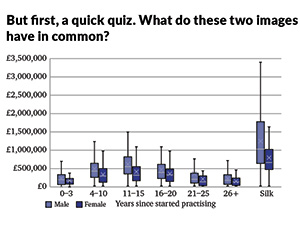
If you have read the Bar Council’s report, Gross earnings by sex and practice area at the self-employed Bar 2024 then you might recognise the first image: it’s the graph illustrating the differences between male and female earnings at the Chancery and commercial Bar.
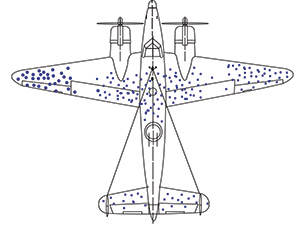
If you have spent time online, then you might recognise the second image: it’s a representation of the location of damage recorded on US naval aircraft on returning from combat missions during World War II.
It might seem as if there is no link between these two images, but I think there is. In order to explain it, I will need to say a little bit more about the picture of the plane with the blue dots.
During the War (so the story goes), Allied researchers carefully ascertained the areas where returning planes had sustained most damage, producing images such as the plane to the left. The researchers then recommended adding more armour to the damaged areas on the basis that they were the areas most in need of protection.
But the statistician Abraham Wald saw things differently. His reasoning was that the planes that had returned after missions and had then been examined by researchers were precisely those that had not been lost in combat. It followed that the damage that they had sustained was in areas that did not need reinforcing. If additional armour was needed, it was in the areas with no blue dots, as the planes that had been hit in those areas must be the ones that did not return to base.
The story itself may have been embellished, but it illustrates a deeper truth about ‘survivorship bias’, i.e., what Wikipedia describes as the ‘error of concentrating on entities that passed a selection process while overlooking those that did not’. (The image of the plane with the blue dots comes from Wikipedia’s entry on survivorship bias.) As Wikipedia says, ‘This can lead to incorrect conclusions because of incomplete data.’
I hope that by now the link between the two images is clear. All of the data points in the Bar Council’s graph represent ‘survivors’, that is to say, barristers who have continued in self-employed practice. There are no data points on the graph for those who have left the Bar entirely. Any conclusions we might draw from such data are therefore at risk of suffering from survivorship bias: by concentrating on how to solve the earnings gap between the men and women who have made it through to an established practice, or even taken silk, we may be ignoring the problems of those who never make it that far in the first place.
Perhaps the largest single problem of that kind is the difficulty of combining life as a barrister with life as a new mother. It is hardly a secret that it can seem impossible to combine babies and barrister-ing. Take, for example, Joanna Hardy-Susskind’s widely researched article in the November 2024 issue of Counsel magazine, ‘Where have all the criminal barristers gone?’, which states: ‘Mothers either wanting or raising babies struggled to see how the job could fit with new responsibilities’, or, more anecdotally, Caighli Taylor’s article ‘Shaping a part-time criminal practice’ in the series about parenthood in the November 2025 issue of Counsel, which states: ‘I had long thought that returning to the criminal Bar after maternity leave would present insurmountable challenges.’
When women have been able to return to work with young children, the solution often involves part-time working, at least for a while. Here are some sample quotations from the November 2025 articles in Counsel: ‘An early decision that proved effective was to work Wednesday to Friday’; ‘For the first six months I decided I wanted to work three days a week, Tuesday-Thursday, with Mondays and Fridays untouchable’; ‘I’ve slowly returned to practice over the past few months, working just one day a week to begin with and increasing this to two.’
Again, this is hardly a secret. I wrote an article for Counsel back in July 2021 entitled ‘A court system fit for big-league, part-time work’. The aim of my piece was to put forward some ideas for pushing back against the long-hours culture at the Bar which, it seemed to me, was one of the significant causes of poor female retention at the Bar. (The ability to work part-time is, of course, also valuable for many people other than mothers, in particular fathers or others with caring responsibilities.)
Unfortunately, I am not sure that much has changed in the last few years. So, for example, near the end of her 2024 article, Hardy-Susskind asks: ‘Can I imagine a woman standing up in a courtroom full of men and saying, no, she could not keep sitting late as her child’s nursery place depended on punctuality?’ Her answer was that she struggled to see it. I struggle too.
Another example of my fears is this question from the Bar Council’s recent Barristers’ Working Lives Survey 2025:
The apparent premise for this question is that regular full-time work (which, let us remember, is the norm for most working people, even people with responsible professional jobs) will be towards the bottom end of the spectrum. The compilers of the questionnaire plainly considered that there would be such large numbers of barristers who work long hours on six or even seven days a week that it was worth creating separate categories for them. By contrast, part-time work, which can cover anything from a few hours to 4.5 days a week, was envisaged as affecting a small number of people unworthy of further categorisation.
Now let us imagine ourselves in the position of someone in a position of responsibility trying to solve the gender earnings gap. What does the solution look like?
That is a conceptually simple question. This is a profession in which income is largely a function of hours (or days) worked multiplied by hourly (or daily) rate charged. Closing the gender earnings gap therefore almost inevitably means achieving circumstances in which either men work fewer hours or, being realistic, women work more hours. Those extra hours of work could come out of unpaid or lower-paid professional commitments, such as pro bono, committee or part-time judicial work, or they could come out of time spent not working at all, such as family time or sleep, but either way, that’s what a solution to the gender earnings gap looks like: more time billing and less time doing other things.
The tension here is obvious. Trying to close the gender earnings gap means getting women to work more hours; but improving female retention means increasing the ability of women to work fewer hours – and not merely giving them the option of working fewer hours but allowing them to do so without feeling that they are being left behind or not pulling their weight. (I strongly suspect that having more men who worked part-time – and loudly said so – would help with this.)
It is worth stressing that the Bar Council’s calculation of the gender earnings gap explicitly does not take into account differences in hours worked. (The report notes: ‘There are differences in working patterns between men and women at the Bar. More women (14%) than men (8%) describe themselves as working “part-time’’,’ which, it says, ‘may explain some of the disparity in earning’, but it does not attempt to analyse the effect.) That means that if a woman moves to working part-time, even if she earns the same pro rata, she ‘worsens’ the gender earnings gap. Conversely, any woman who has been working part-time, but struggling, will find that if she finally throws in the towel and moves to a different profession with a better approach to work-life balance then she has ‘improved’ the gender earnings gap. (Equally, it seems ridiculous to suggest that that whenever I spend time with my family then in some way I improve the situation of my female colleagues.)
It seems to me that it sends entirely the wrong signal to collect and present data in the way we have been doing. No woman who attempts the tricky job of combining motherhood with a professional job should find herself worsening some perceived injustice by doing so. But that is the effect of the current data.
I therefore want to propose the following alternatives.
First, it is of course very important to identify whether women are being treated worse than men, but we need do that properly. Surely the starting point is to see whether there is a pro rata gender earnings gap and, if so, where? I therefore propose that every barrister should be asked for their most recently charged hourly and refresher rates when filling in their annual authorisation to practise (AtP) form. (The Bar Council data is taken from the AtP process.) By that I mean the actual rates in fact charged, not just an indicative band quoted by a clerk. We all know that these rates vary from case to case, but such variations even themselves out and with enough data it should be possible to see whether men and women of similar experience are being charged out at similar rates. That would enable us to see precisely where the underlying problems lie.
Second, questions about working hours should not be phrased as if part-time working is an unusual ‘none of the above’-type residual category. The next Barristers Working Lives survey should therefore simply ask ‘how many hours do you work in a typical week?’ The variation among part-time work is surely at least as interesting as that between the various kinds of workaholic.
Third, it is surely also important to know whether there is a gap between men and women in terms of whether they are working as many hours as they want to work. At a time when concerns about wellbeing and stress are receiving increased attention, we are interested not merely in whether women are getting in as many billable hours as men, but whether men and women are finding themselves over-worked, under-worked or perhaps even getting the balance right. A gender wellbeing gap is – surely? – every bit as interesting as a gender earnings gap. The next survey should therefore ask: ‘are you working broadly as many hours a week/year as you would wish, or too many, or too few?’
I would hope that if we had reliable data on pro rata earnings, working hours variation and actual versus desired workload then we would find ourselves much better able to solve the underlying problems that face women at the Bar. I fear that, in the meantime, policy-makers and decision-makers are navigating in the dark, trying to steer between crude measures of ‘more work’ or ‘less work’, without making the changes that will help to create more survivors at the Bar of the future.
Bar Council, Gross earnings by sex and practice area at the self-employed Bar 2024
‘Where have all the criminal barristers gone?’, Joanna Hardy-Susskind, Counsel, November 2024
‘Shaping a part-time criminal practice’, Caighli Taylor, Counsel, November 2025
Counsel, November 2025 (full issue)
‘A court system fit for big-league, part-time work’, James Hatt, Counsel, July 2021
The Inner Temple Movers and Returners Podcast
Support and practical advice for barristers planning, managing or returning from a break in practice, as well as those transferring between practice areas or chambers.Hosted by practitioners, each episode features guests with expertise and lived experience in moving and returning: www.innertemple.org.uk/podcast.

James Hatt is a barrister at 4 Pump Court and father to three school-age children. His wife also works in the law.
I would like to use this article to suggest that the current approach to thinking about the gender earnings gap at the Bar, with no regard for part-time working, has the potential to make matters worse, rather than better, for women barristers, and I want to propose that we collect and discuss entirely different data instead.
© Bar Council
© McGeddon - Own work, CC BY-SA 4.0
If you have read the Bar Council’s report, Gross earnings by sex and practice area at the self-employed Bar 2024 then you might recognise the first image: it’s the graph illustrating the differences between male and female earnings at the Chancery and commercial Bar.
If you have spent time online, then you might recognise the second image: it’s a representation of the location of damage recorded on US naval aircraft on returning from combat missions during World War II.
It might seem as if there is no link between these two images, but I think there is. In order to explain it, I will need to say a little bit more about the picture of the plane with the blue dots.
During the War (so the story goes), Allied researchers carefully ascertained the areas where returning planes had sustained most damage, producing images such as the plane to the left. The researchers then recommended adding more armour to the damaged areas on the basis that they were the areas most in need of protection.
But the statistician Abraham Wald saw things differently. His reasoning was that the planes that had returned after missions and had then been examined by researchers were precisely those that had not been lost in combat. It followed that the damage that they had sustained was in areas that did not need reinforcing. If additional armour was needed, it was in the areas with no blue dots, as the planes that had been hit in those areas must be the ones that did not return to base.
The story itself may have been embellished, but it illustrates a deeper truth about ‘survivorship bias’, i.e., what Wikipedia describes as the ‘error of concentrating on entities that passed a selection process while overlooking those that did not’. (The image of the plane with the blue dots comes from Wikipedia’s entry on survivorship bias.) As Wikipedia says, ‘This can lead to incorrect conclusions because of incomplete data.’
I hope that by now the link between the two images is clear. All of the data points in the Bar Council’s graph represent ‘survivors’, that is to say, barristers who have continued in self-employed practice. There are no data points on the graph for those who have left the Bar entirely. Any conclusions we might draw from such data are therefore at risk of suffering from survivorship bias: by concentrating on how to solve the earnings gap between the men and women who have made it through to an established practice, or even taken silk, we may be ignoring the problems of those who never make it that far in the first place.
Perhaps the largest single problem of that kind is the difficulty of combining life as a barrister with life as a new mother. It is hardly a secret that it can seem impossible to combine babies and barrister-ing. Take, for example, Joanna Hardy-Susskind’s widely researched article in the November 2024 issue of Counsel magazine, ‘Where have all the criminal barristers gone?’, which states: ‘Mothers either wanting or raising babies struggled to see how the job could fit with new responsibilities’, or, more anecdotally, Caighli Taylor’s article ‘Shaping a part-time criminal practice’ in the series about parenthood in the November 2025 issue of Counsel, which states: ‘I had long thought that returning to the criminal Bar after maternity leave would present insurmountable challenges.’
When women have been able to return to work with young children, the solution often involves part-time working, at least for a while. Here are some sample quotations from the November 2025 articles in Counsel: ‘An early decision that proved effective was to work Wednesday to Friday’; ‘For the first six months I decided I wanted to work three days a week, Tuesday-Thursday, with Mondays and Fridays untouchable’; ‘I’ve slowly returned to practice over the past few months, working just one day a week to begin with and increasing this to two.’
Again, this is hardly a secret. I wrote an article for Counsel back in July 2021 entitled ‘A court system fit for big-league, part-time work’. The aim of my piece was to put forward some ideas for pushing back against the long-hours culture at the Bar which, it seemed to me, was one of the significant causes of poor female retention at the Bar. (The ability to work part-time is, of course, also valuable for many people other than mothers, in particular fathers or others with caring responsibilities.)
Unfortunately, I am not sure that much has changed in the last few years. So, for example, near the end of her 2024 article, Hardy-Susskind asks: ‘Can I imagine a woman standing up in a courtroom full of men and saying, no, she could not keep sitting late as her child’s nursery place depended on punctuality?’ Her answer was that she struggled to see it. I struggle too.
Another example of my fears is this question from the Bar Council’s recent Barristers’ Working Lives Survey 2025:
The apparent premise for this question is that regular full-time work (which, let us remember, is the norm for most working people, even people with responsible professional jobs) will be towards the bottom end of the spectrum. The compilers of the questionnaire plainly considered that there would be such large numbers of barristers who work long hours on six or even seven days a week that it was worth creating separate categories for them. By contrast, part-time work, which can cover anything from a few hours to 4.5 days a week, was envisaged as affecting a small number of people unworthy of further categorisation.
Now let us imagine ourselves in the position of someone in a position of responsibility trying to solve the gender earnings gap. What does the solution look like?
That is a conceptually simple question. This is a profession in which income is largely a function of hours (or days) worked multiplied by hourly (or daily) rate charged. Closing the gender earnings gap therefore almost inevitably means achieving circumstances in which either men work fewer hours or, being realistic, women work more hours. Those extra hours of work could come out of unpaid or lower-paid professional commitments, such as pro bono, committee or part-time judicial work, or they could come out of time spent not working at all, such as family time or sleep, but either way, that’s what a solution to the gender earnings gap looks like: more time billing and less time doing other things.
The tension here is obvious. Trying to close the gender earnings gap means getting women to work more hours; but improving female retention means increasing the ability of women to work fewer hours – and not merely giving them the option of working fewer hours but allowing them to do so without feeling that they are being left behind or not pulling their weight. (I strongly suspect that having more men who worked part-time – and loudly said so – would help with this.)
It is worth stressing that the Bar Council’s calculation of the gender earnings gap explicitly does not take into account differences in hours worked. (The report notes: ‘There are differences in working patterns between men and women at the Bar. More women (14%) than men (8%) describe themselves as working “part-time’’,’ which, it says, ‘may explain some of the disparity in earning’, but it does not attempt to analyse the effect.) That means that if a woman moves to working part-time, even if she earns the same pro rata, she ‘worsens’ the gender earnings gap. Conversely, any woman who has been working part-time, but struggling, will find that if she finally throws in the towel and moves to a different profession with a better approach to work-life balance then she has ‘improved’ the gender earnings gap. (Equally, it seems ridiculous to suggest that that whenever I spend time with my family then in some way I improve the situation of my female colleagues.)
It seems to me that it sends entirely the wrong signal to collect and present data in the way we have been doing. No woman who attempts the tricky job of combining motherhood with a professional job should find herself worsening some perceived injustice by doing so. But that is the effect of the current data.
I therefore want to propose the following alternatives.
First, it is of course very important to identify whether women are being treated worse than men, but we need do that properly. Surely the starting point is to see whether there is a pro rata gender earnings gap and, if so, where? I therefore propose that every barrister should be asked for their most recently charged hourly and refresher rates when filling in their annual authorisation to practise (AtP) form. (The Bar Council data is taken from the AtP process.) By that I mean the actual rates in fact charged, not just an indicative band quoted by a clerk. We all know that these rates vary from case to case, but such variations even themselves out and with enough data it should be possible to see whether men and women of similar experience are being charged out at similar rates. That would enable us to see precisely where the underlying problems lie.
Second, questions about working hours should not be phrased as if part-time working is an unusual ‘none of the above’-type residual category. The next Barristers Working Lives survey should therefore simply ask ‘how many hours do you work in a typical week?’ The variation among part-time work is surely at least as interesting as that between the various kinds of workaholic.
Third, it is surely also important to know whether there is a gap between men and women in terms of whether they are working as many hours as they want to work. At a time when concerns about wellbeing and stress are receiving increased attention, we are interested not merely in whether women are getting in as many billable hours as men, but whether men and women are finding themselves over-worked, under-worked or perhaps even getting the balance right. A gender wellbeing gap is – surely? – every bit as interesting as a gender earnings gap. The next survey should therefore ask: ‘are you working broadly as many hours a week/year as you would wish, or too many, or too few?’
I would hope that if we had reliable data on pro rata earnings, working hours variation and actual versus desired workload then we would find ourselves much better able to solve the underlying problems that face women at the Bar. I fear that, in the meantime, policy-makers and decision-makers are navigating in the dark, trying to steer between crude measures of ‘more work’ or ‘less work’, without making the changes that will help to create more survivors at the Bar of the future.
Bar Council, Gross earnings by sex and practice area at the self-employed Bar 2024
‘Where have all the criminal barristers gone?’, Joanna Hardy-Susskind, Counsel, November 2024
‘Shaping a part-time criminal practice’, Caighli Taylor, Counsel, November 2025
Counsel, November 2025 (full issue)
‘A court system fit for big-league, part-time work’, James Hatt, Counsel, July 2021
The Inner Temple Movers and Returners Podcast
Support and practical advice for barristers planning, managing or returning from a break in practice, as well as those transferring between practice areas or chambers.Hosted by practitioners, each episode features guests with expertise and lived experience in moving and returning: www.innertemple.org.uk/podcast.
Are conclusions drawn from earnings data at risk of survivorship bias? asks James Hatt


The Chair of the Bar reports back
Susie Griffin on the admin that keeps barristers from billable work
Clement Cowley, Partner at The Penny Group, explains how global events can influence the performance of pensions and ISAs, and why taking a long-term approach to investing is often the most effective strategy
Mário Barroso, Head of R&D and Method Development at AlphaBiolabs, discusses what family law professionals need to know about hallucinogens, from the main hallucinogenic drugs encountered in family proceedings, to their effects and the testing options available
Harmony Christian Ministries is the latest charity to benefit from a £500 donation from AlphaBiolabs via the company’s Giving Back initiative
By David Green
At the start of her term, Chair of the Bar 2026 Kirsty Brimelow KC set out a series of priorities for the year ahead. One of those priorities was children in the justice system
As the world becomes more digital, Barbara Vinagre Mota examines international research into the mental health consequences of judges’ exposure to graphic and immersive evidence, highlighting the importance of support systems
In an era of patient-centred care and growing concern over misconduct in medical settings, why do women still lack the right to choose women consultants for examination and treatment? Charles Davey investigates
Reviewed by Daniel Barnett
James McNeill Whistler at Tate Britain until 27 September Rothko in Florence at Palazzo Strozzi until 23 August Reviewed by Stephen Cragg KC