*/


Don’t cry for me, Argentina; cry for your eardrums, because Jamie Lloyd cranks Andrew Lloyd Webber’s rock opera up to a decibel level usually reserved for Glastonbury.
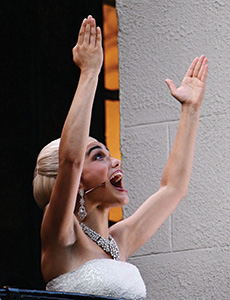
If you stroll down Argyll Street, you may find yourself swept into a throng gazing upward, as Rachel Zegler’s voice soars from the Palladium’s balcony. This moment, which will be talked about in a ‘I was there’ sense for years, is the centerpiece of Lloyd’s radical revival.
Evita is a sung-through musical biography by the powerhouse duo Andrew Lloyd Webber and Tim Rice. Since its 1978 West End debut, the show has become a touchstone of musical theatre, famous for its anthemic score and the enigmatic morality of its heroine. Evita dramatises the meteoric rise and tragic fall of Eva Perón, Argentina’s First Lady in the years following World War 2.
You are plunged into Eva’s world at the moment of her death, as the Argentine nation mourns. Flashbacks propel you into 1930s Argentina, where a teenage Eva Duarte, burning with ambition, claws her way from the provinces to Buenos Aires. The show’s opening numbers, ‘Oh What a Circus’ and ‘Buenos Aires’, set the tone: dazzling, relentless and brimming with contempt. Eva’s journey is a series of calculated seductions; of lovers, of the public, of power itself. She meets and marries Colonel Juan Perón, aligning her fate with his political ascent. Yet she is no mere consort; she becomes a populist icon, adored by the descamisados (the shirtless masses) and reviled by the elite.
As the narrative unfolds, you witness Eva’s transformation from actress to activist, from manipulator to martyr. Songs like ‘Rainbow High’ and ‘A New Argentina’ pulse with the energy of revolution. The show’s second act traces Eva’s philanthropic crusades, her declining health, and the mythmaking that surrounds her. The final moments, spare and haunting, leave you pondering the cost of ambition and the price of adoration.
Rachel Zegler’s Eva embodies the contradictions of a woman who is at once saint and sinner. Her vocal command is astonishing. Her ‘Don’t Cry for Me Argentina’ is jaw-dropping, delivered to both a crowd of spectators in Argyll Street from the Palladium balcony and to the auditorium via a cinematic live feed. Eva is steely, vulnerable, with palpable ambition yet also raw tenderness shown in her dying song, ‘You Must Love Me’.
Diego Andres Rodriguez’s Che Guevara (who narrates the show and acts as its moral compass, although there is no evidence Che and Evita ever met) is magnetic. His performance crackles with sardonic irony and anger; his ‘High Flying, Adored’ a masterclass in understated heartbreak. Rodriguez’s Che is less the revolutionary icon of history and more an everyman, watching and judging.
The choreography is relentless. Dancers stomp, pose and writhe across an industrial staircase set, conjuring both the fervor of a rally and the chaos of a revolution. The ensemble is a living, breathing organism, their movements at times militaristic, at times sensual. Numbers like ‘A New Argentina’ and ‘And the Money Kept Rolling In’ build to ecstatic climaxes, the choreography amplifying the show’s themes of power and spectacle.
Compared to earlier productions, such as Hal Prince and Elaine Page’s original version, Michael Grandage’s Argentine revival or Elena Rogers’ magnificent performance in 2006, this Evita is both more and less. It is more spectacle, more sensation, more risk. It is less concerned with historical accuracy or narrative clarity. In spirit, it recalls the iconoclasm of Cabaret and the raw energy of Spring Awakening, while its use of live video evokes the multimedia wizardry of Lloyd’s Sunset Boulevard.
This is theatre that matters: urgent, unsettling, unforgettable. By the time you read this, I suspect the show will have sold out. But try to get a ticket if you possibly can.

Daniel Barnett practises from Outer Temple Chambers and presents the legal hour on LBC Radio.
Don’t cry for me, Argentina; cry for your eardrums, because Jamie Lloyd cranks Andrew Lloyd Webber’s rock opera up to a decibel level usually reserved for Glastonbury.
If you stroll down Argyll Street, you may find yourself swept into a throng gazing upward, as Rachel Zegler’s voice soars from the Palladium’s balcony. This moment, which will be talked about in a ‘I was there’ sense for years, is the centerpiece of Lloyd’s radical revival.
Evita is a sung-through musical biography by the powerhouse duo Andrew Lloyd Webber and Tim Rice. Since its 1978 West End debut, the show has become a touchstone of musical theatre, famous for its anthemic score and the enigmatic morality of its heroine. Evita dramatises the meteoric rise and tragic fall of Eva Perón, Argentina’s First Lady in the years following World War 2.
You are plunged into Eva’s world at the moment of her death, as the Argentine nation mourns. Flashbacks propel you into 1930s Argentina, where a teenage Eva Duarte, burning with ambition, claws her way from the provinces to Buenos Aires. The show’s opening numbers, ‘Oh What a Circus’ and ‘Buenos Aires’, set the tone: dazzling, relentless and brimming with contempt. Eva’s journey is a series of calculated seductions; of lovers, of the public, of power itself. She meets and marries Colonel Juan Perón, aligning her fate with his political ascent. Yet she is no mere consort; she becomes a populist icon, adored by the descamisados (the shirtless masses) and reviled by the elite.
As the narrative unfolds, you witness Eva’s transformation from actress to activist, from manipulator to martyr. Songs like ‘Rainbow High’ and ‘A New Argentina’ pulse with the energy of revolution. The show’s second act traces Eva’s philanthropic crusades, her declining health, and the mythmaking that surrounds her. The final moments, spare and haunting, leave you pondering the cost of ambition and the price of adoration.
Rachel Zegler’s Eva embodies the contradictions of a woman who is at once saint and sinner. Her vocal command is astonishing. Her ‘Don’t Cry for Me Argentina’ is jaw-dropping, delivered to both a crowd of spectators in Argyll Street from the Palladium balcony and to the auditorium via a cinematic live feed. Eva is steely, vulnerable, with palpable ambition yet also raw tenderness shown in her dying song, ‘You Must Love Me’.
Diego Andres Rodriguez’s Che Guevara (who narrates the show and acts as its moral compass, although there is no evidence Che and Evita ever met) is magnetic. His performance crackles with sardonic irony and anger; his ‘High Flying, Adored’ a masterclass in understated heartbreak. Rodriguez’s Che is less the revolutionary icon of history and more an everyman, watching and judging.
The choreography is relentless. Dancers stomp, pose and writhe across an industrial staircase set, conjuring both the fervor of a rally and the chaos of a revolution. The ensemble is a living, breathing organism, their movements at times militaristic, at times sensual. Numbers like ‘A New Argentina’ and ‘And the Money Kept Rolling In’ build to ecstatic climaxes, the choreography amplifying the show’s themes of power and spectacle.
Compared to earlier productions, such as Hal Prince and Elaine Page’s original version, Michael Grandage’s Argentine revival or Elena Rogers’ magnificent performance in 2006, this Evita is both more and less. It is more spectacle, more sensation, more risk. It is less concerned with historical accuracy or narrative clarity. In spirit, it recalls the iconoclasm of Cabaret and the raw energy of Spring Awakening, while its use of live video evokes the multimedia wizardry of Lloyd’s Sunset Boulevard.
This is theatre that matters: urgent, unsettling, unforgettable. By the time you read this, I suspect the show will have sold out. But try to get a ticket if you possibly can.

The Chair of the Bar reports back
Susie Griffin on the admin that keeps barristers from billable work
Clement Cowley, Partner at The Penny Group, explains how global events can influence the performance of pensions and ISAs, and why taking a long-term approach to investing is often the most effective strategy
Mário Barroso, Head of R&D and Method Development at AlphaBiolabs, discusses what family law professionals need to know about hallucinogens, from the main hallucinogenic drugs encountered in family proceedings, to their effects and the testing options available
Harmony Christian Ministries is the latest charity to benefit from a £500 donation from AlphaBiolabs via the company’s Giving Back initiative
By David Green

The golden age of advocacy? David Langwallner pays homage to the filmic if contentious barrister Sir Edward Carson and some of his contemporaries
Leah Arthur, a pupil, and her second seat supervisor, John Goss, share their perspectives on building a productive pupil-supervisor relationship
Henry Fingerhut outlines what the Bar Standards Board AI guidance means for early career barristers
The Ministry of Justice will match-fund up to 100 criminal pupillages, with grants available to criminal chambers across England and Wales. Similar to the COIC scheme, the grants will match-fund pupillages additional to those otherwise offered without government funding
Not yet, says Jacob Turner. Regulation, unlike the technology itself, is a domain the legal profession can still control