*/

I always say I have seen everything at the Bar – the good, the bad, the ugly – nothing else can shock me. But then it does. I have witnessed the very best and the very worst behaviours over the course of my career. This is why leading by example with integrity is so important. It still surprises me that in applying for silk, integrity appears to be assumed, not checked. I always complete that part of the form, if acting as an assessor.
How you conduct yourself matters. I was fortunate to learn from the best of the best. I did not need to be told how to behave well but was drawn to surround myself and forge connections with those who did. I have made lifelong friends at the Bar.
Barristers operate in high-pressure, high-stakes environments. Stress may be inevitable; toxicity is not. Yet practitioners continue to report experiences that go beyond difficult personalities and enter the realm of sustained harm.
This article is designed to help barristers, chambers, leaders and clerks identify toxic behaviours early, understand why they take root and, crucially, take practical steps to address them.
Empty vessels can make the most noise. They can also try to wield the most power – often bullying – to make up for their own inadequacies. Why do they do it? Of course there can be deep psychological reasons, but let’s not discount the obvious. Character flaws.
The pursuit of money and power in an environment of pressure and competition can drive insecurity (everyone has them, no excuses) to pave the way for the unacceptable, as if it is inevitable.
Whether it parades as those who think they are just better – an inflated ego, more intelligent, successful, talented, gifted, silver-tongued, superior aka arrogant or sit further up the hierarchy – bad (toxic) behaviour is unacceptable.
Wherever it turns up – in chambers, the conference room or the courtroom – toxic behaviour is a punch in the gut. It’s destabilising and has an intensely negative and (ma)lingering impact, being undermined, discounted and deflated. Most often the offender has form, but masquerades under a façade of position or authority.
Bullying in whatever form stings with its inherent humiliation, especially if it occurs in the presence of others, as does the brute statement of power difference it reinforces.
Toxic behaviour is a threat to health, triggering stress and frustration at the devaluation. Chronic stress is linked to cardiovascular disease, insomnia, depressed immunity overeating and excessive drinking. It is deeply disturbing and destabilises us, prompting the belief that it reflects how all others see you.
The trouble is, it can be catching – like bullies in the playground that club together – the bully, the bullied and the bystander.
Toxic people never take responsibility for their actions. They see you as the problem because their own self-interest trumps all else.
The word toxic is defined as poisonous, derived from the Greek meaning for a ‘poisoned arrow’. In other words, to kill (or poison) in a targeted way. Res ipsa loquitur. ‘Toxic’ is a strong term, but most accurate for behaviour that:
Toxicity is not simply someone being demanding or exacting. It is behaviour that corrodes the integrity of the working environment.
Bullying and harassment – central to the Harman Review – was recognised as systemic, not isolated. Behaviours can be overt or subtle:
Gaslighting and manipulation, hallmarks of toxicity, causes individuals to doubt themselves:
No respect for boundaries occurs in hierarchical settings:
Favouritism and punitive decision-making within chambers structures:
A culture of toxicity:
These behaviours can persist at the Bar as structural features can breed toxic behaviours, if left unchecked:
The Harman Report highlighted that many barristers tolerate poor behaviour because they feel there is no safe mechanism for raising concerns and no confidence that concerns will be actioned.
Silence enables toxicity to flourish
Tackling toxicity is a leadership responsibility that requires an action plan:
A. Action standards of expected behaviour – policies, reminders and consequences.
B. Better reporting – confidential, independent routes and protection.
C. Count on people management skills – conflict resolution, feedback and responsibilities.
D. Gatekeep work fairly – monitor, challenge, equitable exposure.
E. Lead by example – respectful communication, awareness and accountability.
(See ‘The Harman Report – recommendations to reality’, Joanna Chatterton and David Murphy, Counsel, February 2026).
Even without formal authority, barristers can take steps to protect themselves and others:
The Harman Report emphasised the importance of independent reporting mechanisms – they exist to be used.
While pathways to report bad behaviour exist, there is so much more to be done to make them effective in achieving the right outcome.
It falls to each of us to know how to recognise nastiness and how to call it out. Handling toxic people is vital to your welfare and to the greater good.
Psychological safety is not optional. It is a professional necessity.
The Harman Report’s message is clear: cultural change is an urgent professional need. Toxic behaviour is not a necessary by-product of excellence. The best chambers understand that a respectful, supportive environment is the foundation for success, sustained performance, ethical practice, diversity, retention and collegiate excellence.
Managing toxic behaviour is not about conflict – it is about safeguarding professionalism. Let’s call time on toxic.
Do right, harm no one.
***
The Bar Council’s Action plan for implementing the Harman Report
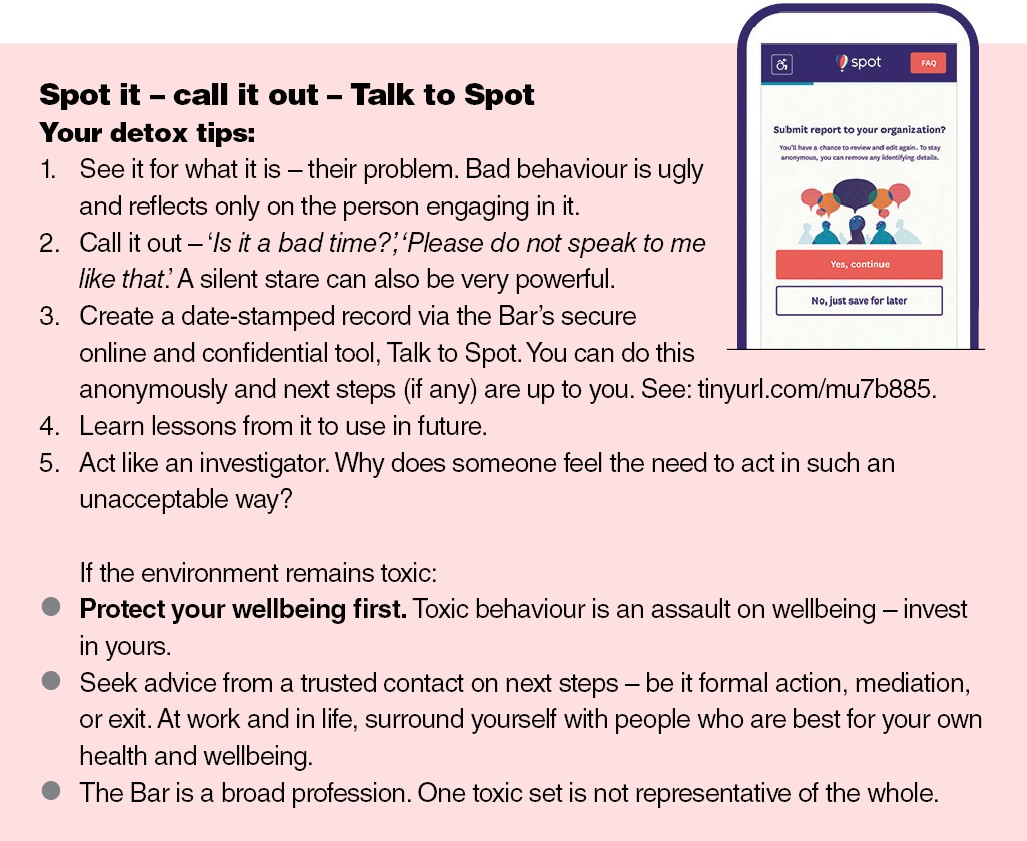
Talk to Spot – the Bar’s secure and confidential online tool to make a date-stamped and anonymous record of an incident or inappropriate behaviour. Next steps are up to you.
The Bar Council’s confidential equality and diversity helpline for pupils and members of the Bar, as well as chambers. Email equality@barcouncil.org.uk You do not need to disclose your name. Find out more here (select ‘Equality and Diversity helpline’ tab).
Wellbeing at the Bar portal – access support, self-help tips and resources for those experiencing or witnessing bullying and harassment. There is also a 24/7 confidential helpline (tel: 0800 169 2040) for self-employed barristers with a practising certificate as well as members of the IBC and LPMA.
LawCare offers peer-to-peer support for anyone in or associated with the legal community. Call: 0800 279 6888 (Mon to Fri 9am to 5pm except bank holidays) or visit www.lawcare.org.uk. The Samaritans can be contacted 24 hours a day, 365 days a year on tel: 116 123, www.samaritans.org or email: jo@samaritans.org. International helplines can be found at: befrienders.org.

Annette Henry KC is a Wellbeing Consultant, Work Life Coach and Founder of Owning Your Wellbeing. At the Bar she specialised in mental health law within criminal defence work and started her consultancy to achieve more positive outcomes in mental fitness and wellbeing in professional practice. She has built a unique career at the intersection of law and wellbeing that also incorporates elite sporting techniques to help navigate ‘Life at the Bar’ and beyond the courtroom.
I always say I have seen everything at the Bar – the good, the bad, the ugly – nothing else can shock me. But then it does. I have witnessed the very best and the very worst behaviours over the course of my career. This is why leading by example with integrity is so important. It still surprises me that in applying for silk, integrity appears to be assumed, not checked. I always complete that part of the form, if acting as an assessor.
How you conduct yourself matters. I was fortunate to learn from the best of the best. I did not need to be told how to behave well but was drawn to surround myself and forge connections with those who did. I have made lifelong friends at the Bar.
Barristers operate in high-pressure, high-stakes environments. Stress may be inevitable; toxicity is not. Yet practitioners continue to report experiences that go beyond difficult personalities and enter the realm of sustained harm.
This article is designed to help barristers, chambers, leaders and clerks identify toxic behaviours early, understand why they take root and, crucially, take practical steps to address them.
Empty vessels can make the most noise. They can also try to wield the most power – often bullying – to make up for their own inadequacies. Why do they do it? Of course there can be deep psychological reasons, but let’s not discount the obvious. Character flaws.
The pursuit of money and power in an environment of pressure and competition can drive insecurity (everyone has them, no excuses) to pave the way for the unacceptable, as if it is inevitable.
Whether it parades as those who think they are just better – an inflated ego, more intelligent, successful, talented, gifted, silver-tongued, superior aka arrogant or sit further up the hierarchy – bad (toxic) behaviour is unacceptable.
Wherever it turns up – in chambers, the conference room or the courtroom – toxic behaviour is a punch in the gut. It’s destabilising and has an intensely negative and (ma)lingering impact, being undermined, discounted and deflated. Most often the offender has form, but masquerades under a façade of position or authority.
Bullying in whatever form stings with its inherent humiliation, especially if it occurs in the presence of others, as does the brute statement of power difference it reinforces.
Toxic behaviour is a threat to health, triggering stress and frustration at the devaluation. Chronic stress is linked to cardiovascular disease, insomnia, depressed immunity overeating and excessive drinking. It is deeply disturbing and destabilises us, prompting the belief that it reflects how all others see you.
The trouble is, it can be catching – like bullies in the playground that club together – the bully, the bullied and the bystander.
Toxic people never take responsibility for their actions. They see you as the problem because their own self-interest trumps all else.
The word toxic is defined as poisonous, derived from the Greek meaning for a ‘poisoned arrow’. In other words, to kill (or poison) in a targeted way. Res ipsa loquitur. ‘Toxic’ is a strong term, but most accurate for behaviour that:
Toxicity is not simply someone being demanding or exacting. It is behaviour that corrodes the integrity of the working environment.
Bullying and harassment – central to the Harman Review – was recognised as systemic, not isolated. Behaviours can be overt or subtle:
Gaslighting and manipulation, hallmarks of toxicity, causes individuals to doubt themselves:
No respect for boundaries occurs in hierarchical settings:
Favouritism and punitive decision-making within chambers structures:
A culture of toxicity:
These behaviours can persist at the Bar as structural features can breed toxic behaviours, if left unchecked:
The Harman Report highlighted that many barristers tolerate poor behaviour because they feel there is no safe mechanism for raising concerns and no confidence that concerns will be actioned.
Silence enables toxicity to flourish
Tackling toxicity is a leadership responsibility that requires an action plan:
A. Action standards of expected behaviour – policies, reminders and consequences.
B. Better reporting – confidential, independent routes and protection.
C. Count on people management skills – conflict resolution, feedback and responsibilities.
D. Gatekeep work fairly – monitor, challenge, equitable exposure.
E. Lead by example – respectful communication, awareness and accountability.
(See ‘The Harman Report – recommendations to reality’, Joanna Chatterton and David Murphy, Counsel, February 2026).
Even without formal authority, barristers can take steps to protect themselves and others:
The Harman Report emphasised the importance of independent reporting mechanisms – they exist to be used.
While pathways to report bad behaviour exist, there is so much more to be done to make them effective in achieving the right outcome.
It falls to each of us to know how to recognise nastiness and how to call it out. Handling toxic people is vital to your welfare and to the greater good.
Psychological safety is not optional. It is a professional necessity.
The Harman Report’s message is clear: cultural change is an urgent professional need. Toxic behaviour is not a necessary by-product of excellence. The best chambers understand that a respectful, supportive environment is the foundation for success, sustained performance, ethical practice, diversity, retention and collegiate excellence.
Managing toxic behaviour is not about conflict – it is about safeguarding professionalism. Let’s call time on toxic.
Do right, harm no one.
***
The Bar Council’s Action plan for implementing the Harman Report
Talk to Spot – the Bar’s secure and confidential online tool to make a date-stamped and anonymous record of an incident or inappropriate behaviour. Next steps are up to you.
The Bar Council’s confidential equality and diversity helpline for pupils and members of the Bar, as well as chambers. Email equality@barcouncil.org.uk You do not need to disclose your name. Find out more here (select ‘Equality and Diversity helpline’ tab).
Wellbeing at the Bar portal – access support, self-help tips and resources for those experiencing or witnessing bullying and harassment. There is also a 24/7 confidential helpline (tel: 0800 169 2040) for self-employed barristers with a practising certificate as well as members of the IBC and LPMA.
LawCare offers peer-to-peer support for anyone in or associated with the legal community. Call: 0800 279 6888 (Mon to Fri 9am to 5pm except bank holidays) or visit www.lawcare.org.uk. The Samaritans can be contacted 24 hours a day, 365 days a year on tel: 116 123, www.samaritans.org or email: jo@samaritans.org. International helplines can be found at: befrienders.org.

The Chair of the Bar reports back
Susie Griffin on the admin that keeps barristers from billable work
Clement Cowley, Partner at The Penny Group, explains how global events can influence the performance of pensions and ISAs, and why taking a long-term approach to investing is often the most effective strategy
Mário Barroso, Head of R&D and Method Development at AlphaBiolabs, discusses what family law professionals need to know about hallucinogens, from the main hallucinogenic drugs encountered in family proceedings, to their effects and the testing options available
Harmony Christian Ministries is the latest charity to benefit from a £500 donation from AlphaBiolabs via the company’s Giving Back initiative
By David Green

At the start of her term, Chair of the Bar 2026 Kirsty Brimelow KC set out a series of priorities for the year ahead. One of those priorities was children in the justice system
As the world becomes more digital, Barbara Vinagre Mota examines international research into the mental health consequences of judges’ exposure to graphic and immersive evidence, highlighting the importance of support systems
In an era of patient-centred care and growing concern over misconduct in medical settings, why do women still lack the right to choose women consultants for examination and treatment? Charles Davey investigates
Reviewed by Daniel Barnett
James McNeill Whistler at Tate Britain until 27 September Rothko in Florence at Palazzo Strozzi until 23 August Reviewed by Stephen Cragg KC