*/
Army Reserve adventures provide the balance that the Bar sometimes lacks, says Ahmad Badar
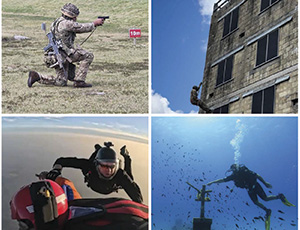
Now that I have your attention, in the interests of full disclosure the sharks were two metre grey sharks and one metre blacktip reef sharks. I am still training towards my British Skydiving A Licence (three static line jumps at 3,500 feet and one accelerated freefall jump at 14,000 feet), and sadly rappelling down buildings is not part of my core job description as a commissioned Royal Signals Reserve officer.
However, to address the question as to why a barrister would feel the need to undertake any of the above, the answer lies partly in the nature of the work that we do. Whether we are in court or drafting, we are constantly moving through documents describing different places, events and experiences. We animate cases, taking the judge, decision-makers or the jury (hopefully) mentally to the places and moments in question so they can understand why our clients acted in the way they did. As a human rights and public law barrister, those journeys often take place in distant or unfamiliar parts of the world. Yet all of this happens either in a closed courtroom or in chambers, usually while standing still or hunched over a desk (in my case, not always with the best posture either). Our minds may cross continents and move through time and space, but physically we have barely moved at all. I suspect our bodies crave that movement. There is also a strong drive to achieve tangible goals outside work, something that becomes even more rewarding when it is done as part of a team.
That is one of the reasons I chose to join the Army Reserve.
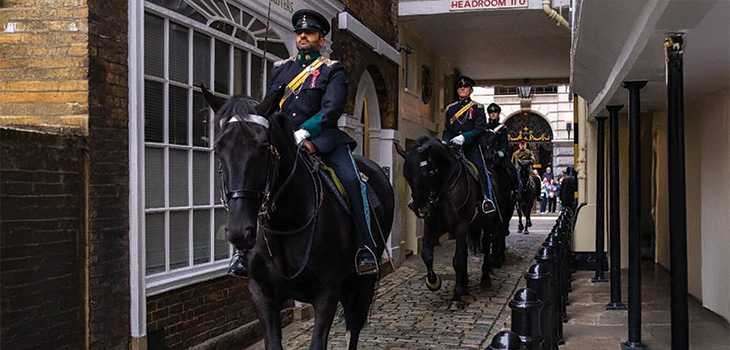
Like many at the Bar, I had always enjoyed sport and the occasional adventure, but the army reserves offered something slightly different: structure, purpose and a team. It also provides the opportunity to learn skills that are far removed from chambers life. Shooting, radio communications, navigation, planning exercises, operating in unfamiliar terrain and functioning with limited sleep are not competencies that typically appear on a barrister’s CV, but they are surprisingly rewarding to develop. My unit even has a mounted detachment for the Lord Mayor’s Show, meaning that horse riding also forms part of training.
The army reserves also introduce something that is sometimes less present in professional life: genuine teamwork under pressure. The Bar, for all its collegiality, remains an individual profession. You prepare your arguments alone, you stand up in court alone and ultimately the responsibility for the case rests with you. Military training, by contrast, is inherently collective. Exercises require coordination, trust and a shared understanding that everyone’s role contributes to the wider mission. There is something refreshing about stepping into an environment where success is measured less by individual performance and more by how well the team functions together.
Of course, the more adventurous activities are part of the appeal as well. Military training has a habit of introducing people to experiences they might not otherwise seek out. Field exercises, operational shooting competitions and various forms of adventurous training all form part of the wider culture. Skydiving and scuba diving grew naturally out of that environment. Once you spend enough time around people who treat jumping out of aircraft as a perfectly normal weekend activity, curiosity tends to take over. Before long, you find yourself at 14,000 feet as the instructor opens the aircraft door and invites you to move towards it.
There is, perhaps surprisingly, a certain overlap with advocacy. Standing up in court can sometimes feel like stepping into the unknown. No matter how carefully a case has been prepared, there is always the possibility of an unexpected question from the bench or a new argument from the other side. In all of these situations, whether in freefall, 60 feet down in a shipwreck, or on your feet in court, preparation is what allows you to remain calm when things become unpredictable.
That said, these pursuits do not come without their challenges. After a full five-day court week, most people would understandably want to go home on Friday evening and put their feet up. Instead, I often find myself leaving a little earlier, packing my kit, changing into uniform and heading to the Army Reserve centre to draw my rifle, ready for whatever taskings the weekend might bring. A word of warning for anyone considering combining skydiving and scuba diving: you cannot speak during either activity, and the hand signals are vastly different, as I discovered the hard way.
Yet the reserves and these adventures provide exactly the balance that the profession sometimes lacks. They remind me that the world extends beyond chambers, skeleton arguments and court listings. They also build qualities, resilience, discipline, teamwork and clear communication, that quietly improve my work as a barrister.
And, if nothing else, they make standing up in court feel rather less intimidating. After all, the judge may ask difficult questions, but at least the courtroom door isn’t open at 14,000 feet.
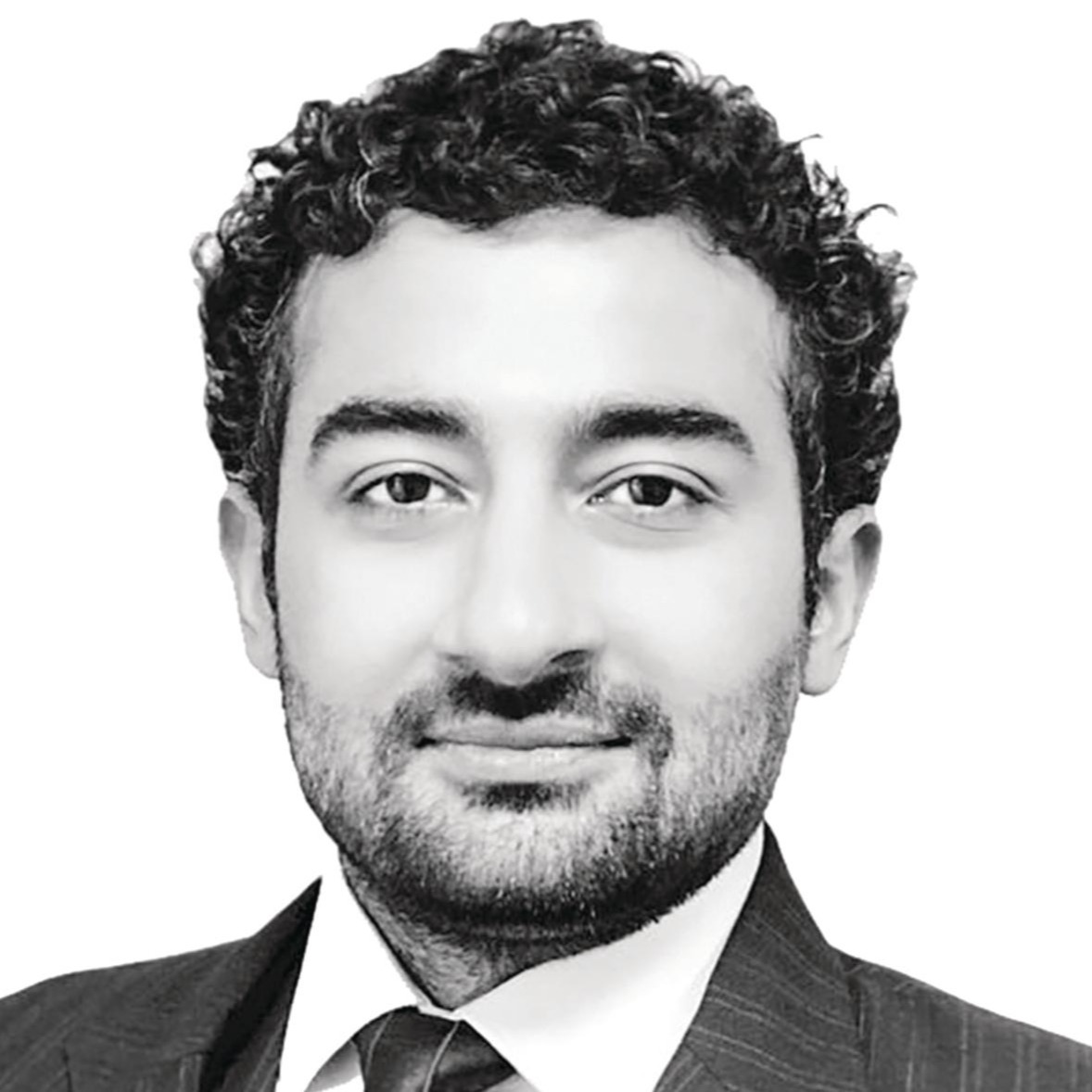
Ahmad Badar is a human rights and public law barrister at 10 King’s Bench Walk and posted at 10 Stone Buildings, Lincoln’s Inn Army Reserve Centre.
Now that I have your attention, in the interests of full disclosure the sharks were two metre grey sharks and one metre blacktip reef sharks. I am still training towards my British Skydiving A Licence (three static line jumps at 3,500 feet and one accelerated freefall jump at 14,000 feet), and sadly rappelling down buildings is not part of my core job description as a commissioned Royal Signals Reserve officer.
However, to address the question as to why a barrister would feel the need to undertake any of the above, the answer lies partly in the nature of the work that we do. Whether we are in court or drafting, we are constantly moving through documents describing different places, events and experiences. We animate cases, taking the judge, decision-makers or the jury (hopefully) mentally to the places and moments in question so they can understand why our clients acted in the way they did. As a human rights and public law barrister, those journeys often take place in distant or unfamiliar parts of the world. Yet all of this happens either in a closed courtroom or in chambers, usually while standing still or hunched over a desk (in my case, not always with the best posture either). Our minds may cross continents and move through time and space, but physically we have barely moved at all. I suspect our bodies crave that movement. There is also a strong drive to achieve tangible goals outside work, something that becomes even more rewarding when it is done as part of a team.
That is one of the reasons I chose to join the Army Reserve.
Like many at the Bar, I had always enjoyed sport and the occasional adventure, but the army reserves offered something slightly different: structure, purpose and a team. It also provides the opportunity to learn skills that are far removed from chambers life. Shooting, radio communications, navigation, planning exercises, operating in unfamiliar terrain and functioning with limited sleep are not competencies that typically appear on a barrister’s CV, but they are surprisingly rewarding to develop. My unit even has a mounted detachment for the Lord Mayor’s Show, meaning that horse riding also forms part of training.
The army reserves also introduce something that is sometimes less present in professional life: genuine teamwork under pressure. The Bar, for all its collegiality, remains an individual profession. You prepare your arguments alone, you stand up in court alone and ultimately the responsibility for the case rests with you. Military training, by contrast, is inherently collective. Exercises require coordination, trust and a shared understanding that everyone’s role contributes to the wider mission. There is something refreshing about stepping into an environment where success is measured less by individual performance and more by how well the team functions together.
Of course, the more adventurous activities are part of the appeal as well. Military training has a habit of introducing people to experiences they might not otherwise seek out. Field exercises, operational shooting competitions and various forms of adventurous training all form part of the wider culture. Skydiving and scuba diving grew naturally out of that environment. Once you spend enough time around people who treat jumping out of aircraft as a perfectly normal weekend activity, curiosity tends to take over. Before long, you find yourself at 14,000 feet as the instructor opens the aircraft door and invites you to move towards it.
There is, perhaps surprisingly, a certain overlap with advocacy. Standing up in court can sometimes feel like stepping into the unknown. No matter how carefully a case has been prepared, there is always the possibility of an unexpected question from the bench or a new argument from the other side. In all of these situations, whether in freefall, 60 feet down in a shipwreck, or on your feet in court, preparation is what allows you to remain calm when things become unpredictable.
That said, these pursuits do not come without their challenges. After a full five-day court week, most people would understandably want to go home on Friday evening and put their feet up. Instead, I often find myself leaving a little earlier, packing my kit, changing into uniform and heading to the Army Reserve centre to draw my rifle, ready for whatever taskings the weekend might bring. A word of warning for anyone considering combining skydiving and scuba diving: you cannot speak during either activity, and the hand signals are vastly different, as I discovered the hard way.
Yet the reserves and these adventures provide exactly the balance that the profession sometimes lacks. They remind me that the world extends beyond chambers, skeleton arguments and court listings. They also build qualities, resilience, discipline, teamwork and clear communication, that quietly improve my work as a barrister.
And, if nothing else, they make standing up in court feel rather less intimidating. After all, the judge may ask difficult questions, but at least the courtroom door isn’t open at 14,000 feet.
Army Reserve adventures provide the balance that the Bar sometimes lacks, says Ahmad Badar

The Chair of the Bar reports back
Susie Griffin on the admin that keeps barristers from billable work
Clement Cowley, Partner at The Penny Group, explains how global events can influence the performance of pensions and ISAs, and why taking a long-term approach to investing is often the most effective strategy
Mário Barroso, Head of R&D and Method Development at AlphaBiolabs, discusses what family law professionals need to know about hallucinogens, from the main hallucinogenic drugs encountered in family proceedings, to their effects and the testing options available
Harmony Christian Ministries is the latest charity to benefit from a £500 donation from AlphaBiolabs via the company’s Giving Back initiative
By David Green
At the start of her term, Chair of the Bar 2026 Kirsty Brimelow KC set out a series of priorities for the year ahead. One of those priorities was children in the justice system
As the world becomes more digital, Barbara Vinagre Mota examines international research into the mental health consequences of judges’ exposure to graphic and immersive evidence, highlighting the importance of support systems
In an era of patient-centred care and growing concern over misconduct in medical settings, why do women still lack the right to choose women consultants for examination and treatment? Charles Davey investigates
Reviewed by Daniel Barnett
James McNeill Whistler at Tate Britain until 27 September Rothko in Florence at Palazzo Strozzi until 23 August Reviewed by Stephen Cragg KC