*/
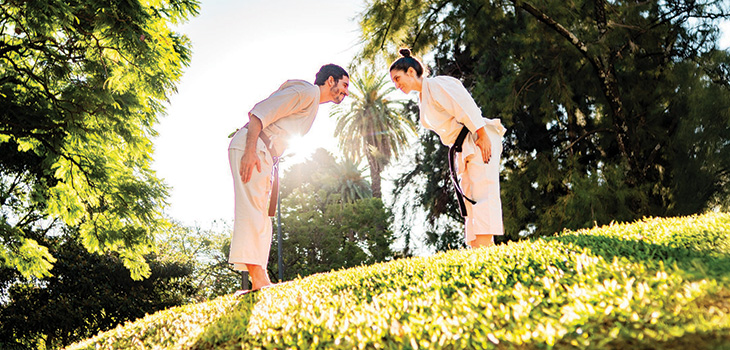
The gentle way. By David Hughes
I blame my son. And Bernard Richmond KC.
Some years ago, teaching advocacy trainers in Cardiff, Bernard Richmond mentioned the concept of kuzushi – ‘breaking balance’. My son wanted to try a combat sport, and this made me think judo might suit him – not, at that point, me. My main sporting interest was rollerskiing, at which I reached the dizzy heights of not-quite-last in the British Rollerski Series.
Judo is usually rendered in English as ‘the gentle way’. French and Spanish prefer ‘the flexible way’, whereas Italian opts for ‘the yielding way’, which to this non-Japanese speaker seems more apt. An Olympic sport and a highly effective form of self-defence, because it doesn’t involve striking, judo can practised realistically but safely. It’s also, more importantly for most of us, great fun.
I found a club, and took my son along. The senseis (coaches) and kids were friendly, he had fun, and the vibe was definitely more Miyagi-do than Cobra Kai. After a while, I thought, if you can’t beat ‘em, join ‘em. ‘If you keep it up, after the summer break, I’ll start too’ was the promise made, and a barrister’s word is their bond…
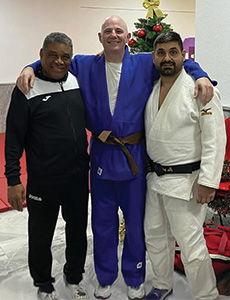
At my first session, I found myself approached by a black belt. Beginners are often paired up with dan-grades, as they are the safest partners. There was a smile that was meant to be reassuring, and off we went.
The great French judoka Teddy Riner has described judo as a dance for strong people. On that score, I’m not a natural judoka. My dancing is characterised by an absence of rhythm, and I lack confidence in physical confrontation. But it didn’t take long for me to start looking forward to classes. I wasn’t getting good, but I was getting better – and so will you.
The belt system means that there’s always something to aim for. Grading (red through to brown belts in the UK) involves learning a syllabus of throws, pins, armlocks and strangles, and demonstrating them in your club. Tori (thrower) and uke (throw-ee) cooperate – you’ll want your clubmates to get their belts. There are then two routes to the coveted black belt, competitive and technical.
Judo is a social activity – it takes two to tachi-waza. And judo people are among the very best: they’ll welcome you into their club and take care of your safety. My son, who has autism, competes in adaptive judo – and gets to see expert fighters show that that is absolutely compatible with kindness and inclusivity.
Unlike when running or cycling or rollerskiing, I don’t find my mind wandering back to work. I’ve gained in self-confidence. I’ve made the sort of friends I trust enough to put me in a strangle-hold. I’ve felt the power of the great Neil Adams (when helping my son to throw me), I’ve met Cuba’s first ever Olympic champion and become friends with a Paralympic silver medallist. I may never be a particularly good judoka, but I can be a good clubmate, who helps those around him get better, and there’s a real satisfaction in that.
Even the Japanese terminology, which can seem an obstacle at first, you’ll start to see as a gateway: it comes quickly enough and means that, if you want to take your gi on holiday, you’ll be able to join in. Wherever you may go, Hajime means ‘go’, ‘mate’ means stop, and the throws between those two have the same names too.

I blame my son. And Bernard Richmond KC.
Some years ago, teaching advocacy trainers in Cardiff, Bernard Richmond mentioned the concept of kuzushi – ‘breaking balance’. My son wanted to try a combat sport, and this made me think judo might suit him – not, at that point, me. My main sporting interest was rollerskiing, at which I reached the dizzy heights of not-quite-last in the British Rollerski Series.
Judo is usually rendered in English as ‘the gentle way’. French and Spanish prefer ‘the flexible way’, whereas Italian opts for ‘the yielding way’, which to this non-Japanese speaker seems more apt. An Olympic sport and a highly effective form of self-defence, because it doesn’t involve striking, judo can practised realistically but safely. It’s also, more importantly for most of us, great fun.
I found a club, and took my son along. The senseis (coaches) and kids were friendly, he had fun, and the vibe was definitely more Miyagi-do than Cobra Kai. After a while, I thought, if you can’t beat ‘em, join ‘em. ‘If you keep it up, after the summer break, I’ll start too’ was the promise made, and a barrister’s word is their bond…
At my first session, I found myself approached by a black belt. Beginners are often paired up with dan-grades, as they are the safest partners. There was a smile that was meant to be reassuring, and off we went.
The great French judoka Teddy Riner has described judo as a dance for strong people. On that score, I’m not a natural judoka. My dancing is characterised by an absence of rhythm, and I lack confidence in physical confrontation. But it didn’t take long for me to start looking forward to classes. I wasn’t getting good, but I was getting better – and so will you.
The belt system means that there’s always something to aim for. Grading (red through to brown belts in the UK) involves learning a syllabus of throws, pins, armlocks and strangles, and demonstrating them in your club. Tori (thrower) and uke (throw-ee) cooperate – you’ll want your clubmates to get their belts. There are then two routes to the coveted black belt, competitive and technical.
Judo is a social activity – it takes two to tachi-waza. And judo people are among the very best: they’ll welcome you into their club and take care of your safety. My son, who has autism, competes in adaptive judo – and gets to see expert fighters show that that is absolutely compatible with kindness and inclusivity.
Unlike when running or cycling or rollerskiing, I don’t find my mind wandering back to work. I’ve gained in self-confidence. I’ve made the sort of friends I trust enough to put me in a strangle-hold. I’ve felt the power of the great Neil Adams (when helping my son to throw me), I’ve met Cuba’s first ever Olympic champion and become friends with a Paralympic silver medallist. I may never be a particularly good judoka, but I can be a good clubmate, who helps those around him get better, and there’s a real satisfaction in that.
Even the Japanese terminology, which can seem an obstacle at first, you’ll start to see as a gateway: it comes quickly enough and means that, if you want to take your gi on holiday, you’ll be able to join in. Wherever you may go, Hajime means ‘go’, ‘mate’ means stop, and the throws between those two have the same names too.
The gentle way. By David Hughes

The Chair of the Bar reports back
Susie Griffin on the admin that keeps barristers from billable work
Clement Cowley, Partner at The Penny Group, explains how global events can influence the performance of pensions and ISAs, and why taking a long-term approach to investing is often the most effective strategy
Mário Barroso, Head of R&D and Method Development at AlphaBiolabs, discusses what family law professionals need to know about hallucinogens, from the main hallucinogenic drugs encountered in family proceedings, to their effects and the testing options available
Harmony Christian Ministries is the latest charity to benefit from a £500 donation from AlphaBiolabs via the company’s Giving Back initiative
By David Green

The golden age of advocacy? David Langwallner pays homage to the filmic if contentious barrister Sir Edward Carson and some of his contemporaries
Leah Arthur, a pupil, and her second seat supervisor, John Goss, share their perspectives on building a productive pupil-supervisor relationship
Henry Fingerhut outlines what the Bar Standards Board AI guidance means for early career barristers
The Ministry of Justice will match-fund up to 100 criminal pupillages, with grants available to criminal chambers across England and Wales. Similar to the COIC scheme, the grants will match-fund pupillages additional to those otherwise offered without government funding
Not yet, says Jacob Turner. Regulation, unlike the technology itself, is a domain the legal profession can still control