*/
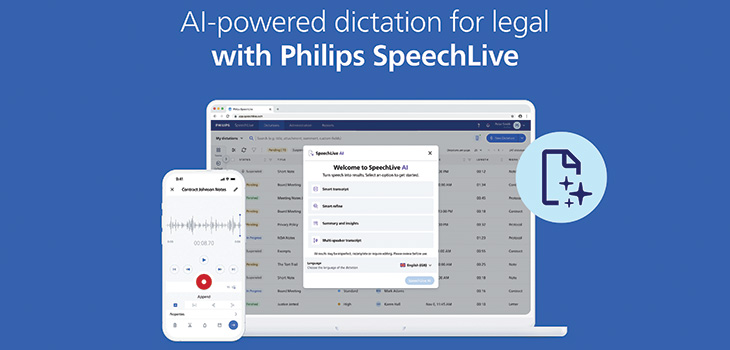
Ryan Prins of Philips SpeechLive explains how barristers can boost drafting efficiency with AI-assisted speech recognition – while keeping full oversight
Legal professionals face increasing pressure to produce high-quality documents efficiently while maintaining accuracy, consistency and compliance. AI-assisted drafting can help streamline document creation, but its effectiveness depends on the quality of the information captured, the structure used to organise it, and the safeguards that support its use.
Accurate legal document creation begins with accurately capturing what was said. SpeechLive Legal AI Assistant is powered by Speech Recognition Legal, a dedicated speech recognition engine designed specifically for the legal sector. Unlike general-purpose speech recognition tools, it is trained to recognise legal terminology, case citations, and commonly used legal phrasing, helping to ensure that important details are captured correctly.
The Legal AI Assistant then combines the transcribed information with relevant supporting materials and a selected template, organising key facts and details into the required document structure. By bringing legal speech recognition and AI-assisted drafting together in a single workflow, SpeechLive Legal supports the document creation process from the initial voice recording through to a structured draft ready for review.
Templates are a key part of this process. Most barristers have established drafting conventions, formatting requirements, and document structures that vary depending on the type of matter and document being created. By incorporating these requirements into custom templates, barristers can generate drafts that more closely reflect their preferred standards and working practices.
The quality of an AI-generated draft depends on several factors, including the accuracy of the source information, the suitability of the chosen template, and the professional review that follows. A well-designed template provides a stronger foundation for consistent document creation and enables firms to apply AI more effectively to specific legal drafting tasks. It can also help improve standardisation across teams and document types.
Alongside efficiency and accuracy, security remains a critical consideration. Lawyers regularly work with confidential and sensitive information, making data security an important factor when evaluating cloud-based software. They need visibility into how providers approach security, data privacy, and compliance to carry out their own assessments and meet regulatory obligations.
The SpeechLive Trust Center provides a central resource where organisations can access information relating to security, privacy, and compliance. By bringing this information together in one place, it helps legal teams evaluate SpeechLive and find the details relevant to their specific requirements when assessing cloud technology.
SpeechLive Legal builds on the established SpeechLive environment, allowing firms to introduce AI-assisted document generation within workflows their teams already know and use. Many legal professionals already rely on SpeechLive for dictation, speech recognition, transcription, delegation, document editing, and review. The Legal AI Assistant extends these capabilities by adding document generation, helping users incorporate AI-assisted drafting into familiar processes without disrupting existing ways of working.
This supports a practical and gradual approach to AI adoption. Rather than requiring firms to introduce entirely new systems, document generation is connected to the tools, workflows, and review structures already in place. As a result, legal teams can explore the benefits of AI while maintaining established processes for quality assurance and oversight.
Importantly, SpeechLive Legal AI Assistant generates drafts, not final legal documents. Every draft must be reviewed by a qualified legal professional to ensure factual accuracy, completeness, legal suitability, and compliance with requirements before it is approved, filed, or shared. The assistant supports the drafting process by organising the information provided into a structured document, but it does not provide legal advice, make legal judgements, or replace professional expertise.
By combining specialist legal speech recognition, AI-assisted document generation, customisable templates, and a secure, trusted workflow, SpeechLive Legal helps lawyers improve efficiency while retaining the professional review and oversight essential to legal practice.

Legal professionals face increasing pressure to produce high-quality documents efficiently while maintaining accuracy, consistency and compliance. AI-assisted drafting can help streamline document creation, but its effectiveness depends on the quality of the information captured, the structure used to organise it, and the safeguards that support its use.
Accurate legal document creation begins with accurately capturing what was said. SpeechLive Legal AI Assistant is powered by Speech Recognition Legal, a dedicated speech recognition engine designed specifically for the legal sector. Unlike general-purpose speech recognition tools, it is trained to recognise legal terminology, case citations, and commonly used legal phrasing, helping to ensure that important details are captured correctly.
The Legal AI Assistant then combines the transcribed information with relevant supporting materials and a selected template, organising key facts and details into the required document structure. By bringing legal speech recognition and AI-assisted drafting together in a single workflow, SpeechLive Legal supports the document creation process from the initial voice recording through to a structured draft ready for review.
Templates are a key part of this process. Most barristers have established drafting conventions, formatting requirements, and document structures that vary depending on the type of matter and document being created. By incorporating these requirements into custom templates, barristers can generate drafts that more closely reflect their preferred standards and working practices.
The quality of an AI-generated draft depends on several factors, including the accuracy of the source information, the suitability of the chosen template, and the professional review that follows. A well-designed template provides a stronger foundation for consistent document creation and enables firms to apply AI more effectively to specific legal drafting tasks. It can also help improve standardisation across teams and document types.
Alongside efficiency and accuracy, security remains a critical consideration. Lawyers regularly work with confidential and sensitive information, making data security an important factor when evaluating cloud-based software. They need visibility into how providers approach security, data privacy, and compliance to carry out their own assessments and meet regulatory obligations.
The SpeechLive Trust Center provides a central resource where organisations can access information relating to security, privacy, and compliance. By bringing this information together in one place, it helps legal teams evaluate SpeechLive and find the details relevant to their specific requirements when assessing cloud technology.
SpeechLive Legal builds on the established SpeechLive environment, allowing firms to introduce AI-assisted document generation within workflows their teams already know and use. Many legal professionals already rely on SpeechLive for dictation, speech recognition, transcription, delegation, document editing, and review. The Legal AI Assistant extends these capabilities by adding document generation, helping users incorporate AI-assisted drafting into familiar processes without disrupting existing ways of working.
This supports a practical and gradual approach to AI adoption. Rather than requiring firms to introduce entirely new systems, document generation is connected to the tools, workflows, and review structures already in place. As a result, legal teams can explore the benefits of AI while maintaining established processes for quality assurance and oversight.
Importantly, SpeechLive Legal AI Assistant generates drafts, not final legal documents. Every draft must be reviewed by a qualified legal professional to ensure factual accuracy, completeness, legal suitability, and compliance with requirements before it is approved, filed, or shared. The assistant supports the drafting process by organising the information provided into a structured document, but it does not provide legal advice, make legal judgements, or replace professional expertise.
By combining specialist legal speech recognition, AI-assisted document generation, customisable templates, and a secure, trusted workflow, SpeechLive Legal helps lawyers improve efficiency while retaining the professional review and oversight essential to legal practice.
Ryan Prins of Philips SpeechLive explains how barristers can boost drafting efficiency with AI-assisted speech recognition – while keeping full oversight

The Chair of the Bar reports back
Conner Wright, Legal Case Manager at AlphaBiolabs, answers the most frequently asked questions about SCRAM Continuous Alcohol Monitoring (SCRAM CAM®) posed by family law professionals
Ryan Prins of Philips SpeechLive explains how barristers can boost drafting efficiency with AI-assisted speech recognition – while keeping full oversight
By Kem Kemal, CEO, Henry Dannell
By BSK Financial Planning
Mário Barroso, Head of R&D and Method Development at AlphaBiolabs

For barristers, managing anxiety is a professional discipline as much as a personal one, says Annette Henry KC. This article examines the cues, clues and practical techniques for avoiding overwhelm and regaining calm
If you’ve never been to the Bar Conference before, this is the year to start. Amelia Clegg previews the profession’s flagship event
After a two-year investigation, Karim Khan KC was removed as ICC Chief Prosecutor in July. With the United States threatening to dismantle the court ‘brick by brick’, what’s next for the beleaguered ICC? asks Chris Stephen
Kick off your career at the Bar Council’s Pupillage Fair this October – it’s one of the most valuable opportunities for aspiring barristers, says Amelia Clegg
Join us on Saturday 21 November 2026 at Leeds Beckett University and see for yourself why the North continues to be an exceptional place to build a career at the Bar