*/
A guide to pupillage on the South Eastern Circuit. By Leon Kazakos KC and Rebecca Malczewski
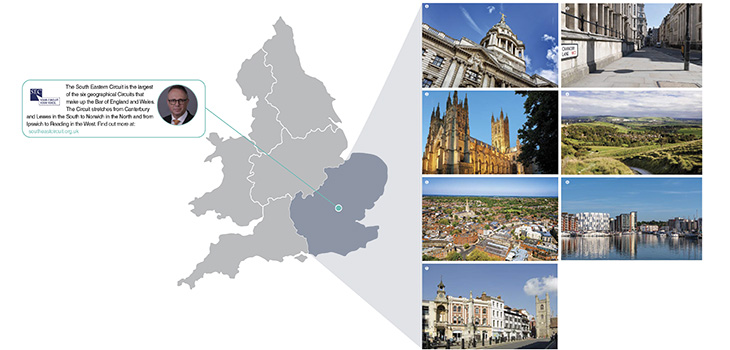
The South Eastern Circuit is the largest of the Circuits and has, along with a breadth of geography, a breadth of practice areas to match. It is not a straightforward task therefore to write about a ‘typical’ experience, as they are and will be diverse. What you encounter in pupillage will depend substantially on your area of specialism and set of chambers.
However, what you can expect from the South Eastern Circuit (as an organisation, from its Leader and from its executive officers) is ongoing educational support, advocacy on your behalf (where necessary) and social events that will enable you to start to make the friendships and other connections that will last throughout your career.
There’s no better way of learning about the life of a pupil in the South East than hearing directly from one of them, so I hand over to Rebecca.
*
From observing a six-month fraud trial at Southwark Crown Court to watching a jury return its verdict in a FGM trial in Court One at the Old Bailey, life as a criminal pupil on the South Eastern Circuit is unique.
Four years earlier, I was working at an asset management firm. I had been there for three years and recently been made an associate. However, I had long considered pursuing a career at the criminal Bar. Evidence of this was found in the primary school yearbook we recently dug out at my parent’s home. Under ‘What do you want to be when you grow up?’, in green felt tip my wobbly handwriting spelled out ‘A barrister’. Aged 11 and with no familial connection to the Bar, who knows what I imagined the word meant.
It was my increasing involvement in charitable work alongside my role, such as arranging for my team to cook and serve breakfast at the Whitechapel Mission, that empowered me to take the risk. I gave up my job, the apartment I shared with my closest friends and moved back home, imperfectly timed with the pandemic.
Studying remotely and with many opportunities to access the Bar on pause, I had to find ways to gain the insight I needed. I became an Independent Custody Visitor at my nearest police station. I answered calls from my childhood bedroom for the National Domestic Abuse Helpline and I sat in the public gallery of my local court. I had no way of knowing if this job was for me, but I was not going to find out until I took the leap.
Yet, my experience as a criminal pupil on the South Eastern Circuit has surpassed all of my hopes. Whether accompanying Treasury Counsel to the Court of Appeal or drafting the response to an application to appeal a sentence for murder, during my First Six I observed and assisted on a wide range of cases.
I saw how training and events provide those on the Circuit with the space for learning and support that the profession deserves. For example, my Pupil Advocacy Course with Gray’s Inn culminated in a mock trial at the Royal Courts of Justice. I completed The Inns of Court College of Advocacy’s Pilot Pupil Training, Advocacy for Children in Conflict with the Law. Other highlights were the Circuit’s quiz night for first six pupils, hosted by Rob Rinder, and The Inns of Court Alliance for Women’s event, ‘Black Women Barristers: The Challenges Faced & A Fairer Future’.
As a second six pupil, I am in court almost every day, managing my own cases across the Youth, Magistrates and Crown Courts. I have been struck by the kindness, generosity and patience of those around me: the junior tenant who has never failed to answer my call, the supervisor who wishes me luck before a challenging hearing or the court usher moving me up the afternoon list, as she offers me her last Werther’s Original.
The people I have met practising on the Circuit are from a range of backgrounds and experiences. Yet their goal is so often the same: to do the best possible job they can.
There is no doubt that being a criminal pupil comes with challenges. Resources are stretched and the stakes are always high. However, there is nothing else I would rather be doing.


Leon Kazakos KC was Leader of the South Eastern Circuit from 2023-2024. A member of 2 Hare Court, he has a wide-ranging defence practice representing those facing serious criminal and regulatory allegations.

Rebecca Malczewski is a pupil at 2 Hare Court. She is also a Senior Scholar of Gray’s Inn, having been awarded the Arden Scholarship, the Inn’s most prestigious award.
The South Eastern Circuit is the largest of the Circuits and has, along with a breadth of geography, a breadth of practice areas to match. It is not a straightforward task therefore to write about a ‘typical’ experience, as they are and will be diverse. What you encounter in pupillage will depend substantially on your area of specialism and set of chambers.
However, what you can expect from the South Eastern Circuit (as an organisation, from its Leader and from its executive officers) is ongoing educational support, advocacy on your behalf (where necessary) and social events that will enable you to start to make the friendships and other connections that will last throughout your career.
There’s no better way of learning about the life of a pupil in the South East than hearing directly from one of them, so I hand over to Rebecca.
*
From observing a six-month fraud trial at Southwark Crown Court to watching a jury return its verdict in a FGM trial in Court One at the Old Bailey, life as a criminal pupil on the South Eastern Circuit is unique.
Four years earlier, I was working at an asset management firm. I had been there for three years and recently been made an associate. However, I had long considered pursuing a career at the criminal Bar. Evidence of this was found in the primary school yearbook we recently dug out at my parent’s home. Under ‘What do you want to be when you grow up?’, in green felt tip my wobbly handwriting spelled out ‘A barrister’. Aged 11 and with no familial connection to the Bar, who knows what I imagined the word meant.
It was my increasing involvement in charitable work alongside my role, such as arranging for my team to cook and serve breakfast at the Whitechapel Mission, that empowered me to take the risk. I gave up my job, the apartment I shared with my closest friends and moved back home, imperfectly timed with the pandemic.
Studying remotely and with many opportunities to access the Bar on pause, I had to find ways to gain the insight I needed. I became an Independent Custody Visitor at my nearest police station. I answered calls from my childhood bedroom for the National Domestic Abuse Helpline and I sat in the public gallery of my local court. I had no way of knowing if this job was for me, but I was not going to find out until I took the leap.
Yet, my experience as a criminal pupil on the South Eastern Circuit has surpassed all of my hopes. Whether accompanying Treasury Counsel to the Court of Appeal or drafting the response to an application to appeal a sentence for murder, during my First Six I observed and assisted on a wide range of cases.
I saw how training and events provide those on the Circuit with the space for learning and support that the profession deserves. For example, my Pupil Advocacy Course with Gray’s Inn culminated in a mock trial at the Royal Courts of Justice. I completed The Inns of Court College of Advocacy’s Pilot Pupil Training, Advocacy for Children in Conflict with the Law. Other highlights were the Circuit’s quiz night for first six pupils, hosted by Rob Rinder, and The Inns of Court Alliance for Women’s event, ‘Black Women Barristers: The Challenges Faced & A Fairer Future’.
As a second six pupil, I am in court almost every day, managing my own cases across the Youth, Magistrates and Crown Courts. I have been struck by the kindness, generosity and patience of those around me: the junior tenant who has never failed to answer my call, the supervisor who wishes me luck before a challenging hearing or the court usher moving me up the afternoon list, as she offers me her last Werther’s Original.
The people I have met practising on the Circuit are from a range of backgrounds and experiences. Yet their goal is so often the same: to do the best possible job they can.
There is no doubt that being a criminal pupil comes with challenges. Resources are stretched and the stakes are always high. However, there is nothing else I would rather be doing.
A guide to pupillage on the South Eastern Circuit. By Leon Kazakos KC and Rebecca Malczewski

The Chair of the Bar reports back
Domestic abuse charity Hull Women's Aid is the latest charity to benefit from a £500 donation via AlphaBiolabs' Giving Back initiative
Conner Wright, Legal Case Manager at AlphaBiolabs, answers the most frequently asked questions about SCRAM Continuous Alcohol Monitoring (SCRAM CAM®) posed by family law professionals
Ryan Prins of Philips SpeechLive explains how barristers can boost drafting efficiency with AI-assisted speech recognition – while keeping full oversight
Finding available counsel shouldn’t be complicated, says Kaan Kartal of Brieflink
By Kem Kemal, CEO, Henry Dannell

By His Honour Judge Seán Enright Reviewed by Joanna Hardy-Susskind
For barristers, managing anxiety is a professional discipline as much as a personal one, says Annette Henry KC. This article examines the cues, clues and practical techniques for avoiding overwhelm and regaining calm
After a two-year investigation, Karim Khan KC was removed as ICC Chief Prosecutor in July. With the United States threatening to dismantle the court ‘brick by brick’, what’s next for the beleaguered ICC? asks Chris Stephen
Kick off your career at the Bar Council’s Pupillage Fair this October – it’s one of the most valuable opportunities for aspiring barristers, says Amelia Clegg
Join us on Saturday 21 November 2026 at Leeds Beckett University and see for yourself why the North continues to be an exceptional place to build a career at the Bar