*/
By His Honour Judge Seán Enright
Reviewed by Joanna Hardy-Susskind
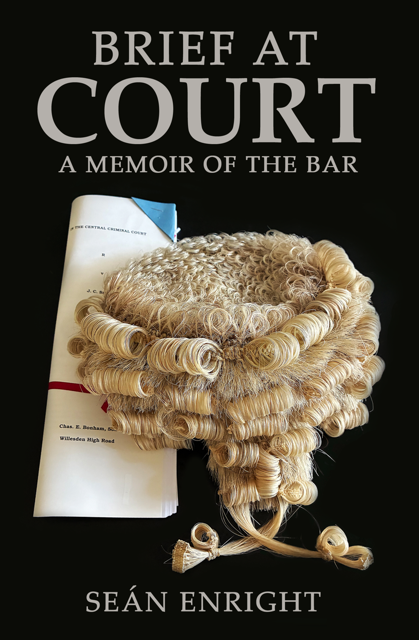
Published by Candy Jar Books (October 2026)
£12.99 (RRP)
Paperback 250pp
ISBN 978-1918097924
If you hang around Peterborough Crown Court for long enough, you will hear it.
You first have to endure the car park, with its convoluted payment scheme, and assorted clientele of criminal defendants, shoppers, and swimmers off to the lido. Once inside, you will enjoy the dated leisure centre décor, and the peeling paintwork. If you have made it that far, you might as well climb the first set of stairs, and push open the heavy doors on your left: courtroom number one.
Inside, justice will be being done. You will detect a stillness in the air. A solemnity and a respect for the law will be clear. But, soon, something more. You will notice that there is absolutely no nonsense here. There is order. And brevity. So much brevity. Do not mistake it (as I once did) for abruptness – this is a courtroom where common sense prevails. The judge – probably not wearing his wig – will strike you as someone who has seen a thing or two. And, while you are in the building, you will hear it. The well-worn robing room phrase: ‘This judge has been around the block.’
Luckily for us, in his memoir, Brief at Court, His Honour Judge Seán Enright takes us back to his days at the Bar, and back around the block with him. This is not a smug victory lap, nor a boring law lecture: both insufferable tendencies of some legal memoirs. No, this is the story – or a tapestry of stories – of the shaping of a lawyer: of his ways, his values, and of where he has come from.
If that sounds grand or lofty, then please do not be mistaken. At times it feels as entertaining as a mischievous pint with the author might be - from dogs farting in court, to briefs being lobbed out of train windows, to a young Mr Enright’s phone being confiscated by an irascible judge and chucked in the bin. The book has an economy of language. It does not dwell on things. Before you have clocked one remarkable story, we are off onto the next one. I’d certainly like to read the director’s cut.
The younger barrister’s anecdotes are occasionally of their time, but that makes them all the more fascinating: this is what the Bar was like in living memory. This is where the system – our system – has graduated from. Those jostling for pupillage now will recognise the doubt, the perseverance, and the sheer grit of a young barrister careering chaotically around the Temple, just getting started. Young barristers will see parallels in the spirit, if not in the detail, of these chapters. Seasoned barristers will recognise the graft of establishing oneself as a trusted brief – the sacrifice, the dark humour, and the friendships we all need to survive the bad days. We are all curious about the human side of any lawyer: what motivates us, who motivates us, and why? A personal story is told by the author which is not mine to repeat – it moved me when I read it.
Encountering a judge outside of court can feel a little like seeing your teacher in the supermarket: ‘you don’t belong here,’ you think, capable only of imagining them at their workplace.
It is great fun, then, to read that a young Enright once partied so hard with his student flatmates that they caused structural damage to their building. It fell down. ‘Well, we were all young once,’ he offers, before cantering on.
He was clearly a decent and thorough brief: once instructed to defend a man accused of driving 89mph in a little Triumph Herald, Mr Enright of counsel instructed an expert to check the vehicle’s top speed. The prosecution instructed their own expert who thrashed the little motor around a racetrack, smoke and flames discharging from the bonnet. A plea deal was struck at 72mph. It is unclear how happy the lay client was with Mr Enright’s services: the car did not survive the experiment.
Before studying law, HHJ Enright once worked in a factory. He describes operating ‘a machine that churned out small metal discs until the container was filled, and then another container, and another and another.’ On our cynical days at the Bar, the justice system might feel a little like that. Case after case, dispute after dispute, on and on the factory line goes. But this book reminds us that in every case, however grand or small, there will be a lesson, a character, an anecdote, a laugh or a memory that we should file away for later – for when we need it most.

Joanna Hardy-Susskind is a criminal defence barrister, writer, and broadcaster.
Published by Candy Jar Books (October 2026)
£12.99 (RRP)
Paperback 250pp
ISBN 978-1918097924
If you hang around Peterborough Crown Court for long enough, you will hear it.
You first have to endure the car park, with its convoluted payment scheme, and assorted clientele of criminal defendants, shoppers, and swimmers off to the lido. Once inside, you will enjoy the dated leisure centre décor, and the peeling paintwork. If you have made it that far, you might as well climb the first set of stairs, and push open the heavy doors on your left: courtroom number one.
Inside, justice will be being done. You will detect a stillness in the air. A solemnity and a respect for the law will be clear. But, soon, something more. You will notice that there is absolutely no nonsense here. There is order. And brevity. So much brevity. Do not mistake it (as I once did) for abruptness – this is a courtroom where common sense prevails. The judge – probably not wearing his wig – will strike you as someone who has seen a thing or two. And, while you are in the building, you will hear it. The well-worn robing room phrase: ‘This judge has been around the block.’
Luckily for us, in his memoir, Brief at Court, His Honour Judge Seán Enright takes us back to his days at the Bar, and back around the block with him. This is not a smug victory lap, nor a boring law lecture: both insufferable tendencies of some legal memoirs. No, this is the story – or a tapestry of stories – of the shaping of a lawyer: of his ways, his values, and of where he has come from.
If that sounds grand or lofty, then please do not be mistaken. At times it feels as entertaining as a mischievous pint with the author might be - from dogs farting in court, to briefs being lobbed out of train windows, to a young Mr Enright’s phone being confiscated by an irascible judge and chucked in the bin. The book has an economy of language. It does not dwell on things. Before you have clocked one remarkable story, we are off onto the next one. I’d certainly like to read the director’s cut.
The younger barrister’s anecdotes are occasionally of their time, but that makes them all the more fascinating: this is what the Bar was like in living memory. This is where the system – our system – has graduated from. Those jostling for pupillage now will recognise the doubt, the perseverance, and the sheer grit of a young barrister careering chaotically around the Temple, just getting started. Young barristers will see parallels in the spirit, if not in the detail, of these chapters. Seasoned barristers will recognise the graft of establishing oneself as a trusted brief – the sacrifice, the dark humour, and the friendships we all need to survive the bad days. We are all curious about the human side of any lawyer: what motivates us, who motivates us, and why? A personal story is told by the author which is not mine to repeat – it moved me when I read it.
Encountering a judge outside of court can feel a little like seeing your teacher in the supermarket: ‘you don’t belong here,’ you think, capable only of imagining them at their workplace.
It is great fun, then, to read that a young Enright once partied so hard with his student flatmates that they caused structural damage to their building. It fell down. ‘Well, we were all young once,’ he offers, before cantering on.
He was clearly a decent and thorough brief: once instructed to defend a man accused of driving 89mph in a little Triumph Herald, Mr Enright of counsel instructed an expert to check the vehicle’s top speed. The prosecution instructed their own expert who thrashed the little motor around a racetrack, smoke and flames discharging from the bonnet. A plea deal was struck at 72mph. It is unclear how happy the lay client was with Mr Enright’s services: the car did not survive the experiment.
Before studying law, HHJ Enright once worked in a factory. He describes operating ‘a machine that churned out small metal discs until the container was filled, and then another container, and another and another.’ On our cynical days at the Bar, the justice system might feel a little like that. Case after case, dispute after dispute, on and on the factory line goes. But this book reminds us that in every case, however grand or small, there will be a lesson, a character, an anecdote, a laugh or a memory that we should file away for later – for when we need it most.
By His Honour Judge Seán Enright
Reviewed by Joanna Hardy-Susskind

The Chair of the Bar reports back
Conner Wright, Legal Case Manager at AlphaBiolabs, answers the most frequently asked questions about SCRAM Continuous Alcohol Monitoring (SCRAM CAM®) posed by family law professionals
Ryan Prins of Philips SpeechLive explains how barristers can boost drafting efficiency with AI-assisted speech recognition – while keeping full oversight
Finding available counsel shouldn’t be complicated, says Kaan Kartal of Brieflink
By Kem Kemal, CEO, Henry Dannell
By BSK Financial Planning

For barristers, managing anxiety is a professional discipline as much as a personal one, says Annette Henry KC. This article examines the cues, clues and practical techniques for avoiding overwhelm and regaining calm
If you’ve never been to the Bar Conference before, this is the year to start. Amelia Clegg previews the profession’s flagship event
After a two-year investigation, Karim Khan KC was removed as ICC Chief Prosecutor in July. With the United States threatening to dismantle the court ‘brick by brick’, what’s next for the beleaguered ICC? asks Chris Stephen
Kick off your career at the Bar Council’s Pupillage Fair this October – it’s one of the most valuable opportunities for aspiring barristers, says Amelia Clegg
Join us on Saturday 21 November 2026 at Leeds Beckett University and see for yourself why the North continues to be an exceptional place to build a career at the Bar