*/
By Peter Oldham KC
Reviewed by Sir Jonathan Swift
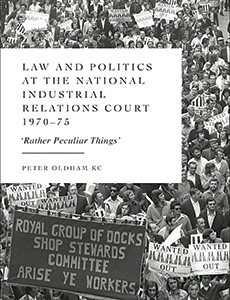
Hart Publishing (2025), Hardback 208 pages, ISBN 9781509985418
Studying labour law at university made me want to practise law. My first steps as a barrister were cases in the Industrial Tribunal. Although my career started much too late for me to visit the National Industrial Relations Court, even by the late 1980s ‘the NIRC’ remained fresh in practitioners’ minds, and its successor the Employment Appeal Tribunal retained the air of a court which, even if no longer on the industrial relations front line, was still a place where law and politics lived side-by-side, sometimes too closely. And even then, labour law (as it was still called) continued to evolve under the gaze of Sir John Donaldson, then the Master of the Rolls, but between 1971 and 1974 the first and only President of the NIRC.
Peter Oldham’s history of the NIRC is a fascinating read, both for the law and the politics. The Industrial Relations Act 1971 took industrial relations policy firmly by the scruff of the neck, establishing a system for trade union registration backed by court-imposed sanctions for ‘unfair industrial practices’. The NIRC, which that Act created, was a bold experiment – an attempt at corporatism that used a court to regulate collective trade union action, the single most controversial topic of its day. By putting the NIRC front and centre as the proposed ‘cure’ for industrial strife, the Act served, inadvertently, to find (and then exceed) the acceptable limits of using law as an instrument of social policy and economic policy. The experiment was short-lived: the NIRC came into existence on 1 December 1971 but by 31 July 1974 was gone. The period was defined by larger-than-life characters, not only the politicians and the trade union leaders, but also the judges who included Lords Hailsham and Denning. The original sources this book mines bring that period and those characters to life, and make it clear that Sir John Donaldson was more than a match for any of them.
The hopes and ambitions of all these men, and the harsh realities that ultimately laid the NIRC low, are revealed in the author’s telling of two epic sagas that came to entangle both the NIRC and its President. The first, in the summer of 1972, involved the litigation in Heatons Transport v TGWU, Churchman v Shop Stewards of the Port of London and Midland Cold Storage v Turner. In all these cases dock workers’ jobs were threatened by the ‘new technology’ of containerisation. In Heatons the NIRC’s attempt to hold unions liable for their shop stewards’ actions was overturned by the Court of Appeal; Churchman found the NIRC caught in the middle of a dispute between union members and a union that refused to comply with the NIRC’s ruling; and in Midland Cold Storage the pigeons released by the Court of Appeal’s judgment in Heatons came home to roost when, unable to hold the union to account, the NIRC imprisoned trade unionists for contempt, making modern martyrs of the ‘Pentonville Five’. Only a speedy ruling by the House of Lords restoring the NIRC’s judgment in Heatons provided Donaldson the opportunity to reverse away from the contempt decisions, release the unionists and avert a national strike. The second saga, caused by the Con-Mech litigation in November 1973, was little more than political confection, but signalled that the NIRC would not survive a change of government.
The author is to be commended. His subject is carefully researched and his writing well-paced. Legal history written as political thriller. Not to be missed.
Sir Jonathan Swift is a judge of the King’s Bench Division.
Hart Publishing (2025), Hardback 208 pages, ISBN 9781509985418
Studying labour law at university made me want to practise law. My first steps as a barrister were cases in the Industrial Tribunal. Although my career started much too late for me to visit the National Industrial Relations Court, even by the late 1980s ‘the NIRC’ remained fresh in practitioners’ minds, and its successor the Employment Appeal Tribunal retained the air of a court which, even if no longer on the industrial relations front line, was still a place where law and politics lived side-by-side, sometimes too closely. And even then, labour law (as it was still called) continued to evolve under the gaze of Sir John Donaldson, then the Master of the Rolls, but between 1971 and 1974 the first and only President of the NIRC.
Peter Oldham’s history of the NIRC is a fascinating read, both for the law and the politics. The Industrial Relations Act 1971 took industrial relations policy firmly by the scruff of the neck, establishing a system for trade union registration backed by court-imposed sanctions for ‘unfair industrial practices’. The NIRC, which that Act created, was a bold experiment – an attempt at corporatism that used a court to regulate collective trade union action, the single most controversial topic of its day. By putting the NIRC front and centre as the proposed ‘cure’ for industrial strife, the Act served, inadvertently, to find (and then exceed) the acceptable limits of using law as an instrument of social policy and economic policy. The experiment was short-lived: the NIRC came into existence on 1 December 1971 but by 31 July 1974 was gone. The period was defined by larger-than-life characters, not only the politicians and the trade union leaders, but also the judges who included Lords Hailsham and Denning. The original sources this book mines bring that period and those characters to life, and make it clear that Sir John Donaldson was more than a match for any of them.
The hopes and ambitions of all these men, and the harsh realities that ultimately laid the NIRC low, are revealed in the author’s telling of two epic sagas that came to entangle both the NIRC and its President. The first, in the summer of 1972, involved the litigation in Heatons Transport v TGWU, Churchman v Shop Stewards of the Port of London and Midland Cold Storage v Turner. In all these cases dock workers’ jobs were threatened by the ‘new technology’ of containerisation. In Heatons the NIRC’s attempt to hold unions liable for their shop stewards’ actions was overturned by the Court of Appeal; Churchman found the NIRC caught in the middle of a dispute between union members and a union that refused to comply with the NIRC’s ruling; and in Midland Cold Storage the pigeons released by the Court of Appeal’s judgment in Heatons came home to roost when, unable to hold the union to account, the NIRC imprisoned trade unionists for contempt, making modern martyrs of the ‘Pentonville Five’. Only a speedy ruling by the House of Lords restoring the NIRC’s judgment in Heatons provided Donaldson the opportunity to reverse away from the contempt decisions, release the unionists and avert a national strike. The second saga, caused by the Con-Mech litigation in November 1973, was little more than political confection, but signalled that the NIRC would not survive a change of government.
The author is to be commended. His subject is carefully researched and his writing well-paced. Legal history written as political thriller. Not to be missed.
By Peter Oldham KC
Reviewed by Sir Jonathan Swift

The Chair of the Bar reports back
Susie Griffin on the admin that keeps barristers from billable work
Clement Cowley, Partner at The Penny Group, explains how global events can influence the performance of pensions and ISAs, and why taking a long-term approach to investing is often the most effective strategy
Mário Barroso, Head of R&D and Method Development at AlphaBiolabs, discusses what family law professionals need to know about hallucinogens, from the main hallucinogenic drugs encountered in family proceedings, to their effects and the testing options available
Harmony Christian Ministries is the latest charity to benefit from a £500 donation from AlphaBiolabs via the company’s Giving Back initiative
By David Green
At the start of her term, Chair of the Bar 2026 Kirsty Brimelow KC set out a series of priorities for the year ahead. One of those priorities was children in the justice system
As the world becomes more digital, Barbara Vinagre Mota examines international research into the mental health consequences of judges’ exposure to graphic and immersive evidence, highlighting the importance of support systems
In an era of patient-centred care and growing concern over misconduct in medical settings, why do women still lack the right to choose women consultants for examination and treatment? Charles Davey investigates
Reviewed by Daniel Barnett
James McNeill Whistler at Tate Britain until 27 September Rothko in Florence at Palazzo Strozzi until 23 August Reviewed by Stephen Cragg KC