*/

As war, climate breakdown and human rights violations reshape global investment, arbitration must protect lawful commerce without becoming blind to the public it affects, argues Aarif Abraham
International arbitration was once sold, in part, as an enlightened alternative to economic, and even armed, conflict: a forum in which commercial disputes could be resolved by law rather than power. In a world of proliferating armed conflict, sanctions, climate emergency and deteriorating respect for fundamental rights, investors need predictable rules and states need credible mechanisms through which obligations can be adjudicated. But the old bargain is under strain. Arbitration can no longer pretend that investment disputes are merely private quarrels about property, contracts and compensation. Increasingly, they are disputes about war, energy transition, public health, indigenous land, environmental harm and the capacity of states to govern in the public interest.
Armed conflicts have doubled to 130 in the past 15 years; sanctions are now ordinary tools of statecraft; and climate change, as we approach a global average of 1.5°C, is a present legal and commercial risk. Investments are destroyed, stranded, nationalised, frozen, regulated or rendered uneconomic by events far beyond the assumptions of the twentieth-century bilateral investment treaty. Investor-state arbitration is increasingly asked to adjudicate disorder beyond the state’s control.
A neutral forum, specialist decision-makers, enforceable awards and treaty protections against expropriation, discrimination and unfair treatment may be indispensable where domestic courts are unavailable, unsafe or compromised. In conflict zones, they may be the difference between redress and pure loss. War clauses, full protection and security obligations, compensation-for-losses provisions and fair and equitable treatment can become central when factories are occupied, infrastructure destroyed, concessions revoked or access to assets lost. Güriş v Syria (ICC Case No. 21845/ZF/AYZ) illustrates the point. Turkish investors recovered losses after losing access to cement plants during the Syrian civil war, when the state withdrew and armed groups took control, with the tribunal holding that the Turkey-Syria bilateral investment treaty (BIT) continued to apply notwithstanding the conflict.
For states, however, the picture is more complicated. A state at war, facing civil unrest, climate disaster or financial emergency, must still govern. It must protect life, maintain order, regulate dangerous activity, and comply with international obligations. It may need to suspend projects, redirect resources, impose sanctions, phase out fossil fuels, protect water supplies or regulate public health. If every serious public measure is treated as a compensable interference with investment, arbitration risks becoming not a guardian of law but an indefensible tax on much-needed government action.
This tension is especially acute in disputes arising from armed conflict. Investment treaties often speak of ‘war’, ‘civil disturbance’ or ‘emergency’, but not always with the precision of international humanitarian or criminal law. In Asian Agricultural Products v Sri Lanka (ICSID Case No. ARB/87/3), the first International Centre for Settlement of Investment Disputes-administered treaty arbitration to deal directly with wartime property destruction, the tribunal treated full protection and security as a due diligence obligation but did not meaningfully integrate the law of armed conflict. Tribunals in cases concerning Libya, Sri Lanka and, more recently, Ukraine have often treated conflict as background fact rather than as a legal regime with its own terminology, duties and limits. Where claims arise from occupied territory, military necessity, sanctions or hostilities, investment law cannot be interpreted in a vacuum.
The same is true of climate change. Recent developments, including the July 2025 Advisory Opinion by the International Court of Justice, have strengthened the proposition that states have binding duties to protect the climate system and to regulate private conduct that causes serious environmental harm. That trajectory is reinforced by the 2024 ITLOS advisory opinion on marine pollution, and by the European Court of Human Rights’ recognition that climate protection can fall within positive obligations under Article 8. Coal phase-outs, drilling restrictions, environmental permits and subsidy withdrawals may be part of a state’s international obligation to protect the public and the environment, not automatic treaty breaches.
This does not mean that states should enjoy a blank cheque. Emergency does not excuse bad faith. Climate policy should not become cover for discrimination, confiscation or arbitrary treatment. Armed conflict does not abolish the rule of law. Investors are entitled to expect that states will act transparently, proportionately and consistently with their commitments. But the relevant question should be a more intelligent one than whether an investor has suffered loss. It should be whether the state measure, viewed in its legal and factual context, crossed the threshold from legitimate regulation into unlawful treatment.
Investors contemplating claims could begin with treaty mapping: nationality, timing, territorial scope, survival clauses, dispute-resolution provisions and the precise standards invoked. A company whose plant has been seized after a change in territorial control must know whether the treaty applies to the territory as controlled in fact, whether a war clause offers a distinct route to compensation, and whether sanctions affect the ability to bring or fund the claim. Tribunals in Crimea-related arbitrations against Russia accepted that Ukrainian investments in Crimea could fall within the Russia-Ukraine BIT once Russia exercised de facto control there. An energy investor facing a sudden coal phase-out should ask a different set of questions: was there a legitimate regulatory process, were comparable investors treated alike, and did the state make promises capable of generating protected expectations? Investors should also think about enforcement from the outset. An award against a sanctioned or ‘insolvent’ state is not the same thing as recovery.
States, for their part, should draft and administer investment obligations with equal care. The next generation of treaties could preserve the right to regulate for climate, health, human rights and security, while avoiding language so broad that it swallows investor protection altogether. In practice, that means keeping a documentary record that would withstand arbitral scrutiny: why contested measures were necessary, proportionate and non-discriminatory. States should conduct impact assessments where required, consult affected communities before approving or cancelling major projects, and apply rules consistently rather than targeting an unpopular foreign investor. Good governance is not only a constitutional virtue; in arbitration it is often the best defence.
The harder question is what arbitration owes to third parties. Investment arbitration is usually bilateral in form: investor versus state. Yet the people most affected by the dispute may be elsewhere. They may be communities near a mine, supply-chain workers, indigenous groups whose land is affected, survivors of violence, users of public services or future generations. They do not draft the treaty. They do not appoint the tribunal. They may never see the pleadings. But the award may shape their lives.
This is the central legitimacy problem. Arbitration’s confidentiality, consensual structure and dependence on party submissions are virtues in ordinary commercial disputes. In public interest disputes they can become weaknesses. A tribunal cannot ordinarily compel third-party evidence. Affected communities may participate, if at all, only as amici. Public scrutiny may be limited. Human rights and environmental harm may enter the case only where one party finds it tactically useful.
One answer is to place greater weight on investor responsibility. For too long, investment law has been criticised as a one-way street: rights for investors, obligations for states. Newer treaties increasingly refer to human rights, environmental standards, corporate social responsibility and sustainable development. Some permit counterclaims or allow tribunals to consider investor conduct when assessing damages. The case law already shows that investor behaviour can matter. In Bear Creek v Peru (ICSID Case No. ARB/14/21), failure to secure a social licence from affected indigenous communities limited recovery to sunk costs. In Copper Mesa v Ecuador (PCA No. 2012-2), investor misconduct and violence contributed to a 30% reduction in compensation. In Urbaser v Argentina (ICSID Case No. ARB/07/26), the tribunal accepted jurisdiction over a human-rights counterclaim concerning the right to water, although it ultimately failed because positive obligations, absent treaty provision, did not extend to private entities.
That development should be welcomed. Investors are not states, and we should be cautious before imposing on private actors the full architecture of public international law obligations. But it is no longer credible to say that investors possess treaty rights without any corresponding responsibilities. At a minimum, tribunals should be able to consider whether an investor complied with domestic law, environmental standards, human rights due diligence, anti-corruption rules and meaningful consultation requirements. Where the treaty permits it, states should be able to bring counterclaims. Where the treaty does not, reform can make that possible.
There is also a case for calibrated transparency. Confidentiality can protect settlement, commercial information and sensitive state interests. But where disputes concern essential public services, environmental regulation, public health, mass harm or conduct during armed conflict, secrecy should not be the default. A practical model would publish awards and procedural orders, disclose redacted core pleadings, permit affected communities or expert bodies to file short submissions, and hold public hearings where security and confidentiality permit. That would not turn arbitration into a public inquiry but make it credible where the public is affected.
Procedural reform matters too. Costs and delay are real problems, but the deeper issue is whether arbitration is equipped to handle public-interest complexity. Tribunals should narrow issues, manage evidence actively, address manifestly weak claims early and integrate relevant public international law. That might mean an early phase on jurisdiction and treaty scope in a Crimea-type occupation dispute; requiring parties to identify the precise environmental measure said to breach the treaty; appointing independent experts on climate science or valuation where experts are poles apart; or encouraging mediation where a hospital, port, water system or renewable-energy project must keep operating while the dispute is resolved. The objective should not be arbitration for its own sake, but lawful, legitimate and effective dispute resolution.
Longer-term reform must be more ambitious. States should review older treaties that constrain climate action or fail to reflect modern human rights and environmental standards. Climate carve-outs, express preservation of regulatory space, investor obligations, counterclaim mechanisms and clearer rules on third-party participation should become ordinary features of investment agreements. Instruments such as the 2016 Morocco-Nigeria BIT and the 2019 Dutch Model BIT point in that direction, rebalancing investor protection with investor responsibility, including environmental, labour and human-rights standards. Reform should also confront quantum. Awards based on speculative future profits can turn lawful transition policy into a fiscal catastrophe. Compensation ought to reflect reality, risk and responsibility.
None of this is an argument for abandoning investment arbitration. In a fractured world, legal process remains preferable to retaliation, coercion or diplomatic pressure. Investors need protection from arbitrary state conduct. States need stable rules to attract responsible capital. But arbitration will survive only if it adapts to a world of war, climate emergency, social fracture and public distrust of institutions perceived to privilege private capital over collective survival.
The guiding principle, to quote Ben Ferencz, is simple: the ‘rule of law, not war’ and responsibility as well as rights. Investment arbitration can still provide a forum in which states are held to their promises and investors are protected from unlawful treatment. But it must also recognise that investment does not occur in a moral or legal vacuum. The environment, the public and victims of serious harm are not peripheral to the dispute merely because they are absent from the caption. If arbitration is to remain legitimate in a world in flux, it must make room for them.
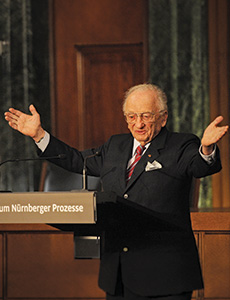
Ben Ferencz’s lifelong commitment to international criminal justice and world peace began in 1945 when he served, at the age of 27, as Chief Prosecutor for the United States at the Nuremberg Trials in The Einsatzgruppen Case. It was his first case. He died at the age of 103 in 2023: www.benferencz.org.
Obligations of States in respect of Climate Change, Advisory Opinion by the International Court of Justice, July 2025
International Tribunal for the Law of the Sea Year 2024
Violations of the European Convention for failing to implement sufficient measures to combat climate change, climate change ruling from the European Court of Human Rights, 2024 (Verein KlimaSeniorinnen Schweiz and Others v Switzerland (application no. 53600/20))

International arbitration was once sold, in part, as an enlightened alternative to economic, and even armed, conflict: a forum in which commercial disputes could be resolved by law rather than power. In a world of proliferating armed conflict, sanctions, climate emergency and deteriorating respect for fundamental rights, investors need predictable rules and states need credible mechanisms through which obligations can be adjudicated. But the old bargain is under strain. Arbitration can no longer pretend that investment disputes are merely private quarrels about property, contracts and compensation. Increasingly, they are disputes about war, energy transition, public health, indigenous land, environmental harm and the capacity of states to govern in the public interest.
Armed conflicts have doubled to 130 in the past 15 years; sanctions are now ordinary tools of statecraft; and climate change, as we approach a global average of 1.5°C, is a present legal and commercial risk. Investments are destroyed, stranded, nationalised, frozen, regulated or rendered uneconomic by events far beyond the assumptions of the twentieth-century bilateral investment treaty. Investor-state arbitration is increasingly asked to adjudicate disorder beyond the state’s control.
A neutral forum, specialist decision-makers, enforceable awards and treaty protections against expropriation, discrimination and unfair treatment may be indispensable where domestic courts are unavailable, unsafe or compromised. In conflict zones, they may be the difference between redress and pure loss. War clauses, full protection and security obligations, compensation-for-losses provisions and fair and equitable treatment can become central when factories are occupied, infrastructure destroyed, concessions revoked or access to assets lost. Güriş v Syria (ICC Case No. 21845/ZF/AYZ) illustrates the point. Turkish investors recovered losses after losing access to cement plants during the Syrian civil war, when the state withdrew and armed groups took control, with the tribunal holding that the Turkey-Syria bilateral investment treaty (BIT) continued to apply notwithstanding the conflict.
For states, however, the picture is more complicated. A state at war, facing civil unrest, climate disaster or financial emergency, must still govern. It must protect life, maintain order, regulate dangerous activity, and comply with international obligations. It may need to suspend projects, redirect resources, impose sanctions, phase out fossil fuels, protect water supplies or regulate public health. If every serious public measure is treated as a compensable interference with investment, arbitration risks becoming not a guardian of law but an indefensible tax on much-needed government action.
This tension is especially acute in disputes arising from armed conflict. Investment treaties often speak of ‘war’, ‘civil disturbance’ or ‘emergency’, but not always with the precision of international humanitarian or criminal law. In Asian Agricultural Products v Sri Lanka (ICSID Case No. ARB/87/3), the first International Centre for Settlement of Investment Disputes-administered treaty arbitration to deal directly with wartime property destruction, the tribunal treated full protection and security as a due diligence obligation but did not meaningfully integrate the law of armed conflict. Tribunals in cases concerning Libya, Sri Lanka and, more recently, Ukraine have often treated conflict as background fact rather than as a legal regime with its own terminology, duties and limits. Where claims arise from occupied territory, military necessity, sanctions or hostilities, investment law cannot be interpreted in a vacuum.
The same is true of climate change. Recent developments, including the July 2025 Advisory Opinion by the International Court of Justice, have strengthened the proposition that states have binding duties to protect the climate system and to regulate private conduct that causes serious environmental harm. That trajectory is reinforced by the 2024 ITLOS advisory opinion on marine pollution, and by the European Court of Human Rights’ recognition that climate protection can fall within positive obligations under Article 8. Coal phase-outs, drilling restrictions, environmental permits and subsidy withdrawals may be part of a state’s international obligation to protect the public and the environment, not automatic treaty breaches.
This does not mean that states should enjoy a blank cheque. Emergency does not excuse bad faith. Climate policy should not become cover for discrimination, confiscation or arbitrary treatment. Armed conflict does not abolish the rule of law. Investors are entitled to expect that states will act transparently, proportionately and consistently with their commitments. But the relevant question should be a more intelligent one than whether an investor has suffered loss. It should be whether the state measure, viewed in its legal and factual context, crossed the threshold from legitimate regulation into unlawful treatment.
Investors contemplating claims could begin with treaty mapping: nationality, timing, territorial scope, survival clauses, dispute-resolution provisions and the precise standards invoked. A company whose plant has been seized after a change in territorial control must know whether the treaty applies to the territory as controlled in fact, whether a war clause offers a distinct route to compensation, and whether sanctions affect the ability to bring or fund the claim. Tribunals in Crimea-related arbitrations against Russia accepted that Ukrainian investments in Crimea could fall within the Russia-Ukraine BIT once Russia exercised de facto control there. An energy investor facing a sudden coal phase-out should ask a different set of questions: was there a legitimate regulatory process, were comparable investors treated alike, and did the state make promises capable of generating protected expectations? Investors should also think about enforcement from the outset. An award against a sanctioned or ‘insolvent’ state is not the same thing as recovery.
States, for their part, should draft and administer investment obligations with equal care. The next generation of treaties could preserve the right to regulate for climate, health, human rights and security, while avoiding language so broad that it swallows investor protection altogether. In practice, that means keeping a documentary record that would withstand arbitral scrutiny: why contested measures were necessary, proportionate and non-discriminatory. States should conduct impact assessments where required, consult affected communities before approving or cancelling major projects, and apply rules consistently rather than targeting an unpopular foreign investor. Good governance is not only a constitutional virtue; in arbitration it is often the best defence.
The harder question is what arbitration owes to third parties. Investment arbitration is usually bilateral in form: investor versus state. Yet the people most affected by the dispute may be elsewhere. They may be communities near a mine, supply-chain workers, indigenous groups whose land is affected, survivors of violence, users of public services or future generations. They do not draft the treaty. They do not appoint the tribunal. They may never see the pleadings. But the award may shape their lives.
This is the central legitimacy problem. Arbitration’s confidentiality, consensual structure and dependence on party submissions are virtues in ordinary commercial disputes. In public interest disputes they can become weaknesses. A tribunal cannot ordinarily compel third-party evidence. Affected communities may participate, if at all, only as amici. Public scrutiny may be limited. Human rights and environmental harm may enter the case only where one party finds it tactically useful.
One answer is to place greater weight on investor responsibility. For too long, investment law has been criticised as a one-way street: rights for investors, obligations for states. Newer treaties increasingly refer to human rights, environmental standards, corporate social responsibility and sustainable development. Some permit counterclaims or allow tribunals to consider investor conduct when assessing damages. The case law already shows that investor behaviour can matter. In Bear Creek v Peru (ICSID Case No. ARB/14/21), failure to secure a social licence from affected indigenous communities limited recovery to sunk costs. In Copper Mesa v Ecuador (PCA No. 2012-2), investor misconduct and violence contributed to a 30% reduction in compensation. In Urbaser v Argentina (ICSID Case No. ARB/07/26), the tribunal accepted jurisdiction over a human-rights counterclaim concerning the right to water, although it ultimately failed because positive obligations, absent treaty provision, did not extend to private entities.
That development should be welcomed. Investors are not states, and we should be cautious before imposing on private actors the full architecture of public international law obligations. But it is no longer credible to say that investors possess treaty rights without any corresponding responsibilities. At a minimum, tribunals should be able to consider whether an investor complied with domestic law, environmental standards, human rights due diligence, anti-corruption rules and meaningful consultation requirements. Where the treaty permits it, states should be able to bring counterclaims. Where the treaty does not, reform can make that possible.
There is also a case for calibrated transparency. Confidentiality can protect settlement, commercial information and sensitive state interests. But where disputes concern essential public services, environmental regulation, public health, mass harm or conduct during armed conflict, secrecy should not be the default. A practical model would publish awards and procedural orders, disclose redacted core pleadings, permit affected communities or expert bodies to file short submissions, and hold public hearings where security and confidentiality permit. That would not turn arbitration into a public inquiry but make it credible where the public is affected.
Procedural reform matters too. Costs and delay are real problems, but the deeper issue is whether arbitration is equipped to handle public-interest complexity. Tribunals should narrow issues, manage evidence actively, address manifestly weak claims early and integrate relevant public international law. That might mean an early phase on jurisdiction and treaty scope in a Crimea-type occupation dispute; requiring parties to identify the precise environmental measure said to breach the treaty; appointing independent experts on climate science or valuation where experts are poles apart; or encouraging mediation where a hospital, port, water system or renewable-energy project must keep operating while the dispute is resolved. The objective should not be arbitration for its own sake, but lawful, legitimate and effective dispute resolution.
Longer-term reform must be more ambitious. States should review older treaties that constrain climate action or fail to reflect modern human rights and environmental standards. Climate carve-outs, express preservation of regulatory space, investor obligations, counterclaim mechanisms and clearer rules on third-party participation should become ordinary features of investment agreements. Instruments such as the 2016 Morocco-Nigeria BIT and the 2019 Dutch Model BIT point in that direction, rebalancing investor protection with investor responsibility, including environmental, labour and human-rights standards. Reform should also confront quantum. Awards based on speculative future profits can turn lawful transition policy into a fiscal catastrophe. Compensation ought to reflect reality, risk and responsibility.
None of this is an argument for abandoning investment arbitration. In a fractured world, legal process remains preferable to retaliation, coercion or diplomatic pressure. Investors need protection from arbitrary state conduct. States need stable rules to attract responsible capital. But arbitration will survive only if it adapts to a world of war, climate emergency, social fracture and public distrust of institutions perceived to privilege private capital over collective survival.
The guiding principle, to quote Ben Ferencz, is simple: the ‘rule of law, not war’ and responsibility as well as rights. Investment arbitration can still provide a forum in which states are held to their promises and investors are protected from unlawful treatment. But it must also recognise that investment does not occur in a moral or legal vacuum. The environment, the public and victims of serious harm are not peripheral to the dispute merely because they are absent from the caption. If arbitration is to remain legitimate in a world in flux, it must make room for them.
Ben Ferencz’s lifelong commitment to international criminal justice and world peace began in 1945 when he served, at the age of 27, as Chief Prosecutor for the United States at the Nuremberg Trials in The Einsatzgruppen Case. It was his first case. He died at the age of 103 in 2023: www.benferencz.org.
Obligations of States in respect of Climate Change, Advisory Opinion by the International Court of Justice, July 2025
International Tribunal for the Law of the Sea Year 2024
Violations of the European Convention for failing to implement sufficient measures to combat climate change, climate change ruling from the European Court of Human Rights, 2024 (Verein KlimaSeniorinnen Schweiz and Others v Switzerland (application no. 53600/20))
As war, climate breakdown and human rights violations reshape global investment, arbitration must protect lawful commerce without becoming blind to the public it affects, argues Aarif Abraham

The Chair of the Bar reports back
Conner Wright, Legal Case Manager at AlphaBiolabs, answers the most frequently asked questions about SCRAM Continuous Alcohol Monitoring (SCRAM CAM®) posed by family law professionals
Ryan Prins of Philips SpeechLive explains how barristers can boost drafting efficiency with AI-assisted speech recognition – while keeping full oversight
Finding available counsel shouldn’t be complicated, says Kaan Kartal of Brieflink
By Kem Kemal, CEO, Henry Dannell
By BSK Financial Planning

For barristers, managing anxiety is a professional discipline as much as a personal one, says Annette Henry KC. This article examines the cues, clues and practical techniques for avoiding overwhelm and regaining calm
If you’ve never been to the Bar Conference before, this is the year to start. Amelia Clegg previews the profession’s flagship event
After a two-year investigation, Karim Khan KC was removed as ICC Chief Prosecutor in July. With the United States threatening to dismantle the court ‘brick by brick’, what’s next for the beleaguered ICC? asks Chris Stephen
Kick off your career at the Bar Council’s Pupillage Fair this October – it’s one of the most valuable opportunities for aspiring barristers, says Amelia Clegg
Join us on Saturday 21 November 2026 at Leeds Beckett University and see for yourself why the North continues to be an exceptional place to build a career at the Bar