*/
Fitzwilliam Museum, Cambridge – until 17 January 2027
Reviewed by Stephen Cragg KC
Something has been happening at the Fitzwilliam Museum. Growing up in Cambridge I remember it as a rather staid and fusty place to visit. However, in 2024, the museum completed a four-year rehang of five main painting galleries, replacing the old arrangement by nationality and date with five themed rooms – Interiors, Men Looking at Women, Identity, Movement and Migration, and Nature. Announcing the change, the museum’s director, Luke Syson, said it ‘juxtaposes historic and contemporary works to offer a narrative that links past and present’. There’s also now an airy entrance, a trendy (if pricey) atrium café, and a rather splendid shop.
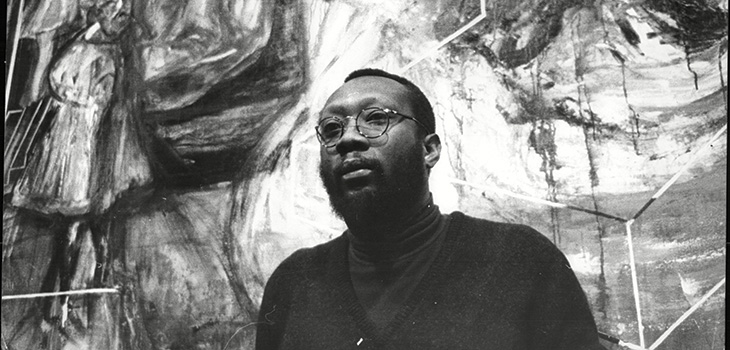
Frank Bowling is part of this new spirit at the Fitzwilliam and he is featured in an exhibition of his own, ‘Seeking the Sublime’, celebrating a career spanning nearly seven decades – gathering works from 1961, when Bowling was still a student, up to a painting finished just last year.
Born in Guyana in 1934, Bowling arrived in London at 19 and quickly found his way into the late-1950s British art world, studying at the Royal College of Art from 1959, where he became friends with David Hockney and was mentored by Francis Bacon. Britain didn’t suit him for long, though, and he moved to New York, working alongside the Abstract Expressionists and following his own interest in colour and geometry. By the mid-1970s he had returned to London, where he has now worked for over four decades.
There have been big retrospectives of Bowling’s work – the Tate Britain show in 2019, for instance, brought together more than 70 paintings. The Fitzwilliam’s exhibition is far more intimate: just ten paintings in a single octagonal room, reached only after walking through the museum’s main galleries. Habda Rashid, the exhibition’s curator and the museum’s first dedicated curator of contemporary art, told Art Africa magazine earlier this year that this route creates ‘an implicit dialogue between past and present’ – and the smaller scale suits Bowling’s work well, since so much of it turns on autobiographical and family memory.
The exhibition opens with The Four Horsemen of the Apocalypse (1961) – a dark, turbulent painting of screaming faces and a fallen body emerging from thick, visceral brushwork. Bowling was given the relevant Bible passage as a subject while at the RCA, but according to the Fitzwilliam’s own wall text, it was also a ‘raw response’ to the murder that same year of the Congolese politician Patrice Lumumba. You can see the influence of his friend and mentor Francis Bacon in its anguished forms. Nearby, Beggar No. 5 (1962-63) is quieter but just as charged: it recalls his mother’s shop in Guyana, where she took in homeless people but made her son wash their feet first, something Bowling has since called traumatic. The figure in the painting looks strangely calm, an unsettling contrast with that memory, and beggars keep reappearing in his early work, as if he were painting his way through it.
From these early figurative works, the show moves into Bowling’s experiments with abstraction like his pouring paintings of the 1970s. In Sentinel (1976), he poured paint onto the canvas and tipped it this way and that, letting gravity do some of the work: streaks of red and blue settle into an upright, almost architectural shape that seems to explain its own title. These paintings sit alongside American colour field painting but have a looser, more improvised, jazz-inspired feel.
Bowling also has an eye for art history that sets him apart from many of his abstract-painting peers. Pond Life (2007) reworks Millais’s famous Ophelia as a hazy yellow field layered over orange and brown, absorbing the original and producing something new. He pushes at what paint can physically do: how thick it can be, how it pools, how it behaves once on the canvas.
Personal life keeps surfacing too. Tracey’s Bouquet (2011) has real petals worked into it, from flowers Tracey Emin sent Bowling when he was awarded the OBE. They are stitched into the canvas using a technique called marouflage, which Bowling took up in the early 1980s to protect the fabric edges of his paintings and later developed into full collage. Swan Upping (2020) is about his lifelong fondness for swans, and the annual count of the birds on the Thames.
Not every painting in Seeking the Sublime hangs in the octagonal room. Potarospray (1980) is elsewhere, in the Fitzwilliam’s newly rehung Movement and Migration gallery, next to a painting by his friend and fellow Guyanese artist Aubrey Williams – one that Bowling bought for the museum himself. The gallery is a fitting spot, reflecting Bowling’s own life.
The last work in the octagonal gallery, made specifically for this show is Yellow Map (2025), a large canvas of South America – the continent that shaped him, even though he was born on its northern edge. Geography has always been personal for Bowling: Guyana, the Atlantic crossings, decades split between Europe and America. And now evocatively presented by the revitalised Fitzwilliam Museum.
Something has been happening at the Fitzwilliam Museum. Growing up in Cambridge I remember it as a rather staid and fusty place to visit. However, in 2024, the museum completed a four-year rehang of five main painting galleries, replacing the old arrangement by nationality and date with five themed rooms – Interiors, Men Looking at Women, Identity, Movement and Migration, and Nature. Announcing the change, the museum’s director, Luke Syson, said it ‘juxtaposes historic and contemporary works to offer a narrative that links past and present’. There’s also now an airy entrance, a trendy (if pricey) atrium café, and a rather splendid shop.
Frank Bowling is part of this new spirit at the Fitzwilliam and he is featured in an exhibition of his own, ‘Seeking the Sublime’, celebrating a career spanning nearly seven decades – gathering works from 1961, when Bowling was still a student, up to a painting finished just last year.
Born in Guyana in 1934, Bowling arrived in London at 19 and quickly found his way into the late-1950s British art world, studying at the Royal College of Art from 1959, where he became friends with David Hockney and was mentored by Francis Bacon. Britain didn’t suit him for long, though, and he moved to New York, working alongside the Abstract Expressionists and following his own interest in colour and geometry. By the mid-1970s he had returned to London, where he has now worked for over four decades.
There have been big retrospectives of Bowling’s work – the Tate Britain show in 2019, for instance, brought together more than 70 paintings. The Fitzwilliam’s exhibition is far more intimate: just ten paintings in a single octagonal room, reached only after walking through the museum’s main galleries. Habda Rashid, the exhibition’s curator and the museum’s first dedicated curator of contemporary art, told Art Africa magazine earlier this year that this route creates ‘an implicit dialogue between past and present’ – and the smaller scale suits Bowling’s work well, since so much of it turns on autobiographical and family memory.
The exhibition opens with The Four Horsemen of the Apocalypse (1961) – a dark, turbulent painting of screaming faces and a fallen body emerging from thick, visceral brushwork. Bowling was given the relevant Bible passage as a subject while at the RCA, but according to the Fitzwilliam’s own wall text, it was also a ‘raw response’ to the murder that same year of the Congolese politician Patrice Lumumba. You can see the influence of his friend and mentor Francis Bacon in its anguished forms. Nearby, Beggar No. 5 (1962-63) is quieter but just as charged: it recalls his mother’s shop in Guyana, where she took in homeless people but made her son wash their feet first, something Bowling has since called traumatic. The figure in the painting looks strangely calm, an unsettling contrast with that memory, and beggars keep reappearing in his early work, as if he were painting his way through it.
From these early figurative works, the show moves into Bowling’s experiments with abstraction like his pouring paintings of the 1970s. In Sentinel (1976), he poured paint onto the canvas and tipped it this way and that, letting gravity do some of the work: streaks of red and blue settle into an upright, almost architectural shape that seems to explain its own title. These paintings sit alongside American colour field painting but have a looser, more improvised, jazz-inspired feel.
Bowling also has an eye for art history that sets him apart from many of his abstract-painting peers. Pond Life (2007) reworks Millais’s famous Ophelia as a hazy yellow field layered over orange and brown, absorbing the original and producing something new. He pushes at what paint can physically do: how thick it can be, how it pools, how it behaves once on the canvas.
Personal life keeps surfacing too. Tracey’s Bouquet (2011) has real petals worked into it, from flowers Tracey Emin sent Bowling when he was awarded the OBE. They are stitched into the canvas using a technique called marouflage, which Bowling took up in the early 1980s to protect the fabric edges of his paintings and later developed into full collage. Swan Upping (2020) is about his lifelong fondness for swans, and the annual count of the birds on the Thames.
Not every painting in Seeking the Sublime hangs in the octagonal room. Potarospray (1980) is elsewhere, in the Fitzwilliam’s newly rehung Movement and Migration gallery, next to a painting by his friend and fellow Guyanese artist Aubrey Williams – one that Bowling bought for the museum himself. The gallery is a fitting spot, reflecting Bowling’s own life.
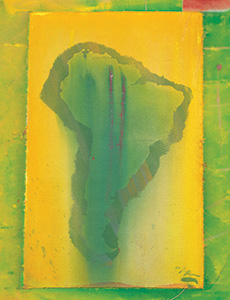
The last work in the octagonal gallery, made specifically for this show is Yellow Map (2025), a large canvas of South America – the continent that shaped him, even though he was born on its northern edge. Geography has always been personal for Bowling: Guyana, the Atlantic crossings, decades split between Europe and America. And now evocatively presented by the revitalised Fitzwilliam Museum.
Fitzwilliam Museum, Cambridge – until 17 January 2027
Reviewed by Stephen Cragg KC

The Chair of the Bar reports back
By Kem Kemal, CEO, Henry Dannell
By BSK Financial Planning
Mário Barroso, Head of R&D and Method Development at AlphaBiolabs
Susie Griffin on the admin that keeps barristers from billable work
Clement Cowley, Partner at The Penny Group, explains how global events can influence the performance of pensions and ISAs, and why taking a long-term approach to investing is often the most effective strategy

Kick off your career at the Bar Council’s Pupillage Fair this October – it’s one of the most valuable opportunities for aspiring barristers, says Amelia Clegg
The golden age of advocacy? David Langwallner pays homage to the filmic if contentious barrister Sir Edward Carson and some of his contemporaries
Henry Fingerhut outlines what the Bar Standards Board AI guidance means for early career barristers
The Ministry of Justice will match-fund up to 100 criminal pupillages, with grants available to criminal chambers across England and Wales. Similar to the COIC scheme, the grants will match-fund pupillages additional to those otherwise offered without government funding
Not yet, says Jacob Turner. Regulation, unlike the technology itself, is a domain the legal profession can still control