*/

Two pupil barristers saw a problem they couldn’t ignore. Six years on, Mass Ndow-Njie and Aaron Mayers reflect on Bridging the Bar’s growth, the paradox at its heart, and the work still to be done
Six years ago, Bridging the Bar (BTB) Academy did not exist. Nor was there a centralised scheme offering hundreds of mini-pupillages each year to aspiring barristers from underrepresented backgrounds. There were no BTB interns at the UK Supreme Court or paid internship opportunities across the Court of Appeal, High Court and Law Commission. There was no network of partner chambers, legal institutions and volunteers helping us deliver the work. There were just two pupil barristers, a problem we could both see, and a question: what were we going to do about it?
We took different routes to the Bar, but we both saw how much of the journey depended on opportunities not equally accessible to all. Talent was everywhere. Access was not. For some, the Bar was a familiar world: there were people to ask, networks to leverage and advice readily available. For others, it was a world they were expected to navigate without a map.
Shortly after BTB was established, Mass wrote in these pages about his journey to the profession, encouraging barristers from non-traditional backgrounds to make themselves visible: ‘Through you, they might see possibilities.’ A year later, Aaron made a similar point in a Medium article: those within the profession could make a difference to those following. Six years on, both ideas remain central: who aspiring barristers can see is just as important as what those through the door will do for them.
Six years of this work have reinforced both beliefs – and taught us what meaningful contribution requires. Inspiration matters, but it cannot provide a mini-pupillage; representation cannot correct the unequal distribution of networks, mentoring and opportunities. Visibility can help aspiring barristers believe they belong at the Bar; opportunity lets them prove it. At some point, someone has to open the door.
When Mass first had the idea for Bridging the Bar, Aaron was his first call. The idea was simple: if access to opportunity was part of the problem, could we bring people together to create more of it? We took on the challenge while establishing our own practices as pupil barristers. The idea was easier than the execution. Neither of us had run a charity before; we were building BTB while learning about the profession for ourselves. We knew we could not do it alone. We brought together people who shared our belief in what BTB could achieve, assembling volunteers for our first Executive Committee. They brought an abundance of energy and ideas, turning an idea shared by two pupil barristers into a functioning organisation. In those early days, we fitted the work around pupillage: court, conferences, deadlines and the demands of establishing our careers.
We quickly learned that recognising inequality at the Bar and agreeing what to do about it were two very different things. Some organisations understood our mission and committed their time, resources and people. Others took more persuading. At times, we saw diversity treated as an event rather than a sustained commitment.
Six years on, we know what genuine investment looks like. It means returning year after year to build a bridge between where the profession is and where it ought to be; giving time, meaningful feedback and real opportunities across the profession; and examining recruitment to ask whether talented candidates are overlooked because they have not had equal opportunities to demonstrate their potential.
We have been fortunate to work with influential organisations which have made that commitment. Their support allowed an idea to become something capable of making a tangible difference. Sometimes that difference is best measured not in programmes or statistics, but in people. Olivia Bennett was part of the first ever cohort of interns on the programme we established in partnership with the UK Supreme Court. Today, she is a barrister at 7BR (the same chambers as Mass) and they have worked alongside each other on cases. There is something particularly rewarding about seeing someone who first came through a BTB programme no longer as a candidate or beneficiary, but simply as a colleague.
Each year, a new cohort joins the BTB Academy. Candidates arrive from different backgrounds, often with considerable ability but uncertain whether they truly belong at the Bar. Over the year, mentoring, advocacy training, application support and professional development build confidence. Applications become stronger. Candidates find their voices. BTB Academy graduates are now between 2.6 and 5.7 times more likely to secure pupillage than the general applicant population.*
Opening a door is not always enough. A mini-pupillage offers little if someone cannot afford the train fare or accommodation to attend. That is why our Resilience Fund helps meet travel, accommodation and caring costs for those most in need, and why the Academy combines practical training with paid internships across the profession. Talent was never the problem. Too often, it is everything between talent and the opportunity to demonstrate it.
For all that progress, however, some barriers remain stubborn. Each year, a new Academy cohort arrives with many of the same concerns. Aspiring barristers still begin from very different starting points: some understand the profession’s unwritten rules; others have to discover them as they go.
Bridging the Bar’s growth brings a tension. We are proud that more candidates join our programmes and more organisations support them. Yet that demand reminds us why our work remains necessary.
The next stage cannot simply help more candidates navigate the profession as it exists. Mentoring, training and creating opportunities will always matter, but lasting progress requires the profession to reflect upon and examine its barriers: how opportunities are distributed, how potential is identified and how recruitment decisions are made.
We have changed too. The two pupil barristers who started Bridging the Bar are now six years into practice. One privilege of that progression has been watching the professional worlds we have built for ourselves overlap with the one we have tried to build through BTB.
What do we want the next six years to bring? We want to make a tangible difference for more people, but scale alone cannot define success. We want former BTB candidates to mentor those who follow them, progress through the profession and eventually occupy positions that shape its future. We want the lessons from our programmes to shape recruitment practices from the inside out, rather than helping candidates navigate them.
There is a paradox at the heart of our ambition for Bridging the Bar. We want BTB to grow to where it is needed, but ultimately we want the need for its work to diminish. The real measure of progress is not how many opportunities we create, but whether an aspiring barrister’s background ceases to influence their ability to access them.
Bridging the Bar began with two pupil barristers asking what we could do. Six years later, we have part of the answer. The next six years are about ensuring that more of the profession becomes part of it.
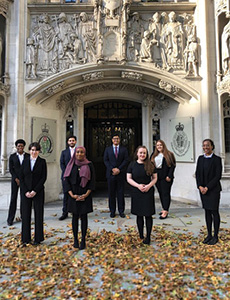
Making history: The first Bridging the Bar UK Supreme Court Interns, in November 2021.
Joining the BTB network
Join over 70 chambers, 26 sponsorship partners and over 300 barristers and members of the judiciary in supporting BTB to achieve its vision for a society where the Bar is accessible for everyone regardless of race, sex, class or other characteristic. Find out more at bridgingthebar.org/our-partners/
* Based on data from BTB’s 24/25 cohort compared with data from the Pupillage Gateway.

Mass Ndow-Njie is an award-winning barrister at 7BR Chambers, specialising in clinical negligence, inquests, public inquiries and sports law. He is the founder and Chair of Bridging the Bar.

Aaron Mayers, a commercial and chancery barrister, works within the Commercial Litigation and Restructuring practice in Conyers’ BVI office. Prior to joining Conyers, Aaron practised at one of England’s largest barristers chambers. Aaron is co-founder and a trustee of Bridging the Bar.
Six years ago, Bridging the Bar (BTB) Academy did not exist. Nor was there a centralised scheme offering hundreds of mini-pupillages each year to aspiring barristers from underrepresented backgrounds. There were no BTB interns at the UK Supreme Court or paid internship opportunities across the Court of Appeal, High Court and Law Commission. There was no network of partner chambers, legal institutions and volunteers helping us deliver the work. There were just two pupil barristers, a problem we could both see, and a question: what were we going to do about it?
We took different routes to the Bar, but we both saw how much of the journey depended on opportunities not equally accessible to all. Talent was everywhere. Access was not. For some, the Bar was a familiar world: there were people to ask, networks to leverage and advice readily available. For others, it was a world they were expected to navigate without a map.
Shortly after BTB was established, Mass wrote in these pages about his journey to the profession, encouraging barristers from non-traditional backgrounds to make themselves visible: ‘Through you, they might see possibilities.’ A year later, Aaron made a similar point in a Medium article: those within the profession could make a difference to those following. Six years on, both ideas remain central: who aspiring barristers can see is just as important as what those through the door will do for them.
Six years of this work have reinforced both beliefs – and taught us what meaningful contribution requires. Inspiration matters, but it cannot provide a mini-pupillage; representation cannot correct the unequal distribution of networks, mentoring and opportunities. Visibility can help aspiring barristers believe they belong at the Bar; opportunity lets them prove it. At some point, someone has to open the door.
When Mass first had the idea for Bridging the Bar, Aaron was his first call. The idea was simple: if access to opportunity was part of the problem, could we bring people together to create more of it? We took on the challenge while establishing our own practices as pupil barristers. The idea was easier than the execution. Neither of us had run a charity before; we were building BTB while learning about the profession for ourselves. We knew we could not do it alone. We brought together people who shared our belief in what BTB could achieve, assembling volunteers for our first Executive Committee. They brought an abundance of energy and ideas, turning an idea shared by two pupil barristers into a functioning organisation. In those early days, we fitted the work around pupillage: court, conferences, deadlines and the demands of establishing our careers.
We quickly learned that recognising inequality at the Bar and agreeing what to do about it were two very different things. Some organisations understood our mission and committed their time, resources and people. Others took more persuading. At times, we saw diversity treated as an event rather than a sustained commitment.
Six years on, we know what genuine investment looks like. It means returning year after year to build a bridge between where the profession is and where it ought to be; giving time, meaningful feedback and real opportunities across the profession; and examining recruitment to ask whether talented candidates are overlooked because they have not had equal opportunities to demonstrate their potential.
We have been fortunate to work with influential organisations which have made that commitment. Their support allowed an idea to become something capable of making a tangible difference. Sometimes that difference is best measured not in programmes or statistics, but in people. Olivia Bennett was part of the first ever cohort of interns on the programme we established in partnership with the UK Supreme Court. Today, she is a barrister at 7BR (the same chambers as Mass) and they have worked alongside each other on cases. There is something particularly rewarding about seeing someone who first came through a BTB programme no longer as a candidate or beneficiary, but simply as a colleague.
Each year, a new cohort joins the BTB Academy. Candidates arrive from different backgrounds, often with considerable ability but uncertain whether they truly belong at the Bar. Over the year, mentoring, advocacy training, application support and professional development build confidence. Applications become stronger. Candidates find their voices. BTB Academy graduates are now between 2.6 and 5.7 times more likely to secure pupillage than the general applicant population.*
Opening a door is not always enough. A mini-pupillage offers little if someone cannot afford the train fare or accommodation to attend. That is why our Resilience Fund helps meet travel, accommodation and caring costs for those most in need, and why the Academy combines practical training with paid internships across the profession. Talent was never the problem. Too often, it is everything between talent and the opportunity to demonstrate it.
For all that progress, however, some barriers remain stubborn. Each year, a new Academy cohort arrives with many of the same concerns. Aspiring barristers still begin from very different starting points: some understand the profession’s unwritten rules; others have to discover them as they go.
Bridging the Bar’s growth brings a tension. We are proud that more candidates join our programmes and more organisations support them. Yet that demand reminds us why our work remains necessary.
The next stage cannot simply help more candidates navigate the profession as it exists. Mentoring, training and creating opportunities will always matter, but lasting progress requires the profession to reflect upon and examine its barriers: how opportunities are distributed, how potential is identified and how recruitment decisions are made.
We have changed too. The two pupil barristers who started Bridging the Bar are now six years into practice. One privilege of that progression has been watching the professional worlds we have built for ourselves overlap with the one we have tried to build through BTB.
What do we want the next six years to bring? We want to make a tangible difference for more people, but scale alone cannot define success. We want former BTB candidates to mentor those who follow them, progress through the profession and eventually occupy positions that shape its future. We want the lessons from our programmes to shape recruitment practices from the inside out, rather than helping candidates navigate them.
There is a paradox at the heart of our ambition for Bridging the Bar. We want BTB to grow to where it is needed, but ultimately we want the need for its work to diminish. The real measure of progress is not how many opportunities we create, but whether an aspiring barrister’s background ceases to influence their ability to access them.
Bridging the Bar began with two pupil barristers asking what we could do. Six years later, we have part of the answer. The next six years are about ensuring that more of the profession becomes part of it.
Making history: The first Bridging the Bar UK Supreme Court Interns, in November 2021.
Joining the BTB network
Join over 70 chambers, 26 sponsorship partners and over 300 barristers and members of the judiciary in supporting BTB to achieve its vision for a society where the Bar is accessible for everyone regardless of race, sex, class or other characteristic. Find out more at bridgingthebar.org/our-partners/
* Based on data from BTB’s 24/25 cohort compared with data from the Pupillage Gateway.
Two pupil barristers saw a problem they couldn’t ignore. Six years on, Mass Ndow-Njie and Aaron Mayers reflect on Bridging the Bar’s growth, the paradox at its heart, and the work still to be done

The Chair of the Bar reports back
By Kem Kemal, CEO, Henry Dannell
By BSK Financial Planning
Mário Barroso, Head of R&D and Method Development at AlphaBiolabs
Susie Griffin on the admin that keeps barristers from billable work
Clement Cowley, Partner at The Penny Group, explains how global events can influence the performance of pensions and ISAs, and why taking a long-term approach to investing is often the most effective strategy

Kick off your career at the Bar Council’s Pupillage Fair this October – it’s one of the most valuable opportunities for aspiring barristers, says Amelia Clegg
The golden age of advocacy? David Langwallner pays homage to the filmic if contentious barrister Sir Edward Carson and some of his contemporaries
Henry Fingerhut outlines what the Bar Standards Board AI guidance means for early career barristers
The Ministry of Justice will match-fund up to 100 criminal pupillages, with grants available to criminal chambers across England and Wales. Similar to the COIC scheme, the grants will match-fund pupillages additional to those otherwise offered without government funding
Not yet, says Jacob Turner. Regulation, unlike the technology itself, is a domain the legal profession can still control