*/

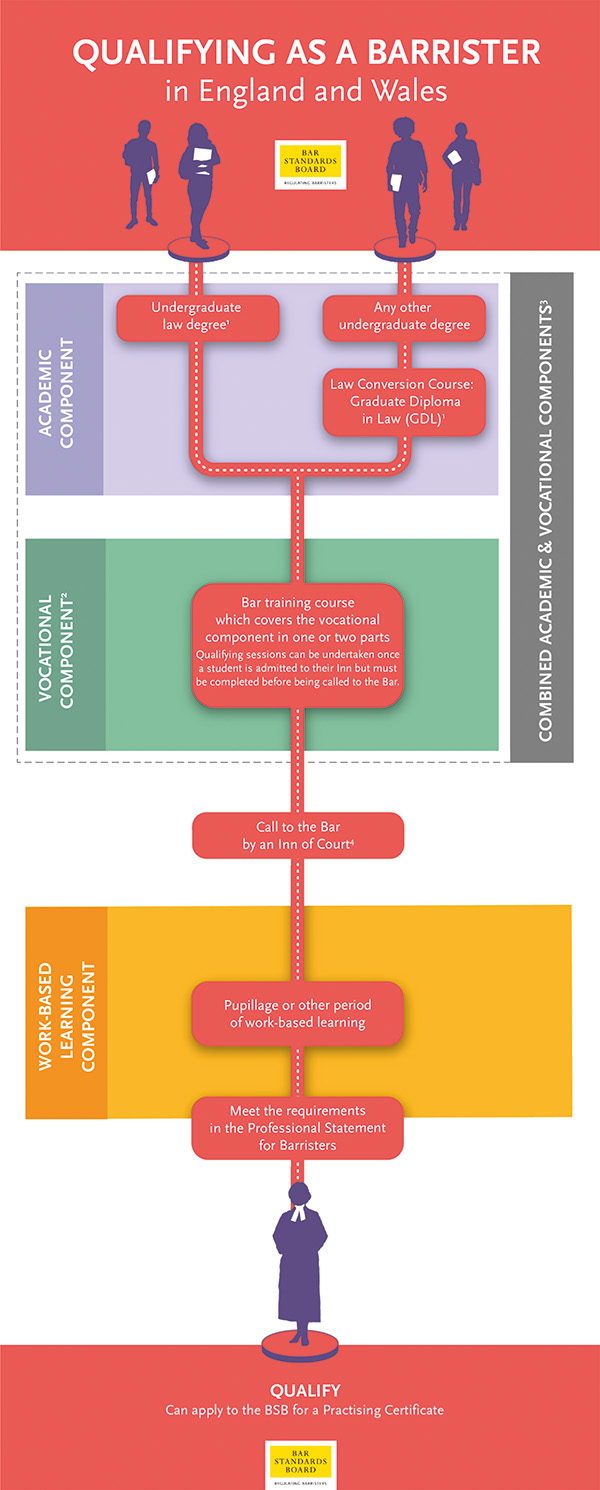
Afew years ago, the Bar’s regulator, the Bar Standards Board (BSB) set out all the knowledge and skills that barristers need on their first day of practice in a document called the Professional Statement, which you can find on our website. The purpose of Bar training is to teach that knowledge and those skills. The path to qualifying as a barrister is shown in the flowchart image overleaf.
There is a lot to learn, and we are very conscious that this can be a long and expensive process. So, in 2019 the BSB introduced a number of reforms to Bar training following several years of engagement, consultation and discussion with the profession, training providers and students. We wanted to achieve:
So, how did we do? Our evaluation of our reforms continues, but our latest 2023 Bar Training Report and an independent evaluation by independent consultants AlphaPlus suggest that we have made some real progress in meeting our objectives.
It’s universities and not the BSB who decide how law degrees are designed – we simply require that your degree or your GDL covers the seven foundations of legal knowledge* and the skills associated with graduate legal work such as legal research and that you achieve at least a 2:2. But we do regulate the way in which the post-graduate vocational Bar training courses are delivered and, following our reforms:
So, we have had some real success with making training more accessible, more affordable and more flexible – there’s more choice as to how and where you study and courses are cheaper – but what about standards?
It is early days to reach conclusions on standards as the new Bar courses were only introduced in 2020. Our report of December 2022 shows that success rates for the cohort that entered Bar training in 2020 vary between 49% and 94%. But success rates are not a simple proxy for assessing standards and these numbers will continue to change as further students complete the course. Not is it straightforward to compare the results of one provider with another because each year of students will vary both in terms of size and the percentage who are taking an assessment for the first time or resitting. In his report covering the December 2022 sitting, the Chair of the Centralised Examinations Board shows that our centralised exams remain demanding with an average pass rate of around 56% for civil litigation and around 50% for criminal litigation. The Report also shows the variation in pass rates between different providers and explains some of the factors that may lead to these variations. The assessments are high stakes and act as a gateway to the profession. They are supported by a highly experienced team within the BSB and externally by independent specialists across the Bar education and training sector.
We want to see a more diverse Bar where success is based on merit alone. We will be able to say more about standards once we have conducted a thematic review of providers’ admissions arrangements, which will also look at how they ensure that standards are maintained once a student is admitted and what systems are in place to ensure that students develop to their full potential, whatever their starting point. This review will begin shortly and will provide useful information on the rigour providers employ in their admissions processes to ensure that only those with a credible chance of success on the course are selected.
Finally, we are also conducting research into pupillage recruitment with a particular focus on fairness and transparency in the process. Finding pupillage after you have completed your vocational training course remains very competitive and there are always many more students seeking pupillages than there are places available. The better your degree, the better are your chances: our research shows that within five years of completing their vocational training around 60-70% of UK based students with a first class degree go on to find pupillage, around 40-50% with a 2:1 and 10-20% with a 2:2. But that certainly doesn’t mean that it’s impossible to get pupillage and we don’t see our role as managing the demand for Bar training. What we do have to do, is to ensure that everyone who is admitted for vocational training is given every possible support to enable them to succeed.
We also want to ensure that students are provided with good, comparable information about the prospects of passing the Bar course and obtaining pupillage. We produce statistics to help students to consider their prospects, which you can find on our website, and course providers are required to provide accessible information, among other things, about pass rates and success rates in securing pupillage. We want to ensure that students can make informed and realistic decisions before they commit themselves financially to Bar training.
Our reforms to Bar training have not yet concluded. The new assessment of Professional Ethics during pupillage has proved timely as ethical issues have risen up the agenda for both the profession and for the regulator. We are also in the process of developing our assessment expectations for competency in two other key skills required of a barrister – advocacy and negotiation.
Finally, the Professional Statement, which forms the basis for the curriculum for Bar training and underpins our framework for continuing professional development, will be kept under review to ensure it remains fit for the future – for example, in relation to new technology (the risks and opportunities of AI and tools such as ChatGPT have been much discussed this year). As part of our work on the continuing competency framework for newly qualified barristers and beyond, we will look at how the Professional Statement can be further embedded into professional development and how it can best support barristers in practice.
So, our research suggests that our Bar training reforms have made good progress towards our aims of a more flexible, affordable and accessible route to practice at the Bar while maintaining high standards. We will never be complacent, however, as our commitment to continuing evaluation and thematic reviews demonstrates. Effective Bar training is fundamental to promoting a diverse and thriving Bar. Through proportionate regulation and reform where it is needed, the BSB can play its part in ensuring a highly competent and more diverse profession where everyone has the chance to succeed on merit.

Mark Neale was Director General of the Bar Standards Board from February 2020 to March 2026.
Afew years ago, the Bar’s regulator, the Bar Standards Board (BSB) set out all the knowledge and skills that barristers need on their first day of practice in a document called the Professional Statement, which you can find on our website. The purpose of Bar training is to teach that knowledge and those skills. The path to qualifying as a barrister is shown in the flowchart image overleaf.
There is a lot to learn, and we are very conscious that this can be a long and expensive process. So, in 2019 the BSB introduced a number of reforms to Bar training following several years of engagement, consultation and discussion with the profession, training providers and students. We wanted to achieve:
So, how did we do? Our evaluation of our reforms continues, but our latest 2023 Bar Training Report and an independent evaluation by independent consultants AlphaPlus suggest that we have made some real progress in meeting our objectives.
It’s universities and not the BSB who decide how law degrees are designed – we simply require that your degree or your GDL covers the seven foundations of legal knowledge* and the skills associated with graduate legal work such as legal research and that you achieve at least a 2:2. But we do regulate the way in which the post-graduate vocational Bar training courses are delivered and, following our reforms:
So, we have had some real success with making training more accessible, more affordable and more flexible – there’s more choice as to how and where you study and courses are cheaper – but what about standards?
It is early days to reach conclusions on standards as the new Bar courses were only introduced in 2020. Our report of December 2022 shows that success rates for the cohort that entered Bar training in 2020 vary between 49% and 94%. But success rates are not a simple proxy for assessing standards and these numbers will continue to change as further students complete the course. Not is it straightforward to compare the results of one provider with another because each year of students will vary both in terms of size and the percentage who are taking an assessment for the first time or resitting. In his report covering the December 2022 sitting, the Chair of the Centralised Examinations Board shows that our centralised exams remain demanding with an average pass rate of around 56% for civil litigation and around 50% for criminal litigation. The Report also shows the variation in pass rates between different providers and explains some of the factors that may lead to these variations. The assessments are high stakes and act as a gateway to the profession. They are supported by a highly experienced team within the BSB and externally by independent specialists across the Bar education and training sector.
We want to see a more diverse Bar where success is based on merit alone. We will be able to say more about standards once we have conducted a thematic review of providers’ admissions arrangements, which will also look at how they ensure that standards are maintained once a student is admitted and what systems are in place to ensure that students develop to their full potential, whatever their starting point. This review will begin shortly and will provide useful information on the rigour providers employ in their admissions processes to ensure that only those with a credible chance of success on the course are selected.
Finally, we are also conducting research into pupillage recruitment with a particular focus on fairness and transparency in the process. Finding pupillage after you have completed your vocational training course remains very competitive and there are always many more students seeking pupillages than there are places available. The better your degree, the better are your chances: our research shows that within five years of completing their vocational training around 60-70% of UK based students with a first class degree go on to find pupillage, around 40-50% with a 2:1 and 10-20% with a 2:2. But that certainly doesn’t mean that it’s impossible to get pupillage and we don’t see our role as managing the demand for Bar training. What we do have to do, is to ensure that everyone who is admitted for vocational training is given every possible support to enable them to succeed.
We also want to ensure that students are provided with good, comparable information about the prospects of passing the Bar course and obtaining pupillage. We produce statistics to help students to consider their prospects, which you can find on our website, and course providers are required to provide accessible information, among other things, about pass rates and success rates in securing pupillage. We want to ensure that students can make informed and realistic decisions before they commit themselves financially to Bar training.
Our reforms to Bar training have not yet concluded. The new assessment of Professional Ethics during pupillage has proved timely as ethical issues have risen up the agenda for both the profession and for the regulator. We are also in the process of developing our assessment expectations for competency in two other key skills required of a barrister – advocacy and negotiation.
Finally, the Professional Statement, which forms the basis for the curriculum for Bar training and underpins our framework for continuing professional development, will be kept under review to ensure it remains fit for the future – for example, in relation to new technology (the risks and opportunities of AI and tools such as ChatGPT have been much discussed this year). As part of our work on the continuing competency framework for newly qualified barristers and beyond, we will look at how the Professional Statement can be further embedded into professional development and how it can best support barristers in practice.
So, our research suggests that our Bar training reforms have made good progress towards our aims of a more flexible, affordable and accessible route to practice at the Bar while maintaining high standards. We will never be complacent, however, as our commitment to continuing evaluation and thematic reviews demonstrates. Effective Bar training is fundamental to promoting a diverse and thriving Bar. Through proportionate regulation and reform where it is needed, the BSB can play its part in ensuring a highly competent and more diverse profession where everyone has the chance to succeed on merit.

The Chair of the Bar reports back
Clement Cowley, Partner at The Penny Group, explains how global events can influence the performance of pensions and ISAs, and why taking a long-term approach to investing is often the most effective strategy
Mário Barroso, Head of R&D and Method Development at AlphaBiolabs, discusses what family law professionals need to know about hallucinogens, from the main hallucinogenic drugs encountered in family proceedings, to their effects and the testing options available
Harmony Christian Ministries is the latest charity to benefit from a £500 donation from AlphaBiolabs via the company’s Giving Back initiative
By David Green
Mário Barroso, Head of R&D and Method Development at AlphaBiolabs, examines the forensic science underpinning hair drug testing, its evidential scope and limitations, and why it remains the gold standard for evidencing patterns of drug use in family proceedings
Developing a tech start-up demands a different definition of excellence to the Bar, says Saara Idelbi. The co-creator of Advocatr on entrepreneurship, AI advocacy training, and matching the thrill of a killer cross-examination
At the start of her term, Chair of the Bar 2026 Kirsty Brimelow KC set out a series of priorities for the year ahead. One of those priorities was children in the justice system
As the world becomes more digital, Barbara Vinagre Mota examines international research into the mental health consequences of judges’ exposure to graphic and immersive evidence, highlighting the importance of support systems
Reviewed by Daniel Barnett
James McNeill Whistler at Tate Britain until 27 September Rothko in Florence at Palazzo Strozzi until 23 August Reviewed by Stephen Cragg KC