*/
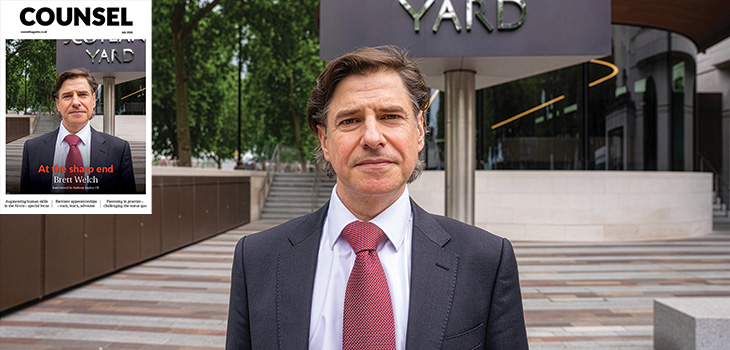
The Chief Legal Officer to the Metropolitan Police, barrister Brett Welch, tells Anthony Inglese CB about his mission and the work to turn the Met around
‘It was a re-creation of the trial of Charles I. I remember watching it on television when I was 10 or 11. I fell in love with the idea of defending courageously an innocent person and getting them off. I knew from then on that I wanted to be a barrister. For me, it was about helping people.’
His career journey took him from chambers to government and now to the job of Chief Legal Officer to the Metropolitan Police, where he has been for the last two years. I am sitting with Brett Welch in a conference room high up in a London police station. Few lawyers have a job that surpasses his in terms of being at the sharp end.
‘The job’s exciting. I like the mission: keeping London safe and being the most trusted police service in the world.’ He leads a legal team of a hundred. ‘As a member of the executive committee I enjoy working with the top of the office to run a police service of 44,000 people and to turn the Met around. There are behaviours that need challenging and addressing, people here that shouldn’t be. In the last three years more than 1,500 officers have been kicked out or left for various forms of misconduct, poor performance or not meeting standards.
‘Two of my legal teams are devoted to misconduct cases. The Met is becoming consciously more open. We need to talk more about what we are doing and engage more with the public. Where something big has happened, we need to get in ahead of the people whose misleading posts on social media risk inflaming tensions; for example, in the case of offences that have given rise to public concern, by sharing the nationality of people who have been arrested and the community from which they come.’ He is in regular contact with government on a range of policy and legal issues, with the Director of Public Prosecutions on cases and with senior criminal and civil judges for constructive discussions about the justice system. His teams advise on inquiries and on the 160-odd inquests that involve the Met in any one year. A currently topical inquiry is the one conducted by Dr Gillian Fairfield into whether the Met has effectively addressed the institutional racism, misogyny and homophobia identified in an earlier report into the murder of Sarah Everard by a serving police officer.
Welch’s in-box reads like a set of BBC news headlines: Mandelson. Helping the Met with the investigation into alleged misconduct in public office. The apology to Graham Linehan, Father Ted creator, for ‘shortcomings’ in the investigation leading to his arrest for gender-critical social media postings. The case prompted a significant change and the Met no longer investigates non-crime hate incidents. Shortly before our interview Sir Mark Rowley, the Commissioner, had written to Zack Polanski, Leader of the Green Party, who had criticised the force used to detain the man suspected of the Golders Green stabbings. ‘Sir Mark was effectively saying, “I don’t intervene in politics, so don’t you make ill-informed comments about policing.” Live facial recognition is a key policing tool. We were very pleased with a recent Divisional Court judgment approving our approach. With the right safeguards on where, when and how we use it, we can create watchlists to identify and catch people wanted for serious offences such as rape and armed robbery.’ Then there’s undercover policing. ‘I’ve got separate teams to advise the mostly former officers, and their managers, and the Commissioner and to handle claims.’
Much attention is given to the policing of protests. ‘We can impose restrictions on marches, for example as to timing and location. If we reasonably believe imposing restrictions will not prevent a march from resulting in serious public disorder, we can ask the Home Secretary for permission to ban the march. We recently used these powers under the 1986 Public Order Act for the first time since 2012 to ban marches for Al-Quds Day and counter-protests in London for a month. We can’t ban static protests, and these went ahead, but in order to minimise risk we required the two protests to be held on opposite sides of the Thames. We also framed the restrictions so that the protests would happen on a Sunday for no more than two hours. This reduced the impact on other communities and businesses. It requires a careful balancing act of the various competing human rights of all involved. And there is, of course, the appeal by the Home Secretary to the Court of Appeal against the Divisional Court’s finding that her proscription of Palestine Action as a terrorist organisation was unlawful.’
How does he keep tabs on everything? ‘I speak constantly to my teams and we use a risk tracker.’ And the secret to being a trusted adviser? ‘Lawyers must avoid being perceived as a barrier. It is not for us to say you can’t do something – unless it unarguably involves a breach of the law. We use a legal risk framework that I introduced to give our clients an analysis of the risks of challenge and of the likelihood and consequences of winning or losing. Across my career some of our clients have then said: thanks for your advice but would you now advise us on what we should do. So, lawyers need to work in different ways with different clients. Not knowing your clients can be a disadvantage. I sometimes have to give advice that I know people don’t want to hear. So, it’s important to build a relationship of trust. Additionally, I use my contacts across government to ensure the Met’s position is understood, but also to understand why sometimes it cannot be accommodated.’
Welch was born and brought up in Buckinghamshire. ‘My parents were first generation graduates, my father a local GP and my mother a hospital manager. They saved for my education from the moment I was born. For years I felt I needed to hide my education at a fee-paying public school, Malvern College in Worcestershire. It took me a long time to be able to talk openly about it. School gave me wonderful opportunities, but you still have to work hard and take them. I am proud that I did. History was my favourite subject. I represented the school at football, cricket and rugby. I played the piano and the trumpet in the school orchestra, brass and wind bands and formed my own jazz band. I was an all-rounder without excelling in any one thing. It taught me that I could handle anything and that I’d be alright. That gave me confidence to go for things in future life – not that I was entitled to succeed, but I was entitled to have a go.
‘When I told my history teacher I wanted to be a barrister, he said: the Bar is competitive, you’ll need a good degree, so do a degree you like and will do well in, get the right result and then convert to law.’ Welch studied history at Manchester, got that good degree, did some mini-pupillages, solicitor placements and judicial shadowing in a Magistrates’ Court, and – ‘still with the romantic attachment to defending people’s interests and their lives’ – was called in 1996. He applied to chambers (‘lots of chambers!’) and obtained pupillage and a tenancy in what was then called Verulam Chambers. ‘This was a classic common law set, a real mix, including crime, mostly defence but some prosecution. I enjoyed it, despite finding it utterly terrifying at times, constantly finding myself in new situations and always fearing I would be judged on my last case.’
Two years later he entered government legal service. Why? ‘It was push and pull. My practice was taking me away from home. Staying away for hearings, having to drop everything at short notice. We got married, moved out of London and wanted to have a family. I realised to be as “present” a parent as I wanted to be I would have to leave the self-employed Bar. A friend in Customs told me that the work was interesting. I ended up joining the special case unit there, prosecuting gun running and drug smuggling, VAT fraud and duty evasion, multi-handed cases of high value, much higher than I would have been getting at the Bar.’
There followed a strikingly successful legal career in government: deputy legal director to the newly-created Assets Recovery Agency, where he helped to set up the Agency and the legal team and to conduct the first ever civil recovery investigations and litigation; adviser in the Education department, where he led the legal team delivering the Coalition policy for taking schools out of local authority control (the Academies and Free Schools programmes); the Treasury, where there was a heavy subordinate legislation drafting practice and international sanctions (‘Russia invaded the Crimea and we worked over the weekend on financial sanctions’); and then to the Transport department, where in 2018 he became the head of the legal department. ‘I felt I had “arrived”. We worked on preparations for a No Deal Brexit and for a With Deal Brexit, the third runway at Heathrow, HS2. During COVID, transport – international and domestic – was a big issue.’
Welch’s last government job was as head of litigation in the Government Legal Department in 2022. ‘I had moved from a £17 million budget in Transport and leading 170 people to a budget of £69 million and leading 650 people. It is the biggest litigation practice in the country, tackling cases from the smallest slips and trips to the biggest constitutional cases of the day. When the headhunters contacted me about the Met Police job, I thought: I am happy where I am, it’s not the right timing after only 21 months in post, but it’s too good a job not to go for!’
Advice to others starting out? ‘It’s good to have an idea of roughly what you want your career to look like. But review it regularly: many of those who have the most fulfilling careers are flexible and open to taking the risk of moving in a totally different direction, of accepting an unexpected secondment, of taking up a new area of law. So, don’t be too rigid, and be prepared to seize opportunities, whether expected or unexpected.’
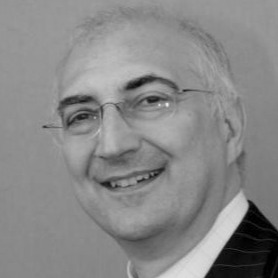
Anthony Inglese CB was head of legal in five Government Legal Departments over a 38-year career, most recently as General Counsel and Solicitor to HM Revenue & Customs. A Bencher of Gray’s Inn, he now trains and mentors lawyers.
‘It was a re-creation of the trial of Charles I. I remember watching it on television when I was 10 or 11. I fell in love with the idea of defending courageously an innocent person and getting them off. I knew from then on that I wanted to be a barrister. For me, it was about helping people.’
His career journey took him from chambers to government and now to the job of Chief Legal Officer to the Metropolitan Police, where he has been for the last two years. I am sitting with Brett Welch in a conference room high up in a London police station. Few lawyers have a job that surpasses his in terms of being at the sharp end.
‘The job’s exciting. I like the mission: keeping London safe and being the most trusted police service in the world.’ He leads a legal team of a hundred. ‘As a member of the executive committee I enjoy working with the top of the office to run a police service of 44,000 people and to turn the Met around. There are behaviours that need challenging and addressing, people here that shouldn’t be. In the last three years more than 1,500 officers have been kicked out or left for various forms of misconduct, poor performance or not meeting standards.
‘Two of my legal teams are devoted to misconduct cases. The Met is becoming consciously more open. We need to talk more about what we are doing and engage more with the public. Where something big has happened, we need to get in ahead of the people whose misleading posts on social media risk inflaming tensions; for example, in the case of offences that have given rise to public concern, by sharing the nationality of people who have been arrested and the community from which they come.’ He is in regular contact with government on a range of policy and legal issues, with the Director of Public Prosecutions on cases and with senior criminal and civil judges for constructive discussions about the justice system. His teams advise on inquiries and on the 160-odd inquests that involve the Met in any one year. A currently topical inquiry is the one conducted by Dr Gillian Fairfield into whether the Met has effectively addressed the institutional racism, misogyny and homophobia identified in an earlier report into the murder of Sarah Everard by a serving police officer.
Welch’s in-box reads like a set of BBC news headlines: Mandelson. Helping the Met with the investigation into alleged misconduct in public office. The apology to Graham Linehan, Father Ted creator, for ‘shortcomings’ in the investigation leading to his arrest for gender-critical social media postings. The case prompted a significant change and the Met no longer investigates non-crime hate incidents. Shortly before our interview Sir Mark Rowley, the Commissioner, had written to Zack Polanski, Leader of the Green Party, who had criticised the force used to detain the man suspected of the Golders Green stabbings. ‘Sir Mark was effectively saying, “I don’t intervene in politics, so don’t you make ill-informed comments about policing.” Live facial recognition is a key policing tool. We were very pleased with a recent Divisional Court judgment approving our approach. With the right safeguards on where, when and how we use it, we can create watchlists to identify and catch people wanted for serious offences such as rape and armed robbery.’ Then there’s undercover policing. ‘I’ve got separate teams to advise the mostly former officers, and their managers, and the Commissioner and to handle claims.’
Much attention is given to the policing of protests. ‘We can impose restrictions on marches, for example as to timing and location. If we reasonably believe imposing restrictions will not prevent a march from resulting in serious public disorder, we can ask the Home Secretary for permission to ban the march. We recently used these powers under the 1986 Public Order Act for the first time since 2012 to ban marches for Al-Quds Day and counter-protests in London for a month. We can’t ban static protests, and these went ahead, but in order to minimise risk we required the two protests to be held on opposite sides of the Thames. We also framed the restrictions so that the protests would happen on a Sunday for no more than two hours. This reduced the impact on other communities and businesses. It requires a careful balancing act of the various competing human rights of all involved. And there is, of course, the appeal by the Home Secretary to the Court of Appeal against the Divisional Court’s finding that her proscription of Palestine Action as a terrorist organisation was unlawful.’
How does he keep tabs on everything? ‘I speak constantly to my teams and we use a risk tracker.’ And the secret to being a trusted adviser? ‘Lawyers must avoid being perceived as a barrier. It is not for us to say you can’t do something – unless it unarguably involves a breach of the law. We use a legal risk framework that I introduced to give our clients an analysis of the risks of challenge and of the likelihood and consequences of winning or losing. Across my career some of our clients have then said: thanks for your advice but would you now advise us on what we should do. So, lawyers need to work in different ways with different clients. Not knowing your clients can be a disadvantage. I sometimes have to give advice that I know people don’t want to hear. So, it’s important to build a relationship of trust. Additionally, I use my contacts across government to ensure the Met’s position is understood, but also to understand why sometimes it cannot be accommodated.’
Welch was born and brought up in Buckinghamshire. ‘My parents were first generation graduates, my father a local GP and my mother a hospital manager. They saved for my education from the moment I was born. For years I felt I needed to hide my education at a fee-paying public school, Malvern College in Worcestershire. It took me a long time to be able to talk openly about it. School gave me wonderful opportunities, but you still have to work hard and take them. I am proud that I did. History was my favourite subject. I represented the school at football, cricket and rugby. I played the piano and the trumpet in the school orchestra, brass and wind bands and formed my own jazz band. I was an all-rounder without excelling in any one thing. It taught me that I could handle anything and that I’d be alright. That gave me confidence to go for things in future life – not that I was entitled to succeed, but I was entitled to have a go.
‘When I told my history teacher I wanted to be a barrister, he said: the Bar is competitive, you’ll need a good degree, so do a degree you like and will do well in, get the right result and then convert to law.’ Welch studied history at Manchester, got that good degree, did some mini-pupillages, solicitor placements and judicial shadowing in a Magistrates’ Court, and – ‘still with the romantic attachment to defending people’s interests and their lives’ – was called in 1996. He applied to chambers (‘lots of chambers!’) and obtained pupillage and a tenancy in what was then called Verulam Chambers. ‘This was a classic common law set, a real mix, including crime, mostly defence but some prosecution. I enjoyed it, despite finding it utterly terrifying at times, constantly finding myself in new situations and always fearing I would be judged on my last case.’
Two years later he entered government legal service. Why? ‘It was push and pull. My practice was taking me away from home. Staying away for hearings, having to drop everything at short notice. We got married, moved out of London and wanted to have a family. I realised to be as “present” a parent as I wanted to be I would have to leave the self-employed Bar. A friend in Customs told me that the work was interesting. I ended up joining the special case unit there, prosecuting gun running and drug smuggling, VAT fraud and duty evasion, multi-handed cases of high value, much higher than I would have been getting at the Bar.’
There followed a strikingly successful legal career in government: deputy legal director to the newly-created Assets Recovery Agency, where he helped to set up the Agency and the legal team and to conduct the first ever civil recovery investigations and litigation; adviser in the Education department, where he led the legal team delivering the Coalition policy for taking schools out of local authority control (the Academies and Free Schools programmes); the Treasury, where there was a heavy subordinate legislation drafting practice and international sanctions (‘Russia invaded the Crimea and we worked over the weekend on financial sanctions’); and then to the Transport department, where in 2018 he became the head of the legal department. ‘I felt I had “arrived”. We worked on preparations for a No Deal Brexit and for a With Deal Brexit, the third runway at Heathrow, HS2. During COVID, transport – international and domestic – was a big issue.’
Welch’s last government job was as head of litigation in the Government Legal Department in 2022. ‘I had moved from a £17 million budget in Transport and leading 170 people to a budget of £69 million and leading 650 people. It is the biggest litigation practice in the country, tackling cases from the smallest slips and trips to the biggest constitutional cases of the day. When the headhunters contacted me about the Met Police job, I thought: I am happy where I am, it’s not the right timing after only 21 months in post, but it’s too good a job not to go for!’
Advice to others starting out? ‘It’s good to have an idea of roughly what you want your career to look like. But review it regularly: many of those who have the most fulfilling careers are flexible and open to taking the risk of moving in a totally different direction, of accepting an unexpected secondment, of taking up a new area of law. So, don’t be too rigid, and be prepared to seize opportunities, whether expected or unexpected.’
The Chief Legal Officer to the Metropolitan Police, barrister Brett Welch, tells Anthony Inglese CB about his mission and the work to turn the Met around


The Chair of the Bar reports back
Susie Griffin on the admin that keeps barristers from billable work
Clement Cowley, Partner at The Penny Group, explains how global events can influence the performance of pensions and ISAs, and why taking a long-term approach to investing is often the most effective strategy
Mário Barroso, Head of R&D and Method Development at AlphaBiolabs, discusses what family law professionals need to know about hallucinogens, from the main hallucinogenic drugs encountered in family proceedings, to their effects and the testing options available
Harmony Christian Ministries is the latest charity to benefit from a £500 donation from AlphaBiolabs via the company’s Giving Back initiative
By David Green
At the start of her term, Chair of the Bar 2026 Kirsty Brimelow KC set out a series of priorities for the year ahead. One of those priorities was children in the justice system
As the world becomes more digital, Barbara Vinagre Mota examines international research into the mental health consequences of judges’ exposure to graphic and immersive evidence, highlighting the importance of support systems
In an era of patient-centred care and growing concern over misconduct in medical settings, why do women still lack the right to choose women consultants for examination and treatment? Charles Davey investigates
Reviewed by Daniel Barnett
James McNeill Whistler at Tate Britain until 27 September Rothko in Florence at Palazzo Strozzi until 23 August Reviewed by Stephen Cragg KC