*/

With reputations forged in the marketplace as much as the courtroom, Don Turner examines the sales side of the ‘barrister business’ – including how to avoid own goals and business development as a collective endeavour
The business of being a self-employed member of chambers is not straightforward. Success at the Bar is rarely determined by technical skill and legal knowledge alone. More often, it rests on the small things, the subtle (and sometimes not so subtle) cues that reassure clients they are in safe hands, and that you are the type of person they like to work with.
Barristers do not come to the Bar to become salespeople. Indeed, the very word ‘sales’ can feel uncomfortable for many professionals. We dislike being sold to, and therefore feel it is cheap, awkward or somehow beneath us to ‘sell’ ourselves. Yet the reality is that we are always promoting ourselves, consciously or unconsciously. Whatever your feelings are about self-promotion, you do not want to be the best barrister that nobody has heard of.
At the highest level, business development can be viewed through two fundamental human traits: we are naturally self-focused and quick to judge. We assess relevance instantly and spot faults faster than we recognise strengths. Reading this article, you are already thinking ‘is this relevant to me?’ and judging whether you can believe what is being said. Clients behave in exactly the same way. If you are dealing with humans, it makes sense to engage with them as humans.
To those of you thinking ‘We pay clerks to do all that’, please stop and think a while. If you have ever worked in a pure sales role, trying to open new accounts and forging new relationships with clients, you will know that it is extremely challenging and very labour intensive. It often takes many months, if not years, to get a ‘foot in the door’ (and many a good person has failed in this role). Across the chambers’ sector, staffing ratios mean that only a small proportion of time is devoted to proactive business development; typically, the few clerks who are employed to build business proactively have many other duties. The collective time resource often equates to only one full-time person. So, if you work in a set of 60-80 members which has one full-time employee to ‘bring home the bacon’, you can see that business development is best approached as a shared responsibility.
The big issue, however, is that you are busy being a barrister and that’s a full-time job! Finding time for business development is challenging enough apart from the fact that most of us don’t sit easy with the whole subject. So, what can you do?
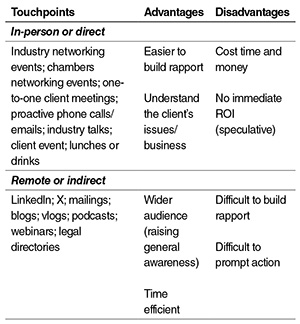
Firstly, there must be a recognition that business development is the responsibility of every member of chambers. Each member should consider how they can contribute, and which activities suit their strengths and preferences. This list highlights some of the ways to emphasise your personal brand:
You cannot do everything, but you can do something. Whatever you choose should form part of an ongoing plan rather than a short burst of enthusiasm followed by months of inactivity. One lecture is better than none but building a reputation as the go-to expert requires strategic and sustained effort.
The key is to identify what you can realistically commit to, what will have the most impact and, most importantly, what you will enjoy. If you enjoy it, you will do it, and you will do it well. You will not be paid for it, so you might as well have fun.
Once you have decided what you are going to do and discussed it with your team and your clerk, then the trick is to understand that you are in competition with every other barrister out there in your field. So, if you’re going to do it, do it properly. If you think LinkedIn is the right platform for you, invest some time in learning how to use it effectively. If you’re interested in giving lectures, consider public speaking or presentation training, or if lunch is your thing, then work on your conversation skills. When you put yourself out there, you’re on show, so make sure you’re presenting your best self.
Whatever you do, you should remember that people are self-focused. They are not interested in you; they are interested in what you can do for them. Can they work with you? Can they trust you with their clients? Will you be easy to work with? Make sure your business development efforts are about them, not you.
One of the great advantages of being a self-employed barrister is that becoming a member of chambers automatically gives you the opportunity for paid work. Because your chambers has a recognised brand and reputation, work will come into chambers. This is the envy of most independent self-employed people who have to work tirelessly for every business opportunity.
However, while outgoing marketing attracts attention, it is wasted effort if the fundamentals of client experience are not in place. In our personal lives we value people who simply do what they said they would do, on time, for the agreed price and without drama.
When considering business development for chambers, sometimes it is less about turning clients on and more about avoiding turning them off. Winning new clients can be a long and demanding process; losing them, however, can happen all too quickly and often for the smallest of reasons.
Why is it so easy to lose a client? Because, as mentioned earlier, human beings are naturally wired to think critically. We tend to spot what we don’t like before we appreciate what we do. That instinctive filtering happens in seconds and can have a lasting impact. A moment of poor communication, a perceived lack of interest or simply the wrong tone can be all it takes to push a client away, even when everything else is technically sound. Whether we realise it or not, we’re constantly being assessed -- ‘Is this someone I want to work with?’ That judgement can happen in seconds.
Ask any manager who has interviewed candidates for a job. Most will tell you they had a sense of ‘yes’ or ‘no’ the moment the person walked into the room and sat down. That gut instinct can be incredibly strong. It can make or break careers, and, while it’s not always fair, it’s very real.
Professionals all too often create own goals. Understandably, it’s natural to become absorbed in the job before us and the pressure to produce work we are proud to put our name to. After all, that’s what they are paying us for! Success also depends on our ability to step outside our own perspective and see matters as our clients to. We must, quite simply, walk in their shoes and understand excellent client services.
A few typical own goals:
Before you think ‘I’m fine in all of the above’, please think more deeply. Ask yourself what a reasonable time might be to respond to a client’s email. This was recently raised in a training room with 13 members of chambers. The topic was heavily debated and the range of responses to this subjective question was vast. If you are ever chased for information, have not followed up a case or have turned up five minutes late for a meeting, you have scored an own goal!
Never miss an opportunity to delight a client; they will tell everybody how great you are. But if you let a client down or even if you are less than what they expect, then they will not recommend you to the next person. Your clients can be your best sales team.
In conclusion, the business side of a barrister’s career is shaped as much by client experience and personal reputation as by legal knowledge and skill. Business development is not solely the responsibility of clerks; every member contributes through how they present themselves, communicate and engage with clients. Outgoing activities such as networking, talks or online presence help raise visibility, while incoming factors such as reliability, responsiveness, attitude and professionalism determine whether clients return.
Much of winning work is about avoiding own goals: delays, poor communication, lack of warmth or inattentiveness. A client is quick to judge, often based on subtle cues, and sustaining strong relationships requires awareness, consistency and empathy.
This short article just skims the surface of how you might promote your practice authentically, deliver an excellent client experience and develop the habits that support long-term success as a self-employed barrister. How do you now take this further? Well, it’s your move.

Barrister Business by Don Turner (BlueGreenBD: January 2026) draws on years of working closely with barristers, clerks and practice teams, conducting numerous consultancy projects and many hours of training and coaching interventions. The topics reflect the themes that arise repeatedly: the habits, assumptions and oversights that shape whether a self-employed professional wins or loses through their client relationships and self-management.
.jpeg?sfvrsn=449a31e9_2)
Don Turner founded PME Training in 2013, delivering pragmatic management, coaching and consultancy exclusively to barristers’ chambers, working with professionals at all levels across England and Wales since its foundation.
The business of being a self-employed member of chambers is not straightforward. Success at the Bar is rarely determined by technical skill and legal knowledge alone. More often, it rests on the small things, the subtle (and sometimes not so subtle) cues that reassure clients they are in safe hands, and that you are the type of person they like to work with.
Barristers do not come to the Bar to become salespeople. Indeed, the very word ‘sales’ can feel uncomfortable for many professionals. We dislike being sold to, and therefore feel it is cheap, awkward or somehow beneath us to ‘sell’ ourselves. Yet the reality is that we are always promoting ourselves, consciously or unconsciously. Whatever your feelings are about self-promotion, you do not want to be the best barrister that nobody has heard of.
At the highest level, business development can be viewed through two fundamental human traits: we are naturally self-focused and quick to judge. We assess relevance instantly and spot faults faster than we recognise strengths. Reading this article, you are already thinking ‘is this relevant to me?’ and judging whether you can believe what is being said. Clients behave in exactly the same way. If you are dealing with humans, it makes sense to engage with them as humans.
To those of you thinking ‘We pay clerks to do all that’, please stop and think a while. If you have ever worked in a pure sales role, trying to open new accounts and forging new relationships with clients, you will know that it is extremely challenging and very labour intensive. It often takes many months, if not years, to get a ‘foot in the door’ (and many a good person has failed in this role). Across the chambers’ sector, staffing ratios mean that only a small proportion of time is devoted to proactive business development; typically, the few clerks who are employed to build business proactively have many other duties. The collective time resource often equates to only one full-time person. So, if you work in a set of 60-80 members which has one full-time employee to ‘bring home the bacon’, you can see that business development is best approached as a shared responsibility.
The big issue, however, is that you are busy being a barrister and that’s a full-time job! Finding time for business development is challenging enough apart from the fact that most of us don’t sit easy with the whole subject. So, what can you do?
Firstly, there must be a recognition that business development is the responsibility of every member of chambers. Each member should consider how they can contribute, and which activities suit their strengths and preferences. This list highlights some of the ways to emphasise your personal brand:
You cannot do everything, but you can do something. Whatever you choose should form part of an ongoing plan rather than a short burst of enthusiasm followed by months of inactivity. One lecture is better than none but building a reputation as the go-to expert requires strategic and sustained effort.
The key is to identify what you can realistically commit to, what will have the most impact and, most importantly, what you will enjoy. If you enjoy it, you will do it, and you will do it well. You will not be paid for it, so you might as well have fun.
Once you have decided what you are going to do and discussed it with your team and your clerk, then the trick is to understand that you are in competition with every other barrister out there in your field. So, if you’re going to do it, do it properly. If you think LinkedIn is the right platform for you, invest some time in learning how to use it effectively. If you’re interested in giving lectures, consider public speaking or presentation training, or if lunch is your thing, then work on your conversation skills. When you put yourself out there, you’re on show, so make sure you’re presenting your best self.
Whatever you do, you should remember that people are self-focused. They are not interested in you; they are interested in what you can do for them. Can they work with you? Can they trust you with their clients? Will you be easy to work with? Make sure your business development efforts are about them, not you.
One of the great advantages of being a self-employed barrister is that becoming a member of chambers automatically gives you the opportunity for paid work. Because your chambers has a recognised brand and reputation, work will come into chambers. This is the envy of most independent self-employed people who have to work tirelessly for every business opportunity.
However, while outgoing marketing attracts attention, it is wasted effort if the fundamentals of client experience are not in place. In our personal lives we value people who simply do what they said they would do, on time, for the agreed price and without drama.
When considering business development for chambers, sometimes it is less about turning clients on and more about avoiding turning them off. Winning new clients can be a long and demanding process; losing them, however, can happen all too quickly and often for the smallest of reasons.
Why is it so easy to lose a client? Because, as mentioned earlier, human beings are naturally wired to think critically. We tend to spot what we don’t like before we appreciate what we do. That instinctive filtering happens in seconds and can have a lasting impact. A moment of poor communication, a perceived lack of interest or simply the wrong tone can be all it takes to push a client away, even when everything else is technically sound. Whether we realise it or not, we’re constantly being assessed -- ‘Is this someone I want to work with?’ That judgement can happen in seconds.
Ask any manager who has interviewed candidates for a job. Most will tell you they had a sense of ‘yes’ or ‘no’ the moment the person walked into the room and sat down. That gut instinct can be incredibly strong. It can make or break careers, and, while it’s not always fair, it’s very real.
Professionals all too often create own goals. Understandably, it’s natural to become absorbed in the job before us and the pressure to produce work we are proud to put our name to. After all, that’s what they are paying us for! Success also depends on our ability to step outside our own perspective and see matters as our clients to. We must, quite simply, walk in their shoes and understand excellent client services.
A few typical own goals:
Before you think ‘I’m fine in all of the above’, please think more deeply. Ask yourself what a reasonable time might be to respond to a client’s email. This was recently raised in a training room with 13 members of chambers. The topic was heavily debated and the range of responses to this subjective question was vast. If you are ever chased for information, have not followed up a case or have turned up five minutes late for a meeting, you have scored an own goal!
Never miss an opportunity to delight a client; they will tell everybody how great you are. But if you let a client down or even if you are less than what they expect, then they will not recommend you to the next person. Your clients can be your best sales team.
In conclusion, the business side of a barrister’s career is shaped as much by client experience and personal reputation as by legal knowledge and skill. Business development is not solely the responsibility of clerks; every member contributes through how they present themselves, communicate and engage with clients. Outgoing activities such as networking, talks or online presence help raise visibility, while incoming factors such as reliability, responsiveness, attitude and professionalism determine whether clients return.
Much of winning work is about avoiding own goals: delays, poor communication, lack of warmth or inattentiveness. A client is quick to judge, often based on subtle cues, and sustaining strong relationships requires awareness, consistency and empathy.
This short article just skims the surface of how you might promote your practice authentically, deliver an excellent client experience and develop the habits that support long-term success as a self-employed barrister. How do you now take this further? Well, it’s your move.
Barrister Business by Don Turner (BlueGreenBD: January 2026) draws on years of working closely with barristers, clerks and practice teams, conducting numerous consultancy projects and many hours of training and coaching interventions. The topics reflect the themes that arise repeatedly: the habits, assumptions and oversights that shape whether a self-employed professional wins or loses through their client relationships and self-management.
With reputations forged in the marketplace as much as the courtroom, Don Turner examines the sales side of the ‘barrister business’ – including how to avoid own goals and business development as a collective endeavour


The Chair of the Bar reports back
Susie Griffin on the admin that keeps barristers from billable work
Clement Cowley, Partner at The Penny Group, explains how global events can influence the performance of pensions and ISAs, and why taking a long-term approach to investing is often the most effective strategy
Mário Barroso, Head of R&D and Method Development at AlphaBiolabs, discusses what family law professionals need to know about hallucinogens, from the main hallucinogenic drugs encountered in family proceedings, to their effects and the testing options available
Harmony Christian Ministries is the latest charity to benefit from a £500 donation from AlphaBiolabs via the company’s Giving Back initiative
By David Green
At the start of her term, Chair of the Bar 2026 Kirsty Brimelow KC set out a series of priorities for the year ahead. One of those priorities was children in the justice system
As the world becomes more digital, Barbara Vinagre Mota examines international research into the mental health consequences of judges’ exposure to graphic and immersive evidence, highlighting the importance of support systems
In an era of patient-centred care and growing concern over misconduct in medical settings, why do women still lack the right to choose women consultants for examination and treatment? Charles Davey investigates
Reviewed by Daniel Barnett
James McNeill Whistler at Tate Britain until 27 September Rothko in Florence at Palazzo Strozzi until 23 August Reviewed by Stephen Cragg KC