*/

In February 2024, Lincoln’s Inn showed its commitment to promoting diversity across the country, by holding its first Equality, Diversity and Inclusion (EDI) Forum event outside London. A collaboration between the Northern and North Eastern Circuits, it was held at Park Square Barristers in Leeds and was organised on behalf of the Inn by Bencher, Chief Master Karen Shuman, Brie Stevens-Hoare KC and Laura Gould.
I had the privilege of chairing the evening in the presence of our host and former Leader of the Northern Circuit, Lisa Roberts KC, who introduced our esteemed panel, which consisted of Winston Hunter KC, Recorder and barrister Aisha Wadoodi and junior barrister, Hafsah Hussain.
The purpose of the event was to see if we could identify the best tools to tackle one of the biggest challenges that the Bar faces in terms of diversity, which is to ensure that the very slow progress to greater access to the profession doesn’t come to a halt or, even worse, start to slide backwards. After all, diversity initiatives are nothing new and have regularly come and gone over the last 25 years with arguably little effect.
The three main topics for discussion were Recruitment, Retention and Promotion with consideration being given to what we do well and what we can improve on.
The first tool we all agreed was essential to increasing diversity is community outreach work. Furthermore, it was the view of the panel that rather than focusing only on students already studying law, or the Bar Course, more emphasis should be placed on school pupils that are pre A-level and maybe even as young as Year 4 or 5. After all, these are the ‘hearts and minds’ that we need to capture, especially those from inner city and lower socio-economic areas. It is these students who represent the long-term future of a diverse Bar. However, this will only happen if a significant number of us make the effort to reach out to them and invite them into our profession.
Of course, it has to be recognised that with the ever-increasing workloads that are being thrust upon us, making time to do school visits is not easy. However, my experience is that not only is it very rewarding and worthwhile, but that most schools will jump at the chance of having one or two barristers attending for a short talk of about 45 minutes (preferably in wigs and gowns). They understand our work commitments and will be only too happy to schedule the talk before court, in assembly, or much later in the school day. However, like many of the tools at our disposal we can only effectively deploy them if we have the wider support of clerks and, in particular, the judiciary. It is hoped that judges will be able to employ a small amount of flexibility from time to time, that would allow us to attend these school events during the court day.
Of course, there is no point in recruiting people if you cannot retain them. For example, although the number of women at the Bar has increased dramatically over the last 25 years, the attrition rate is also rather startling. It is accepted that the reasons why people leave the profession are often complicated. The best way to try and understand this, in my view, is via regular wellbeing seminars. I am sure we all agree it is vital that, as a profession, we get to the heart of why people are either deserting certain practice areas (principally crime) or leaving the Bar altogether.
Some people might be sceptical as to whether ‘wellbeing’ really exists at the Bar at all. The sad reality is that most practitioners are struggling with what already seem to be relentless demands on our time. Then, after a long day in court, we are expected to go home and spend the evening (and most of the weekend) editing ABEs, completing ground rules hearing forms and writing openings, sometimes in very straightforward cases, because the judge has ordered it to be so. The panel also recognised that in practice women do get pigeonholed, with many finding themselves shackled to an endless conveyor belt of sex cases.
It is my view that clerks, the judiciary and the Crown Prosecution Service (CPS) need to be alive to these issues and also be aware of the almost intolerable pressures that the current workloads are placing on people, together with the heavy toll that that this job can take on people’s family life and mental health. It is no wonder that many people are left feeling that they have no option but to simply walk away.
However, at least wellbeing is now on the agenda and many Circuits and chambers are running regular wellbeing sessions to help us spot the signs of stress in ourselves and our colleagues. Whether the necessary help and support comes in time to stop more people leaving the profession, remains to be seen.
On the EDI panel were two KCs and one Recorder and, therefore, we were obviously in the presence of high achievers. The temptation is to say ‘what is the problem?’ The problem, as I see it, is that there are still too few women and people from ethnic minorities getting on to the bench, CPS grade 4 work or taking silk. Although the number of women being appointed is increasing, the number of those from ethnic minorities and especially ethnic minority women, remains stubbornly low. What was interesting, however, was that the resource our panelists relied on the most outside of their families in reaching their career goals was the support and encouragement from those in the profession, whether it be clerks, judges or other members of the Bar.
I am delighted to say that, overall, the panelists were positive in their view that although slow, changes were coming. Nevertheless, it was also my view that we all have to be vigilant and remain committed to fostering and nurturing that change, in order to make sure that the initiatives that we have put in place now do not simply peter out, like so many have done before them.
What I took away from the forum was that the best resources to effect lasting change at the Bar come from within ourselves as practitioners, with the ability that each one of us has to encourage, motivate and look out for, not only those within the profession but also those on the outside looking in.
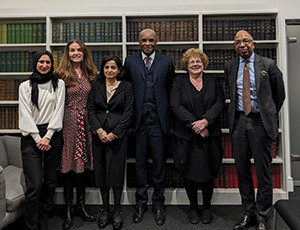
The panel: L-R Hafsah Hussain, Lisa Roberts KC, Aisha Wadoodi, Glenn Parsons, Chief Master Karen Shuman and Winston Hunter KC.
You can find support at www.wellbeingatthebar.org.uk and a 24/7 helpline on 0800 169 2040 for self-employed barristers with a practising certificate and members of the IBC and LPMA. Other sources of support include LawCare on tel: 0800 279 6888 (Mon-Fri, 9-5) or email support@lawcare.org.uk; the Samaritans on tel: 116 123 or email: jo@samaritans.org; and international helplines at: befrienders.org

Glenn Parsons is a barrister at Park Square Barristers, Leeds. Glenn was called to the Bar in 1999 (Lincoln’s Inn) and practises in crime. He is also Chair of the North Eastern Circuit Diversity Outreach Programme, which aims to increase diversity at the Bar. Glenn ran a successful three-year campaign for greater recognition for the forgotten Caribbean servicemen of World War II.
In February 2024, Lincoln’s Inn showed its commitment to promoting diversity across the country, by holding its first Equality, Diversity and Inclusion (EDI) Forum event outside London. A collaboration between the Northern and North Eastern Circuits, it was held at Park Square Barristers in Leeds and was organised on behalf of the Inn by Bencher, Chief Master Karen Shuman, Brie Stevens-Hoare KC and Laura Gould.
I had the privilege of chairing the evening in the presence of our host and former Leader of the Northern Circuit, Lisa Roberts KC, who introduced our esteemed panel, which consisted of Winston Hunter KC, Recorder and barrister Aisha Wadoodi and junior barrister, Hafsah Hussain.
The purpose of the event was to see if we could identify the best tools to tackle one of the biggest challenges that the Bar faces in terms of diversity, which is to ensure that the very slow progress to greater access to the profession doesn’t come to a halt or, even worse, start to slide backwards. After all, diversity initiatives are nothing new and have regularly come and gone over the last 25 years with arguably little effect.
The three main topics for discussion were Recruitment, Retention and Promotion with consideration being given to what we do well and what we can improve on.
The first tool we all agreed was essential to increasing diversity is community outreach work. Furthermore, it was the view of the panel that rather than focusing only on students already studying law, or the Bar Course, more emphasis should be placed on school pupils that are pre A-level and maybe even as young as Year 4 or 5. After all, these are the ‘hearts and minds’ that we need to capture, especially those from inner city and lower socio-economic areas. It is these students who represent the long-term future of a diverse Bar. However, this will only happen if a significant number of us make the effort to reach out to them and invite them into our profession.
Of course, it has to be recognised that with the ever-increasing workloads that are being thrust upon us, making time to do school visits is not easy. However, my experience is that not only is it very rewarding and worthwhile, but that most schools will jump at the chance of having one or two barristers attending for a short talk of about 45 minutes (preferably in wigs and gowns). They understand our work commitments and will be only too happy to schedule the talk before court, in assembly, or much later in the school day. However, like many of the tools at our disposal we can only effectively deploy them if we have the wider support of clerks and, in particular, the judiciary. It is hoped that judges will be able to employ a small amount of flexibility from time to time, that would allow us to attend these school events during the court day.
Of course, there is no point in recruiting people if you cannot retain them. For example, although the number of women at the Bar has increased dramatically over the last 25 years, the attrition rate is also rather startling. It is accepted that the reasons why people leave the profession are often complicated. The best way to try and understand this, in my view, is via regular wellbeing seminars. I am sure we all agree it is vital that, as a profession, we get to the heart of why people are either deserting certain practice areas (principally crime) or leaving the Bar altogether.
Some people might be sceptical as to whether ‘wellbeing’ really exists at the Bar at all. The sad reality is that most practitioners are struggling with what already seem to be relentless demands on our time. Then, after a long day in court, we are expected to go home and spend the evening (and most of the weekend) editing ABEs, completing ground rules hearing forms and writing openings, sometimes in very straightforward cases, because the judge has ordered it to be so. The panel also recognised that in practice women do get pigeonholed, with many finding themselves shackled to an endless conveyor belt of sex cases.
It is my view that clerks, the judiciary and the Crown Prosecution Service (CPS) need to be alive to these issues and also be aware of the almost intolerable pressures that the current workloads are placing on people, together with the heavy toll that that this job can take on people’s family life and mental health. It is no wonder that many people are left feeling that they have no option but to simply walk away.
However, at least wellbeing is now on the agenda and many Circuits and chambers are running regular wellbeing sessions to help us spot the signs of stress in ourselves and our colleagues. Whether the necessary help and support comes in time to stop more people leaving the profession, remains to be seen.
On the EDI panel were two KCs and one Recorder and, therefore, we were obviously in the presence of high achievers. The temptation is to say ‘what is the problem?’ The problem, as I see it, is that there are still too few women and people from ethnic minorities getting on to the bench, CPS grade 4 work or taking silk. Although the number of women being appointed is increasing, the number of those from ethnic minorities and especially ethnic minority women, remains stubbornly low. What was interesting, however, was that the resource our panelists relied on the most outside of their families in reaching their career goals was the support and encouragement from those in the profession, whether it be clerks, judges or other members of the Bar.
I am delighted to say that, overall, the panelists were positive in their view that although slow, changes were coming. Nevertheless, it was also my view that we all have to be vigilant and remain committed to fostering and nurturing that change, in order to make sure that the initiatives that we have put in place now do not simply peter out, like so many have done before them.
What I took away from the forum was that the best resources to effect lasting change at the Bar come from within ourselves as practitioners, with the ability that each one of us has to encourage, motivate and look out for, not only those within the profession but also those on the outside looking in.
The panel: L-R Hafsah Hussain, Lisa Roberts KC, Aisha Wadoodi, Glenn Parsons, Chief Master Karen Shuman and Winston Hunter KC.
You can find support at www.wellbeingatthebar.org.uk and a 24/7 helpline on 0800 169 2040 for self-employed barristers with a practising certificate and members of the IBC and LPMA. Other sources of support include LawCare on tel: 0800 279 6888 (Mon-Fri, 9-5) or email support@lawcare.org.uk; the Samaritans on tel: 116 123 or email: jo@samaritans.org; and international helplines at: befrienders.org

The Chair of the Bar reports back
Susie Griffin on the admin that keeps barristers from billable work
Clement Cowley, Partner at The Penny Group, explains how global events can influence the performance of pensions and ISAs, and why taking a long-term approach to investing is often the most effective strategy
Mário Barroso, Head of R&D and Method Development at AlphaBiolabs, discusses what family law professionals need to know about hallucinogens, from the main hallucinogenic drugs encountered in family proceedings, to their effects and the testing options available
Harmony Christian Ministries is the latest charity to benefit from a £500 donation from AlphaBiolabs via the company’s Giving Back initiative
By David Green

The golden age of advocacy? David Langwallner pays homage to the filmic if contentious barrister Sir Edward Carson and some of his contemporaries
Leah Arthur, a pupil, and her second seat supervisor, John Goss, share their perspectives on building a productive pupil-supervisor relationship
Henry Fingerhut outlines what the Bar Standards Board AI guidance means for early career barristers
The Ministry of Justice will match-fund up to 100 criminal pupillages, with grants available to criminal chambers across England and Wales. Similar to the COIC scheme, the grants will match-fund pupillages additional to those otherwise offered without government funding
Not yet, says Jacob Turner. Regulation, unlike the technology itself, is a domain the legal profession can still control