*/
By Adam Tomkins
Reviewed by Dr Bysshe Inigo Coffey
On the Law of Speaking Freely is an urgent and intelligent book. Adam Tomkins is right to use the present participle in the title. After all, ‘free speech’ should be a living phrase and bring to mind those two dear Johns (Milton and Mill). Quotations should bubble up readily: something about the ‘precious lifeblood of a master spirit’, or history teeming ‘with instances of truth put down by persecution’. But today ‘free speech’ drags behind it a ghoulish and clanking parade of culture war noise. Yet Tomkins manages to shake it off and in doing so says more about that clamour than a volume like The Free Speech Wars (Manchester University Press, 2020) ever could. He returns to what it means to think, speak, and write freely, and why it matters.
To do so he has to go back. The book has two parts – then and now – and it accomplishes a great deal for its size. Tomkins begins with the story of the ages of heresy, sedition and offence. But ‘none of these ages is over: even now we still live in them’. We move through the English context of the Civil War, Reformation, Counter-Reformation, and what he considers to be the ‘first stirrings of free speech’ with Milton and the Levellers. He has a gift for assimilation, and he is at ease with disparate material. In other hands one might feel hurried or as if sat in a crammer.
If the book is historically succinct and sharp, it is also happily literary. The discussion of Cato’s Letters is confidently handled, and he is excellent on Swift and Johnson’s sceptical turn (I note that David Womersley is thanked). It is then that Tomkins turns to Mill before addressing America, and the First Amendment that ‘most iconic, legal commitment to free speech’. It is a book from which to learn about the now and then, and it is also a book for the here and there. The reader need not worry about anglocentrism.
In the now section, Tomkins discusses media freedom, offensive and hate speech, and online safety. In so few words it is difficult to do justice to such a book on the law of speaking freely. So let me be coercive: read it.
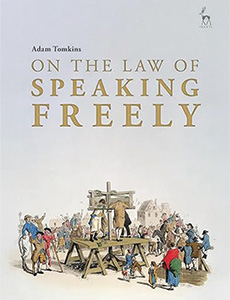
Bloomsbury: May 2025 Paperback 280 pages ISBN 9781509972104
.jpeg?sfvrsn=368e95b1_2)
Dr Bysshe Inigo Coffey is a tutor at St Anne’s College and English Departmental Lecturer, University of Oxford. He is a former British Academy Postdoctoral Fellow and Early Career Fellow at Balliol College, Oxford. He is the author of Shelley’s Broken World (Liverpool University Press: 2023). He is an Inner Temple GDL Scholar, and he is currently researching the relationship between literary and legal interpretation.
On the Law of Speaking Freely is an urgent and intelligent book. Adam Tomkins is right to use the present participle in the title. After all, ‘free speech’ should be a living phrase and bring to mind those two dear Johns (Milton and Mill). Quotations should bubble up readily: something about the ‘precious lifeblood of a master spirit’, or history teeming ‘with instances of truth put down by persecution’. But today ‘free speech’ drags behind it a ghoulish and clanking parade of culture war noise. Yet Tomkins manages to shake it off and in doing so says more about that clamour than a volume like The Free Speech Wars (Manchester University Press, 2020) ever could. He returns to what it means to think, speak, and write freely, and why it matters.
To do so he has to go back. The book has two parts – then and now – and it accomplishes a great deal for its size. Tomkins begins with the story of the ages of heresy, sedition and offence. But ‘none of these ages is over: even now we still live in them’. We move through the English context of the Civil War, Reformation, Counter-Reformation, and what he considers to be the ‘first stirrings of free speech’ with Milton and the Levellers. He has a gift for assimilation, and he is at ease with disparate material. In other hands one might feel hurried or as if sat in a crammer.
If the book is historically succinct and sharp, it is also happily literary. The discussion of Cato’s Letters is confidently handled, and he is excellent on Swift and Johnson’s sceptical turn (I note that David Womersley is thanked). It is then that Tomkins turns to Mill before addressing America, and the First Amendment that ‘most iconic, legal commitment to free speech’. It is a book from which to learn about the now and then, and it is also a book for the here and there. The reader need not worry about anglocentrism.
In the now section, Tomkins discusses media freedom, offensive and hate speech, and online safety. In so few words it is difficult to do justice to such a book on the law of speaking freely. So let me be coercive: read it.
Bloomsbury: May 2025 Paperback 280 pages ISBN 9781509972104
By Adam Tomkins
Reviewed by Dr Bysshe Inigo Coffey

The Chair of the Bar reports back
Susie Griffin on the admin that keeps barristers from billable work
Clement Cowley, Partner at The Penny Group, explains how global events can influence the performance of pensions and ISAs, and why taking a long-term approach to investing is often the most effective strategy
Mário Barroso, Head of R&D and Method Development at AlphaBiolabs, discusses what family law professionals need to know about hallucinogens, from the main hallucinogenic drugs encountered in family proceedings, to their effects and the testing options available
Harmony Christian Ministries is the latest charity to benefit from a £500 donation from AlphaBiolabs via the company’s Giving Back initiative
By David Green
At the start of her term, Chair of the Bar 2026 Kirsty Brimelow KC set out a series of priorities for the year ahead. One of those priorities was children in the justice system
As the world becomes more digital, Barbara Vinagre Mota examines international research into the mental health consequences of judges’ exposure to graphic and immersive evidence, highlighting the importance of support systems
In an era of patient-centred care and growing concern over misconduct in medical settings, why do women still lack the right to choose women consultants for examination and treatment? Charles Davey investigates
Reviewed by Daniel Barnett
James McNeill Whistler at Tate Britain until 27 September Rothko in Florence at Palazzo Strozzi until 23 August Reviewed by Stephen Cragg KC