*/
Reviewed by Daniel Barnett

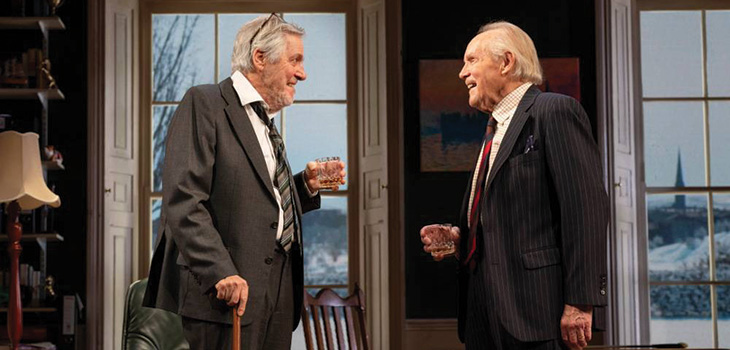
Jonathan Lynn’s new play – the final chapter in the Yes, Minister saga, written solo following the death of his co-creator Antony Jay in 2016 – transplants the now-octogenarian Jim Hacker and Sir Humphrey Appleby to the cloisters of an Oxford college.
Hacker, played by Griff Rhys Jones, has settled into comfortable irrelevance as Master of the fictional Hacker College. His marbles, never his strongest suit, are gently drifting. When a string of politically incorrect remarks lands him in hot water, he calls in Sir Humphrey. The old firm rides again, though at a slightly reduced gallop.
Rhys Jones makes for an endearing Hacker. He potters and blusters around with a warmth and physical comedy that suits the character’s twilight befuddlement. Hacker has always been a man playing catch-up with the room, and Rhys Jones leans into that beautifully, boggling his way through confrontations he only half understands. There is genuine pathos in his confusion, a man who once held the highest office in the land now unable to remember where he left his glasses. (On his head, naturally.)
The problem, and it is a substantial one, is Sir Humphrey. Clive Francis is a fine actor with impeccable comic timing, and he earns two rounds of mid-scene applause for his rapid-fire delivery of those famously serpentine sentences. But the performance never quite captures what made Nigel Hawthorne’s original so devastating – a silk dagger wrapped in courtesy, the charm was the weapon, the elaborate syntax a form of elegant violence against common sense. Francis plays the verbosity but misses the velvet menace. His Sir Humphrey is busy where Hawthorne’s was lethal, competent where the original was sublime. The audience cheers the monologues because they remember what they used to mean. Nostalgia is a powerful anaesthetic, but it wears off.
The writing lets both actors down. Lynn has constructed something closer to a conversation piece than a plot. The first act establishes Hacker’s predicament with the slow deliberation of a civil servant composing a memorandum, while the second abandons dramatic momentum in favour of a rolling seminar on contemporary issues. Brexit, cancel culture, inheritance tax, trigger warnings, diversity policies – all ticked off with efficiency. The original series was brilliant because its satire emerged from the machinery of government itself, the gap between what politicians say and what civil servants do. Here, the characters mostly just discuss topics, like Question Time panellists.
There are laughs, to be fair. William Chubb does solid, dry work as Sir David, bearing bad news with practised sympathy. A stairlift provides reliable physical comedy, and Hacker’s inability to manage his trouser zip delivers the kind of gentle sight gag the Apollo audience lapped up. But genuinely sharp laughs – the kind that made the TV series essential viewing and Margaret Thatcher grant the crew access to Number 10 – are thin on the ground.
The production looks handsome enough. Lee Newby’s set captures the faded grandeur of a minor Oxford lodge with pleasing detail and Leo Flint’s video projections give us shifting seasons beyond the bay windows – a quietly effective metaphor for the passing of time these characters are trying to ignore. Lynn and his co-director Michael Gyngell keep the pace ticking over, though the evening could easily lose 15 minutes without anyone noticing.
What the play does well, perhaps unexpectedly, is allow its characters to grow old. There is genuine tenderness in the way Hacker and Sir Humphrey circle each other in their declining years, two men whose entire relationship was built on institutional power discovering what remains when the institutions have moved on.
Fans of the original may find enough to justify an evening out. The verbal fencing still has its moments, the characters remain loveable, and there is comfort in spending time in their company. But this is a show running on the fumes of something that was once magnificent, and the absence of Jay’s co-authorship is felt in every scene that reaches for a punchline and finds only a talking point. These right honourable gentlemen, two of British comedy’s most treasured creations, deserved a sharper send-off.

Daniel Barnett practises from Outer Temple Chambers and presents the legal hour on LBC Radio.
Jonathan Lynn’s new play – the final chapter in the Yes, Minister saga, written solo following the death of his co-creator Antony Jay in 2016 – transplants the now-octogenarian Jim Hacker and Sir Humphrey Appleby to the cloisters of an Oxford college.
Hacker, played by Griff Rhys Jones, has settled into comfortable irrelevance as Master of the fictional Hacker College. His marbles, never his strongest suit, are gently drifting. When a string of politically incorrect remarks lands him in hot water, he calls in Sir Humphrey. The old firm rides again, though at a slightly reduced gallop.
Rhys Jones makes for an endearing Hacker. He potters and blusters around with a warmth and physical comedy that suits the character’s twilight befuddlement. Hacker has always been a man playing catch-up with the room, and Rhys Jones leans into that beautifully, boggling his way through confrontations he only half understands. There is genuine pathos in his confusion, a man who once held the highest office in the land now unable to remember where he left his glasses. (On his head, naturally.)
The problem, and it is a substantial one, is Sir Humphrey. Clive Francis is a fine actor with impeccable comic timing, and he earns two rounds of mid-scene applause for his rapid-fire delivery of those famously serpentine sentences. But the performance never quite captures what made Nigel Hawthorne’s original so devastating – a silk dagger wrapped in courtesy, the charm was the weapon, the elaborate syntax a form of elegant violence against common sense. Francis plays the verbosity but misses the velvet menace. His Sir Humphrey is busy where Hawthorne’s was lethal, competent where the original was sublime. The audience cheers the monologues because they remember what they used to mean. Nostalgia is a powerful anaesthetic, but it wears off.
The writing lets both actors down. Lynn has constructed something closer to a conversation piece than a plot. The first act establishes Hacker’s predicament with the slow deliberation of a civil servant composing a memorandum, while the second abandons dramatic momentum in favour of a rolling seminar on contemporary issues. Brexit, cancel culture, inheritance tax, trigger warnings, diversity policies – all ticked off with efficiency. The original series was brilliant because its satire emerged from the machinery of government itself, the gap between what politicians say and what civil servants do. Here, the characters mostly just discuss topics, like Question Time panellists.
There are laughs, to be fair. William Chubb does solid, dry work as Sir David, bearing bad news with practised sympathy. A stairlift provides reliable physical comedy, and Hacker’s inability to manage his trouser zip delivers the kind of gentle sight gag the Apollo audience lapped up. But genuinely sharp laughs – the kind that made the TV series essential viewing and Margaret Thatcher grant the crew access to Number 10 – are thin on the ground.
The production looks handsome enough. Lee Newby’s set captures the faded grandeur of a minor Oxford lodge with pleasing detail and Leo Flint’s video projections give us shifting seasons beyond the bay windows – a quietly effective metaphor for the passing of time these characters are trying to ignore. Lynn and his co-director Michael Gyngell keep the pace ticking over, though the evening could easily lose 15 minutes without anyone noticing.
What the play does well, perhaps unexpectedly, is allow its characters to grow old. There is genuine tenderness in the way Hacker and Sir Humphrey circle each other in their declining years, two men whose entire relationship was built on institutional power discovering what remains when the institutions have moved on.
Fans of the original may find enough to justify an evening out. The verbal fencing still has its moments, the characters remain loveable, and there is comfort in spending time in their company. But this is a show running on the fumes of something that was once magnificent, and the absence of Jay’s co-authorship is felt in every scene that reaches for a punchline and finds only a talking point. These right honourable gentlemen, two of British comedy’s most treasured creations, deserved a sharper send-off.
Reviewed by Daniel Barnett

The Chair of the Bar reports back
Susie Griffin on the admin that keeps barristers from billable work
Clement Cowley, Partner at The Penny Group, explains how global events can influence the performance of pensions and ISAs, and why taking a long-term approach to investing is often the most effective strategy
Mário Barroso, Head of R&D and Method Development at AlphaBiolabs, discusses what family law professionals need to know about hallucinogens, from the main hallucinogenic drugs encountered in family proceedings, to their effects and the testing options available
Harmony Christian Ministries is the latest charity to benefit from a £500 donation from AlphaBiolabs via the company’s Giving Back initiative
By David Green
At the start of her term, Chair of the Bar 2026 Kirsty Brimelow KC set out a series of priorities for the year ahead. One of those priorities was children in the justice system
As the world becomes more digital, Barbara Vinagre Mota examines international research into the mental health consequences of judges’ exposure to graphic and immersive evidence, highlighting the importance of support systems
In an era of patient-centred care and growing concern over misconduct in medical settings, why do women still lack the right to choose women consultants for examination and treatment? Charles Davey investigates
Reviewed by Daniel Barnett
James McNeill Whistler at Tate Britain until 27 September Rothko in Florence at Palazzo Strozzi until 23 August Reviewed by Stephen Cragg KC