*/
.jpg?sfvrsn=979235e1_1)
It’s been one year since the Harman Report was published, so where are we on tackling harassment and bullying at the Bar? Nadia Motraghi KC meets Dame Maria Miller, the Bar’s first Commissioner for Conduct, to find out
In January, Dame Maria Miller DBE was appointed as the Bar’s first Commissioner for Conduct, implementing one of the key recommendations arising from Baroness Harriet Harman KC’s Independent Review into Bullying, Harassment and Sexual Harassment at the Bar.
What else has changed since publication of the Harman Report in September 2025? I sit down with Dame Maria to discuss the progress made so far, and what lies ahead.
I begin by asking which of her previous professional roles she feels has best prepared her for the Commissioner position. ‘I draw on all of them,’ Dame Maria tells me, citing her 20 years in Parliament, serving as an MP, Minister and Chair of the Women and Equalities Select Committee, and also her 20 years in communications before entering politics. ‘One of the challenges facing the Commissioner,’ she explains, ‘is communicating change effectively; and this is not just ensuring clarity on what is changing, but also what those changes mean for barristers individually and for chambers as a whole.’
Dame Maria is no stranger to driving cultural change – including on harassment and bullying. Understanding the unique ecosystem of the Bar, she says, has been a crucial first step alongside establishing trust.
‘I’m making it a priority to get outside the M25. It’s important to be seen as the Commissioner for Conduct throughout England and Wales; not just for a small area around High Holborn.’ She has spent months listening and engaging with barristers, the judiciary, the Inns of Court, Bar Standards Board (BSB), specialist Bar associations, Circuits and chambers across the country.
That trust is essential, not only for individuals to feel able to seek information and support, but also for chambers, regulators and the wider profession to view the Commissioner and her team as trusted partners in improving standards across the Bar.
How has her role as Commissioner for Conduct been received? ‘I’ve been blown away,’ she tells me, ‘by just how seriously everyone I’ve spoken to at the Bar takes this issue; just how committed people are to tackling bullying and harassment.’
But, at the same time, she recognises that ‘the barriers to reporting identified in the Harman Report are very real.’
The statistics illustrate the challenge. In the Barristers’ Working Lives survey, around one in four barristers reported experiencing harassment or bullying. That rises to around 40% of women and approaches 50% among women from minority ethnic backgrounds. Yet only a small proportion of those experiences ever get reported to the Bar Standards Board (BSB) or to Talk to Spot, the online system for recording and reporting incidents.
‘People can understandably be reticent about making a complaint or a report,’ she says.
‘One really important development is the new joint protocol agreed between the BSB and the Commissioner.’
Under this protocol, barristers can discharge their professional obligation to report serious misconduct relating to bullying and harassment by making a report to the Commissioner via Talk to Spot. Crucially, the protocol confirms there is no obligation on those who have experienced bullying or harassment themselves to report it to the BSB.
Moreover, Dame Maria says that the regulator has recognised, for the first time, a new category of ‘confidant’ who, likewise, is not subject to a reporting obligation – another significant step.
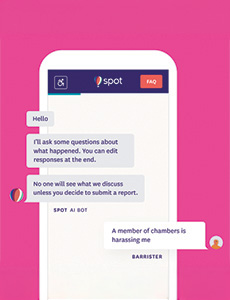
She walks me through Talk to Spot, the Bar’s confidential reporting platform. A user can create a confidential record that remains visible only to them. If later they decide they want support, the user can convert that record into a report which is received by the Commissioner’s small, experienced triage team. This can even be done anonymously.
From there, ‘they can receive advice about what they might wish to do next’. Dame Maria emphasises that other than in the very rare circumstance involving an immediate safeguarding issue, ‘every stage of the process is driven by the person who has experienced the behaviour.’
Where appropriate, individuals can be supported to make an onward report to the BSB. Under the joint protocol, they can also request that the regulator keeps the Commissioner informed about the progress of their case, addressing concerns previously raised by those who found the reporting process difficult to navigate once a complaint had been submitted.
Like Baroness Harman, Dame Maria believes the profession must fundamentally shift where the risk lies. ‘We need jeopardy to change sides,’ she says. ‘It should not be those experiencing bullying or harassment who are concerned they have the most to lose.’
Looking at the Talk to Spot statistics, one finding has stood out. ‘Approximately half of the reports we’ve received through Talk to Spot relate to judicial behaviour,’ she says. ‘In all of the conversations with barristers I have had, they have said how difficult it can be – even for senior members – to raise concerns about judges.’
That insight has led to one of the most pivotal initiatives to date. The Commissioner has signed an agreement with the Lady Chief Justice and the Senior President of Tribunals aimed at removing barriers to reporting bullying, harassment, discrimination and exclusionary behaviour in court.
This agreement enables the Commissioner to act as an intermediary, raising informal concerns about judicial behaviour with the Lead Judge for Diversity and Inclusion, Leadership Development and Wellbeing, Lady Justice Whipple, on behalf of those barristers who wish to do so.
Furthermore, barristers can now raise these concerns directly through Talk to Spot, with the Commissioner able to progress informal complaints under the new protocol where appropriate.
The protocol also provides greater clarity about the different routes available for raising concerns, whether directly, through the Commissioner or via designated senior members of the Bar.
‘This is an important piece in the jigsaw for breaking down reporting barriers,’ Dame Maria says. She will be meeting with Whipple LJ regularly to monitor emerging themes and identify any patterns that merit wider action.
Equally crucial is the Commissioner’s work supporting chambers to improve their own policies, procedures and training – reducing the likelihood that incidents arise in the first place, and enabling chambers who do receive reports of harassment and bullying to be well placed to address them in line with best practice.
To that end, Dame Maria has recently published Tackling bullying, harassment and sexual harassment: a toolkit for chambers to help sets improve their governance, procedures and processes. The Harman Report highlighted the need for clearer, more accessible and consistently applied processes to tackle harassment and bullying across the Bar.
‘The whole team and I stand ready to support chambers in any way we can in interpreting the guidance and adopting the practices,’ she says. In some cases, following a Talk to Spot report, the Commissioner’s team engages directly with chambers. When this occurs, the team has consistently found chambers to be receptive to the Commissioner’s guidance and recommendations.
Dame Maria describes the role of the Inns as ‘incredibly important’, recognising their unique position in supporting aspiring barristers and those undertaking training, ‘often at one of the most vulnerable stages of their careers’.
‘Without exception, the Inns have been exceptionally supportive,’ she says, noting that the Inns are revising their codes of conduct to ensure they are tackling harassment and bullying appropriately and signposting where support is available at the Inns.
For Dame Maria, the year since publication of the Harman Report has been about laying strong foundations: building confidence, creating safer reporting mechanisms and strengthening relationships across the justice system.
But she sees these developments as part of a broader ambition. Her focus, she says, is on ensuring that the Bar has the policies, processes and culture needed to support and sustain what she describes as a ‘world-leading justice system’.
The Harman Report challenged the profession to remove the barriers that historically prevented people from speaking up. Twelve months on, meaningful progress has made.
The next challenge is ensuring that every barrister, whatever their level of seniority or background, knows that if they experience bullying or harassment, support is available, that they remain in control, and that the system is increasingly equipped to listen.
See also ‘Talk to spot – a need-to-know’. Dame Maria and Lady Justice Whipple will be speaking at the Bar Conference on Saturday 14 November at One Great George Street, London. In ‘Beyond Harman: What’s changed one year on?’, they will talk about the actions taken so far and answer questions on what’s next: www.barcouncil.org.uk/barconference.

Nadia Motraghi KC is Co-head of the Employment Group at Old Square Chambers, Vice Chair of the Equality, Diversity and Social Mobility Committee of the Bar Council and an Honorary Fellow of St John’s College, Oxford.
In January, Dame Maria Miller DBE was appointed as the Bar’s first Commissioner for Conduct, implementing one of the key recommendations arising from Baroness Harriet Harman KC’s Independent Review into Bullying, Harassment and Sexual Harassment at the Bar.
What else has changed since publication of the Harman Report in September 2025? I sit down with Dame Maria to discuss the progress made so far, and what lies ahead.
I begin by asking which of her previous professional roles she feels has best prepared her for the Commissioner position. ‘I draw on all of them,’ Dame Maria tells me, citing her 20 years in Parliament, serving as an MP, Minister and Chair of the Women and Equalities Select Committee, and also her 20 years in communications before entering politics. ‘One of the challenges facing the Commissioner,’ she explains, ‘is communicating change effectively; and this is not just ensuring clarity on what is changing, but also what those changes mean for barristers individually and for chambers as a whole.’
Dame Maria is no stranger to driving cultural change – including on harassment and bullying. Understanding the unique ecosystem of the Bar, she says, has been a crucial first step alongside establishing trust.
‘I’m making it a priority to get outside the M25. It’s important to be seen as the Commissioner for Conduct throughout England and Wales; not just for a small area around High Holborn.’ She has spent months listening and engaging with barristers, the judiciary, the Inns of Court, Bar Standards Board (BSB), specialist Bar associations, Circuits and chambers across the country.
That trust is essential, not only for individuals to feel able to seek information and support, but also for chambers, regulators and the wider profession to view the Commissioner and her team as trusted partners in improving standards across the Bar.
How has her role as Commissioner for Conduct been received? ‘I’ve been blown away,’ she tells me, ‘by just how seriously everyone I’ve spoken to at the Bar takes this issue; just how committed people are to tackling bullying and harassment.’
But, at the same time, she recognises that ‘the barriers to reporting identified in the Harman Report are very real.’
The statistics illustrate the challenge. In the Barristers’ Working Lives survey, around one in four barristers reported experiencing harassment or bullying. That rises to around 40% of women and approaches 50% among women from minority ethnic backgrounds. Yet only a small proportion of those experiences ever get reported to the Bar Standards Board (BSB) or to Talk to Spot, the online system for recording and reporting incidents.
‘People can understandably be reticent about making a complaint or a report,’ she says.
‘One really important development is the new joint protocol agreed between the BSB and the Commissioner.’
Under this protocol, barristers can discharge their professional obligation to report serious misconduct relating to bullying and harassment by making a report to the Commissioner via Talk to Spot. Crucially, the protocol confirms there is no obligation on those who have experienced bullying or harassment themselves to report it to the BSB.
Moreover, Dame Maria says that the regulator has recognised, for the first time, a new category of ‘confidant’ who, likewise, is not subject to a reporting obligation – another significant step.
She walks me through Talk to Spot, the Bar’s confidential reporting platform. A user can create a confidential record that remains visible only to them. If later they decide they want support, the user can convert that record into a report which is received by the Commissioner’s small, experienced triage team. This can even be done anonymously.
From there, ‘they can receive advice about what they might wish to do next’. Dame Maria emphasises that other than in the very rare circumstance involving an immediate safeguarding issue, ‘every stage of the process is driven by the person who has experienced the behaviour.’
Where appropriate, individuals can be supported to make an onward report to the BSB. Under the joint protocol, they can also request that the regulator keeps the Commissioner informed about the progress of their case, addressing concerns previously raised by those who found the reporting process difficult to navigate once a complaint had been submitted.
Like Baroness Harman, Dame Maria believes the profession must fundamentally shift where the risk lies. ‘We need jeopardy to change sides,’ she says. ‘It should not be those experiencing bullying or harassment who are concerned they have the most to lose.’
Looking at the Talk to Spot statistics, one finding has stood out. ‘Approximately half of the reports we’ve received through Talk to Spot relate to judicial behaviour,’ she says. ‘In all of the conversations with barristers I have had, they have said how difficult it can be – even for senior members – to raise concerns about judges.’
That insight has led to one of the most pivotal initiatives to date. The Commissioner has signed an agreement with the Lady Chief Justice and the Senior President of Tribunals aimed at removing barriers to reporting bullying, harassment, discrimination and exclusionary behaviour in court.
This agreement enables the Commissioner to act as an intermediary, raising informal concerns about judicial behaviour with the Lead Judge for Diversity and Inclusion, Leadership Development and Wellbeing, Lady Justice Whipple, on behalf of those barristers who wish to do so.
Furthermore, barristers can now raise these concerns directly through Talk to Spot, with the Commissioner able to progress informal complaints under the new protocol where appropriate.
The protocol also provides greater clarity about the different routes available for raising concerns, whether directly, through the Commissioner or via designated senior members of the Bar.
‘This is an important piece in the jigsaw for breaking down reporting barriers,’ Dame Maria says. She will be meeting with Whipple LJ regularly to monitor emerging themes and identify any patterns that merit wider action.
Equally crucial is the Commissioner’s work supporting chambers to improve their own policies, procedures and training – reducing the likelihood that incidents arise in the first place, and enabling chambers who do receive reports of harassment and bullying to be well placed to address them in line with best practice.
To that end, Dame Maria has recently published Tackling bullying, harassment and sexual harassment: a toolkit for chambers to help sets improve their governance, procedures and processes. The Harman Report highlighted the need for clearer, more accessible and consistently applied processes to tackle harassment and bullying across the Bar.
‘The whole team and I stand ready to support chambers in any way we can in interpreting the guidance and adopting the practices,’ she says. In some cases, following a Talk to Spot report, the Commissioner’s team engages directly with chambers. When this occurs, the team has consistently found chambers to be receptive to the Commissioner’s guidance and recommendations.
Dame Maria describes the role of the Inns as ‘incredibly important’, recognising their unique position in supporting aspiring barristers and those undertaking training, ‘often at one of the most vulnerable stages of their careers’.
‘Without exception, the Inns have been exceptionally supportive,’ she says, noting that the Inns are revising their codes of conduct to ensure they are tackling harassment and bullying appropriately and signposting where support is available at the Inns.
For Dame Maria, the year since publication of the Harman Report has been about laying strong foundations: building confidence, creating safer reporting mechanisms and strengthening relationships across the justice system.
But she sees these developments as part of a broader ambition. Her focus, she says, is on ensuring that the Bar has the policies, processes and culture needed to support and sustain what she describes as a ‘world-leading justice system’.
The Harman Report challenged the profession to remove the barriers that historically prevented people from speaking up. Twelve months on, meaningful progress has made.
The next challenge is ensuring that every barrister, whatever their level of seniority or background, knows that if they experience bullying or harassment, support is available, that they remain in control, and that the system is increasingly equipped to listen.
See also ‘Talk to spot – a need-to-know’. Dame Maria and Lady Justice Whipple will be speaking at the Bar Conference on Saturday 14 November at One Great George Street, London. In ‘Beyond Harman: What’s changed one year on?’, they will talk about the actions taken so far and answer questions on what’s next: www.barcouncil.org.uk/barconference.
It’s been one year since the Harman Report was published, so where are we on tackling harassment and bullying at the Bar? Nadia Motraghi KC meets Dame Maria Miller, the Bar’s first Commissioner for Conduct, to find out

The Chair of the Bar reports back
By Kem Kemal, CEO, Henry Dannell
By BSK Financial Planning
Mário Barroso, Head of R&D and Method Development at AlphaBiolabs
Susie Griffin on the admin that keeps barristers from billable work
Clement Cowley, Partner at The Penny Group, explains how global events can influence the performance of pensions and ISAs, and why taking a long-term approach to investing is often the most effective strategy

Kick off your career at the Bar Council’s Pupillage Fair this October – it’s one of the most valuable opportunities for aspiring barristers, says Amelia Clegg
Join us on Saturday 21 November 2026 at Leeds Beckett University and see for yourself why the North continues to be an exceptional place to build a career at the Bar
The golden age of advocacy? David Langwallner pays homage to the filmic if contentious barrister Sir Edward Carson and some of his contemporaries
Henry Fingerhut outlines what the Bar Standards Board AI guidance means for early career barristers
Not yet, says Jacob Turner. Regulation, unlike the technology itself, is a domain the legal profession can still control