*/
Reviewed by Robin Jackson
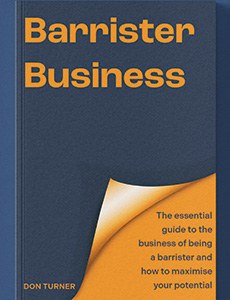
This really is a unique book, essential for barristers at any stage of their career.
Surprisingly, there seems to have been precious little written about how to manage your own business as a barrister. The Independent Bar, reviewed in Counsel magazine in July 2018, was a fine book then and is still relevant and available today. But it deals mainly with the management of chambers, not how an individual barrister, taking their first step on the ladder, can navigate the complexities of starting and developing their practice or how an established practitioner can both cope and thrive with the pressures at the self-employed Bar.
There are three short guides available from the Bar Council: the slightly outdated Building and managing your practice A-Z, which hasn’t been updated since 2018; Practice review guide for barristers and clerks published in 2023; and the 2025 edition of the Young Barristers’ Committee’s very good Starting at the Bar: your essential guide. Again, these should be read to start to understand your place within the Bar and, critically, what is expected by the regulator and your chambers, but these guides are really just for those in their early years or specifically for practice reviews.
Barrister Business, subtitled ‘The essential guide to the business of being a barrister and how to maximise your potential’, is relevant to any barrister, other than perhaps someone who has reached the very pinnacle of their career.
The author, Don Turner, is neither a barrister nor a clerk, but someone who has had considerable experience in working with and observing the workings of chambers and individual clerks and barristers. After a long a career in technical services and strategic marketing management, Turner then established a specialist business focused on the Bar and, over the last 13 years, has trained and coached hundreds of clerks and barristers and worked with many chambers on consultancy projects; I expect many of you reading this will have come across him. His previous business experience, his substantial knowledge of how the Bar operates and his own success at building a self-employed business, as well as his obviously creative, insightful and empathetic nature, combine to make this book a most valuable guide.
Because the book is aimed at all levels of practitioners, it inevitably begins with the fundamentals of starting out in practice and an explanation of how, in general, chambers operate. Already established practitioners might skim over these parts, though there are still plenty of nuggets that many a seasoned barrister could do with noting, such as financial management, wellbeing and understanding clients. However, as Turner himself points out, this is not a book you need to or should read cover to cover, but one you should dip into and out of; Turner writes, as your career progresses, ‘Keep the book nearby. It’s designed to grow with you.’ The book is very clear in its structure, and it’s written in a deliberately easy and conversational style.
Sections follow on business development, ‘how to avoid own goals’ (essential yet often overlooked) and, the concluding part, ‘It’s your move’, which gets to the nub of ‘being strategic with your personal development’. The title of the final chapter, ‘Is this the end or just the beginning? It’s over to you’, should resonate with any self-employed professional.
This book fills a notable gap. It would well serve students on the Bar training course and pupils as preparation for their future career, it should be read by all supervisors to help them guide their pupils and it would benefit almost all barristers already in practice as well as their clerks. And at £18.99 (surely tax-allowable), I really cannot think of any reason you should not buy Barrister Business.

Robin Jackson is the Civil Strategy Director at Guildhall Chambers, having worked in barristers’ chambers and as a legal-sector consultant since 2008, following other professional-services management roles and a successful public-sector career.
This really is a unique book, essential for barristers at any stage of their career.
Surprisingly, there seems to have been precious little written about how to manage your own business as a barrister. The Independent Bar, reviewed in Counsel magazine in July 2018, was a fine book then and is still relevant and available today. But it deals mainly with the management of chambers, not how an individual barrister, taking their first step on the ladder, can navigate the complexities of starting and developing their practice or how an established practitioner can both cope and thrive with the pressures at the self-employed Bar.
There are three short guides available from the Bar Council: the slightly outdated Building and managing your practice A-Z, which hasn’t been updated since 2018; Practice review guide for barristers and clerks published in 2023; and the 2025 edition of the Young Barristers’ Committee’s very good Starting at the Bar: your essential guide. Again, these should be read to start to understand your place within the Bar and, critically, what is expected by the regulator and your chambers, but these guides are really just for those in their early years or specifically for practice reviews.
Barrister Business, subtitled ‘The essential guide to the business of being a barrister and how to maximise your potential’, is relevant to any barrister, other than perhaps someone who has reached the very pinnacle of their career.
The author, Don Turner, is neither a barrister nor a clerk, but someone who has had considerable experience in working with and observing the workings of chambers and individual clerks and barristers. After a long a career in technical services and strategic marketing management, Turner then established a specialist business focused on the Bar and, over the last 13 years, has trained and coached hundreds of clerks and barristers and worked with many chambers on consultancy projects; I expect many of you reading this will have come across him. His previous business experience, his substantial knowledge of how the Bar operates and his own success at building a self-employed business, as well as his obviously creative, insightful and empathetic nature, combine to make this book a most valuable guide.
Because the book is aimed at all levels of practitioners, it inevitably begins with the fundamentals of starting out in practice and an explanation of how, in general, chambers operate. Already established practitioners might skim over these parts, though there are still plenty of nuggets that many a seasoned barrister could do with noting, such as financial management, wellbeing and understanding clients. However, as Turner himself points out, this is not a book you need to or should read cover to cover, but one you should dip into and out of; Turner writes, as your career progresses, ‘Keep the book nearby. It’s designed to grow with you.’ The book is very clear in its structure, and it’s written in a deliberately easy and conversational style.
Sections follow on business development, ‘how to avoid own goals’ (essential yet often overlooked) and, the concluding part, ‘It’s your move’, which gets to the nub of ‘being strategic with your personal development’. The title of the final chapter, ‘Is this the end or just the beginning? It’s over to you’, should resonate with any self-employed professional.
This book fills a notable gap. It would well serve students on the Bar training course and pupils as preparation for their future career, it should be read by all supervisors to help them guide their pupils and it would benefit almost all barristers already in practice as well as their clerks. And at £18.99 (surely tax-allowable), I really cannot think of any reason you should not buy Barrister Business.
Reviewed by Robin Jackson

The Chair of the Bar reports back
By BSK Financial Planning
Susie Griffin on the admin that keeps barristers from billable work
Clement Cowley, Partner at The Penny Group, explains how global events can influence the performance of pensions and ISAs, and why taking a long-term approach to investing is often the most effective strategy
Mário Barroso, Head of R&D and Method Development at AlphaBiolabs, discusses what family law professionals need to know about hallucinogens, from the main hallucinogenic drugs encountered in family proceedings, to their effects and the testing options available
Harmony Christian Ministries is the latest charity to benefit from a £500 donation from AlphaBiolabs via the company’s Giving Back initiative

Kick off your career at the Bar Council’s Pupillage Fair this October – it’s one of the most valuable opportunities for aspiring barristers, says Amelia Clegg
The golden age of advocacy? David Langwallner pays homage to the filmic if contentious barrister Sir Edward Carson and some of his contemporaries
Henry Fingerhut outlines what the Bar Standards Board AI guidance means for early career barristers
The Ministry of Justice will match-fund up to 100 criminal pupillages, with grants available to criminal chambers across England and Wales. Similar to the COIC scheme, the grants will match-fund pupillages additional to those otherwise offered without government funding
Not yet, says Jacob Turner. Regulation, unlike the technology itself, is a domain the legal profession can still control