*/

Congratulations! You have chosen an area of law that is intellectually stimulating, covering a wide range of different legal and regulatory fields with multiple overlapping legal frameworks, from national law overlaid with principles from constitutional and public administrative law, EU Retained law and the European Convention on Human Rights. You will face the highs of fast turnaround hearings on your feet from day one, either defending important government initiatives or advocating for the interests of those less fortunate in society.
But… you are not the only one! In the recent Legal Cheek Student Perceptions Report for the Bar 2023, public law and human rights were among the five most popular practice areas for prospective barristers. The report also mentioned that ‘some students were operating on generalisation or stereotypes about the profession’ and, perhaps, had a lack of understanding about what the role of solicitors or barristers entail.
So, what is life at the public law Bar like? How, more importantly, do you prepare not just for pupillage applications but for life ahead as a junior public law barrister?
There is no typical day in the life of a junior in the public law Bar. ‘Public law’ is a broad church, and each day varies depending on the nature of the cases coming into chambers or from the contacts you make as you start on your profession. One day, you may be dealing with individual parents claiming housing or SEND educational rights, another you may be acting for a NGO or charity in an environmental matter, the next an asylum claim, followed by acting for a public authority in defending a contentious decision in a regulated sector that has significant financial impact for a large company, affecting its business model or reputation.
At Monckton Chambers, for example, members undertake work on behalf of both claimants and defendants, acting for individuals, families, NGOs and charities, companies, regulators and local authorities to ensure their rights are upheld and their interests protected. A large number of our members are appointed to the Attorney General’s ‘A’, ‘B’, ‘C’ and ‘Public International Law’ Panel of Counsel, from which they represent clients including Secretaries of State and central government agencies in challenges to their decisions. Our members work on judicial review challenges before not only the Administrative Court but also other specialist courts and tribunals such as the Competition Appeal Tribunal, the Technology and Construction Court and the Information Tribunal as well as international courts, such as the European Court of Justice and the European Court of Human Rights.
Usually there will be a mix of led and unled work, and – depending on the set – a mix of claimant and defendant work. While managing such a mix is demanding, it all contributes to improving a junior’s legal skills, advocacy and judgmental ‘nouse’. The work can be fast-paced: many public law cases require expedition or interim relief, which can mean that case progress through the court extremely fast or that the case is listed for an urgent hearing. There are many opportunities for junior advocacy in such cases.
In public law cases with a more human element, for example when advising on a housing or social care issue, the work often calls for a high degree of pragmatism and creativity when marshalling evidence, devising the overall strategy, and advising the client. Led work, in bigger teams, is usually high-profile and generates interesting legal arguments. The junior’s role is no less important, but in these cases typically consists of legal research, drafting pleadings, supporting the production of witness evidence, and playing a leading role in any interlocutory applications (for example, arguments around disclosure or confidentiality).
Giving the varied and often unpredictable nature of the work, a junior at the public law needs to be able to adapt to the variety of demands placed on them and enjoy the ride!
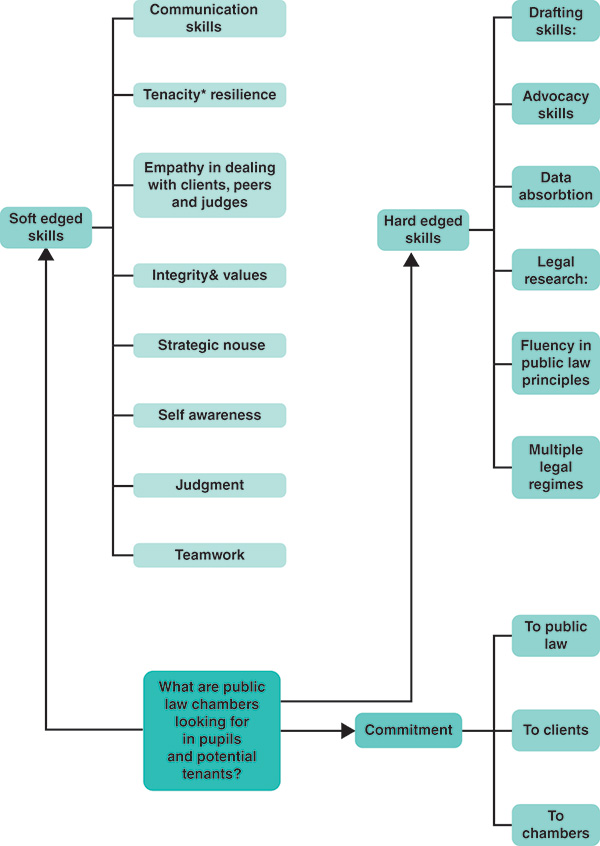
Public law pupillages are very competitive and it goes without saying that the hard-edged skills, in terms of legal ability and research, are taken as standard. Being a barrister is much more than just being a good lawyer. There are wider skillsets needed to be the complete package (see Figure 1).
So, while you will need to be able to research Hansard and dig root and branch through constitutional cases since 1610 before condensing your analysis into a pithy note or even shorter pleading, that will only get you so far. You need a broader range of soft skills and personal qualities to make it at the Bar. Top of the list is effective oral communication – you can only persuade and influence your team and, ultimately the judge, if you are clear and considered. A sense of judgment and perspective is key which may come from previous work experience or wider life experience. You need to have empathy in understanding different perspectives, creativity in coming up with pragmatic solutions and an ability to place the law in a practical context. Although many prospective students cite the independence and autonomy of the Bar as an attraction, you need to be able to work in a team and show commitment in times of urgency and pressure.
Ultimately, although the Bar is a profession, you will need to build the client contacts and experience to make your way. Work will not just land on your desk tied up in pretty ribbons. You need to be a self-starter who will commit to taking the time to understand your clients’ predicament (large or small), form client relationships and develop a business strategy to support chambers wider goals.
No one expects you to be the finished article at the start of your pupillage interview! Life at the Bar is one of continuing learning and mindset growth. You just need to be able to show your potential and commitment in the best light.
So while academics will feature as an important part of your application, don’t ignore the other aspects. Try to develop your oral advocacy and communication skills by getting involved in mock trials, public speaking or debates, volunteer for local charities, the Free Representation Unit, Advocate, Citizens Advice or voluntary law clinics. If you have a year between university and Bar school, then get paralegal experience with a law firm or in-house legal experience at a company/NGO or a regulator. Write student articles or find opportunities to speak – many specialist Bar associations, such as ALBA: the Constitutional and Administrative Law Bar Association, the Bar European Group, UK Association for European Law, Human Rights Law Association, Junior Competition Network and the UK State Aid Law Association have student memberships where you can attend lectures, write papers or give talks. Make sure you visit the Administrative Court (which sits in London, Bristol, Birmingham, Cardiff, Manchester and Leeds) and watch interesting public law cases (you can get details from the Daily Case List). Observe the advocates and their different styles and approaches. What works? What doesn’t? Why are they taking a particular line?
Above all, reach out and ask practitioners! The Bar is a friendly profession, and we have all had to start somewhere. The Inns and ALBA have mentoring programs where you can have a regular slot with a barrister, whose career has been matched to your interests. Many chambers have student evenings and mentoring or work experience slots where you can shadow a barrister and see what a public law practice is like at the coal face.
© Howard, Proud, Hafesji

Anneli Howard KC is a barrister at Monckton Chambers, Chambers and Partners ‘Chambers of the Year’ 2022.

Imogen Proud is a barrister at Monckton Chambers, Chambers and Partners ‘Chambers of the Year’ 2022.

Khatija Hafesji is a barrister at Monckton Chambers, Chambers and Partners ‘Chambers of the Year’ 2022.
Congratulations! You have chosen an area of law that is intellectually stimulating, covering a wide range of different legal and regulatory fields with multiple overlapping legal frameworks, from national law overlaid with principles from constitutional and public administrative law, EU Retained law and the European Convention on Human Rights. You will face the highs of fast turnaround hearings on your feet from day one, either defending important government initiatives or advocating for the interests of those less fortunate in society.
But… you are not the only one! In the recent Legal Cheek Student Perceptions Report for the Bar 2023, public law and human rights were among the five most popular practice areas for prospective barristers. The report also mentioned that ‘some students were operating on generalisation or stereotypes about the profession’ and, perhaps, had a lack of understanding about what the role of solicitors or barristers entail.
So, what is life at the public law Bar like? How, more importantly, do you prepare not just for pupillage applications but for life ahead as a junior public law barrister?
There is no typical day in the life of a junior in the public law Bar. ‘Public law’ is a broad church, and each day varies depending on the nature of the cases coming into chambers or from the contacts you make as you start on your profession. One day, you may be dealing with individual parents claiming housing or SEND educational rights, another you may be acting for a NGO or charity in an environmental matter, the next an asylum claim, followed by acting for a public authority in defending a contentious decision in a regulated sector that has significant financial impact for a large company, affecting its business model or reputation.
At Monckton Chambers, for example, members undertake work on behalf of both claimants and defendants, acting for individuals, families, NGOs and charities, companies, regulators and local authorities to ensure their rights are upheld and their interests protected. A large number of our members are appointed to the Attorney General’s ‘A’, ‘B’, ‘C’ and ‘Public International Law’ Panel of Counsel, from which they represent clients including Secretaries of State and central government agencies in challenges to their decisions. Our members work on judicial review challenges before not only the Administrative Court but also other specialist courts and tribunals such as the Competition Appeal Tribunal, the Technology and Construction Court and the Information Tribunal as well as international courts, such as the European Court of Justice and the European Court of Human Rights.
Usually there will be a mix of led and unled work, and – depending on the set – a mix of claimant and defendant work. While managing such a mix is demanding, it all contributes to improving a junior’s legal skills, advocacy and judgmental ‘nouse’. The work can be fast-paced: many public law cases require expedition or interim relief, which can mean that case progress through the court extremely fast or that the case is listed for an urgent hearing. There are many opportunities for junior advocacy in such cases.
In public law cases with a more human element, for example when advising on a housing or social care issue, the work often calls for a high degree of pragmatism and creativity when marshalling evidence, devising the overall strategy, and advising the client. Led work, in bigger teams, is usually high-profile and generates interesting legal arguments. The junior’s role is no less important, but in these cases typically consists of legal research, drafting pleadings, supporting the production of witness evidence, and playing a leading role in any interlocutory applications (for example, arguments around disclosure or confidentiality).
Giving the varied and often unpredictable nature of the work, a junior at the public law needs to be able to adapt to the variety of demands placed on them and enjoy the ride!
Public law pupillages are very competitive and it goes without saying that the hard-edged skills, in terms of legal ability and research, are taken as standard. Being a barrister is much more than just being a good lawyer. There are wider skillsets needed to be the complete package (see Figure 1).
So, while you will need to be able to research Hansard and dig root and branch through constitutional cases since 1610 before condensing your analysis into a pithy note or even shorter pleading, that will only get you so far. You need a broader range of soft skills and personal qualities to make it at the Bar. Top of the list is effective oral communication – you can only persuade and influence your team and, ultimately the judge, if you are clear and considered. A sense of judgment and perspective is key which may come from previous work experience or wider life experience. You need to have empathy in understanding different perspectives, creativity in coming up with pragmatic solutions and an ability to place the law in a practical context. Although many prospective students cite the independence and autonomy of the Bar as an attraction, you need to be able to work in a team and show commitment in times of urgency and pressure.
Ultimately, although the Bar is a profession, you will need to build the client contacts and experience to make your way. Work will not just land on your desk tied up in pretty ribbons. You need to be a self-starter who will commit to taking the time to understand your clients’ predicament (large or small), form client relationships and develop a business strategy to support chambers wider goals.
No one expects you to be the finished article at the start of your pupillage interview! Life at the Bar is one of continuing learning and mindset growth. You just need to be able to show your potential and commitment in the best light.
So while academics will feature as an important part of your application, don’t ignore the other aspects. Try to develop your oral advocacy and communication skills by getting involved in mock trials, public speaking or debates, volunteer for local charities, the Free Representation Unit, Advocate, Citizens Advice or voluntary law clinics. If you have a year between university and Bar school, then get paralegal experience with a law firm or in-house legal experience at a company/NGO or a regulator. Write student articles or find opportunities to speak – many specialist Bar associations, such as ALBA: the Constitutional and Administrative Law Bar Association, the Bar European Group, UK Association for European Law, Human Rights Law Association, Junior Competition Network and the UK State Aid Law Association have student memberships where you can attend lectures, write papers or give talks. Make sure you visit the Administrative Court (which sits in London, Bristol, Birmingham, Cardiff, Manchester and Leeds) and watch interesting public law cases (you can get details from the Daily Case List). Observe the advocates and their different styles and approaches. What works? What doesn’t? Why are they taking a particular line?
Above all, reach out and ask practitioners! The Bar is a friendly profession, and we have all had to start somewhere. The Inns and ALBA have mentoring programs where you can have a regular slot with a barrister, whose career has been matched to your interests. Many chambers have student evenings and mentoring or work experience slots where you can shadow a barrister and see what a public law practice is like at the coal face.
© Howard, Proud, Hafesji


The Chair of the Bar reports back
Susie Griffin on the admin that keeps barristers from billable work
Clement Cowley, Partner at The Penny Group, explains how global events can influence the performance of pensions and ISAs, and why taking a long-term approach to investing is often the most effective strategy
Mário Barroso, Head of R&D and Method Development at AlphaBiolabs, discusses what family law professionals need to know about hallucinogens, from the main hallucinogenic drugs encountered in family proceedings, to their effects and the testing options available
Harmony Christian Ministries is the latest charity to benefit from a £500 donation from AlphaBiolabs via the company’s Giving Back initiative
By David Green
At the start of her term, Chair of the Bar 2026 Kirsty Brimelow KC set out a series of priorities for the year ahead. One of those priorities was children in the justice system
As the world becomes more digital, Barbara Vinagre Mota examines international research into the mental health consequences of judges’ exposure to graphic and immersive evidence, highlighting the importance of support systems
In an era of patient-centred care and growing concern over misconduct in medical settings, why do women still lack the right to choose women consultants for examination and treatment? Charles Davey investigates
Reviewed by Daniel Barnett
James McNeill Whistler at Tate Britain until 27 September Rothko in Florence at Palazzo Strozzi until 23 August Reviewed by Stephen Cragg KC