*/

It has been nearly four years since the death of the remarkable and brilliant Ruth Bader Ginsburg, the second woman ever to serve on the Supreme Court of the United States. She was renowned for her steely determination and tenacity as much as for her brilliant legal aptitude. She became an inspirational touchstone, not just for women but for everyone who had sought to and still strove to overcome adversity and setback.
The ‘Notorious RBG’ speaks volumes to those of us who have endured stumbling blocks on the way to our chosen careers and have sought to push, and ultimately overcome, boundaries to progression. She once said, ‘Whatever you choose to do, leave tracks.’ In other words, set positive examples for others who come after you to show what can be achieved even in the face of adversity. I have always been a firm believer in showing what can be done, regardless of where you come from and what hurdles you meet on the way, as long as you have the talent, grit and imagination to press on.
I was a sixth form, state school pupil when I decided that I wanted to be a barrister. Inspired by the courage of the fictional Atticus Finch, I wanted to do something that gave a voice to others. I suspect that anyone who pursues the path to being a barrister feels a similar pull. At the time of my decision, there was no internet I could use to find out how to do this or read about others who had chosen this career and could speak of their own experiences. I read as much as I could on barristers that I could find in my local library – dusty articles replete with images straight out of a Punch cartoon of elderly White men in stripey trousers and tailcoats plying their trade in court. I didn’t find my inspiration there, but I did take on board the lessons learned from my parents; neither university educated but both steeped in a strong work ethic and delivering a clear message that hard work was a necessity for personal progress. That has served me well as I have continued in my career at the Bar. Talent and determination will take you some distance but there is no substitute for working hard at each step of the way.
In 1992, the first in my family to attend university, I started a law degree at the London School of Economics. I was lucky enough to be taught by seminal leaders in their fields and was exposed to the academic study of subjects such as medical care and the law, civil liberties in Northern Ireland, environmental law and the philosophy of legal systems and their importance to the functioning of society – an education that fed my desire to pursue the academic into the practical application of the law. I recall how I would choose a spot in the library closest to the Royal Courts of Justice, to be as near as I could to the career I wanted to pursue, watching those who had achieved their aspirations coming and going during the day in their bands and gowns and hoping that, one day, I would be among them. Having that visual reminder of where I wanted to be in years to come provided motivation when the hours pouring over the All England Law Reports dragged. It turned a nebulous idea into something more tangible to aim for.
University and Bar school were not the easiest of years. Due to financial constraints, I worked a number of jobs to fund my studies. This continued into pupillage when, at one stage, I worked as a cleaner each morning, went to court as a pupil, waitressed in the evenings and designed floors for Amtico at the weekend. I am so pleased that pupils now are properly funded so that many will not have to take on extra work at this important, formative time in their careers and I am very proud to be part of my Inn’s (Inner Temple) team of scholarship interviewers, providing more opportunity for those who have the drive and talent to become a barrister but might be deterred by finances. I would encourage anyone thinking of this career to consider applying for scholarship awards through one of the four Inns of Court. They can be life changing opportunities and I have never tired of knowing that, in some instances, the award of a scholarship has been a true ‘sliding doors’ moment for many aspiring advocates.
Having secured pupillage – a Herculean task in itself and one that requires much stamina as the search is negotiated alongside studying, stamina that will stand you in good stead later in your career – I couldn’t wait to start. I was eager to put the academic training into practice. In 2021, the Secret Barrister described the life of a barrister thus: ‘They will excel at carrying out the legal and administrative functions of others for free in order to plug the gaping holes in a chronically under-resourced and understaffed justice system.’
That still rings true today but it makes our jobs vital. The responsibility to ‘get it right’ can weigh heavily and can bring on nerves, worry and stress. All of that is ‘normal’. Never fear fear. Never allow yourself to think that you are the only one feeling nervous. All of us do. Preparation is the key to combatting this worry. I made sure that every time I went to court I was as prepared as I could be. It didn’t matter whether it was a relatively straightforward first appearance or, nowadays, opening a multi defendant murder trial. Know your brief. Care about your case, your reputation. Remember how much you have done to get to where you now are and never take it for granted. It is a privilege to use your voice for the benefit of others. There is human life and emotion at the heart of any set of instructions – and that is something worth remembering; as are your own efforts to reach the stage you are at. I still remember how hard I worked to overcome hurdles to get to where I am in my career, and they act as a useful reminder as to why I am here when the late-night oil is burned.
Sadly, I did not secure tenancy at the completion of my pupillage. This seemed like a catastrophic setback at the time, but I remained undeterred. An option available to me was to become an employed advocate. This was a valuable lesson learned at an early stage – if the first path to what you want to do is shut down, be creative and find another. Those of you who know anything of RBG’s career will know that she struggled, despite undoubted ability, to secure a job at the end of her academic achievements. Undeterred, she sought out and excelled in roles as a law clerk and later at the American Civil Liberties Union (ACLU) where she co-founded the Women’s Rights Project and, as its general counsel, her skilled and strategic advocacy led directly to the end of gender discrimination in many areas of the law. Obstacles in your path can be disheartening, challenging and may shake your determination but, used constructively, they can broaden your horizons and strengthen your inner resolve and commitment.
Since 1999 I have practised as an employed barrister. The early years certainly challenged that inner resolve. In my first role, I worked for a sole practitioner who would deliberately undermine my efforts and confidence. He would leave notes on my desk telling me I had little, if any, competence and I left that job with a considerable dent in my self-worth. When I went on to other employed roles, employed barristers in the Crown Court were a rare commodity and there were some self-employed barristers who were openly hostile, telling me to leave robing rooms as I was not a ‘proper barrister’ and daubing aggressive graffiti on robing room notice boards about ‘in house’ advocates.
I have often reflected on these years and thought how easy it would have been to have left the profession I loved. I am glad that I did not. Instead, I took a different path. I, and many others in my position, worked harder still to show that we were not the poor relation but were independent and could compete along with the best of our call. Even at that stage, I knew that using my voice didn’t just mean for those I defended or spoke for when I prosecuted. It was also important to set an example for others who chose the same path as me later.
It was for this reason that, in 2019, I decided, as an employed advocate in the Crown Prosecution Service, to apply to become a King’s Counsel. This rigorous application would be one decided on merit and on the same standards as any other advocate who applied regardless of whether employed, self-employed, solicitor or barrister. I wanted to leave my own tracks for others so that they might have a less arduous time in the important formative years of practice. I wanted to set an example of what could be accomplished by hard work, determination, and preparation despite setbacks along the way.
For this reason, taking silk, and the appointment ceremony itself in 2020, was a significant moment in my career. When I had looked at those images of stripey trousers in my local library, when I had sat and watched silks come and go from the Royal Courts of Justice during my university years, when I had been called to the Bar and seen them in court as I started in practice, not once did I ever think I would be in that position.
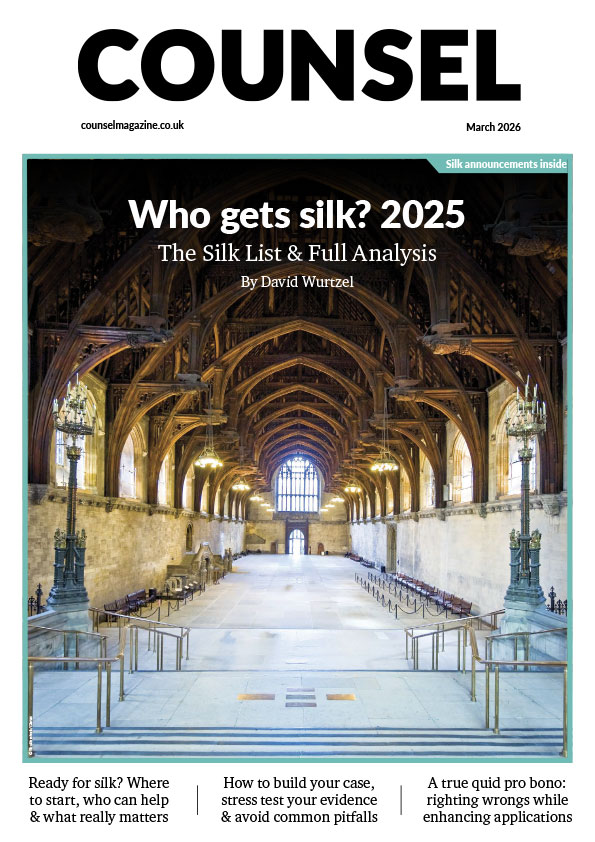
On the day of the silk ceremony, I had been advised by a friend to take a moment to sit quietly and take it all in. When that moment came, as I waited for my family and friends in the grand hall in my ceremonial robes, having just been appointed, I scrolled through the ‘mental rolodex’ of moments over my 20 years of practice. I remembered vividly the call from my pupil supervisor to say I had not been successful in securing tenancy. I remembered the countless part-time jobs I had to take to make ends meet while I pursued my aims. I remembered the notes about my competence from the first employed role I took. I recalled the all-night call-outs to police stations when I worked as a duty solicitor. I reflected on the occasions when a member of the profession or a judge had been sceptical or scathing about my employment status. I remembered the countless hours I had worked on cases, honing in on detail and making sure that I had left nothing to chance. I felt glad to have experienced all of it. It had fuelled my determination to prove the naysayers wrong, to do justice to my parents’ work ethic and to justify the incredible faith in me that so many other practitioners and judges had shown.
Moreover, I now had a voice to speak to others, for others, who might experience similar challenges. Ruth Bader Ginsburg was right. You should leave tracks where you can. There will be moments along the way where the path seems unclear or too difficult to navigate, and when doubt threatens to overwhelm. But I would say this: have faith in your abilities. Use those moments positively, proactively and recognise that they will ultimately shape you as a better barrister. Sometimes it is useful to remember that the obstacle is often the way forward. As RBG also said, when she reflected later in life on the difficulty she faced in securing work post-study:
‘So often in life things that you regard as an impediment turn out to be great good fortune.’
I hope to be able to use that good fortune now to remind anyone embarking on a career at the Bar that it is worth every second of determination and hard work. It is a wonderful, rewarding and brilliant profession to choose.


Heidi Stonecliffe KC is thought to be only the fourth lawyer – and the first woman – at the Crown Prosecution Service to be made silk. She joined the CPS in 2006 and prosecutes cases involving allegations of homicide, gang violence, firearms and drug conspiracies, often multi-defendant and lengthy trials. She is Vice Chair of the Bar for 2025, was Chair of the Bar Council’s Employed Barristers’ Committee for 2024 and is a Bencher at Inner Temple.
It has been nearly four years since the death of the remarkable and brilliant Ruth Bader Ginsburg, the second woman ever to serve on the Supreme Court of the United States. She was renowned for her steely determination and tenacity as much as for her brilliant legal aptitude. She became an inspirational touchstone, not just for women but for everyone who had sought to and still strove to overcome adversity and setback.
The ‘Notorious RBG’ speaks volumes to those of us who have endured stumbling blocks on the way to our chosen careers and have sought to push, and ultimately overcome, boundaries to progression. She once said, ‘Whatever you choose to do, leave tracks.’ In other words, set positive examples for others who come after you to show what can be achieved even in the face of adversity. I have always been a firm believer in showing what can be done, regardless of where you come from and what hurdles you meet on the way, as long as you have the talent, grit and imagination to press on.
I was a sixth form, state school pupil when I decided that I wanted to be a barrister. Inspired by the courage of the fictional Atticus Finch, I wanted to do something that gave a voice to others. I suspect that anyone who pursues the path to being a barrister feels a similar pull. At the time of my decision, there was no internet I could use to find out how to do this or read about others who had chosen this career and could speak of their own experiences. I read as much as I could on barristers that I could find in my local library – dusty articles replete with images straight out of a Punch cartoon of elderly White men in stripey trousers and tailcoats plying their trade in court. I didn’t find my inspiration there, but I did take on board the lessons learned from my parents; neither university educated but both steeped in a strong work ethic and delivering a clear message that hard work was a necessity for personal progress. That has served me well as I have continued in my career at the Bar. Talent and determination will take you some distance but there is no substitute for working hard at each step of the way.
In 1992, the first in my family to attend university, I started a law degree at the London School of Economics. I was lucky enough to be taught by seminal leaders in their fields and was exposed to the academic study of subjects such as medical care and the law, civil liberties in Northern Ireland, environmental law and the philosophy of legal systems and their importance to the functioning of society – an education that fed my desire to pursue the academic into the practical application of the law. I recall how I would choose a spot in the library closest to the Royal Courts of Justice, to be as near as I could to the career I wanted to pursue, watching those who had achieved their aspirations coming and going during the day in their bands and gowns and hoping that, one day, I would be among them. Having that visual reminder of where I wanted to be in years to come provided motivation when the hours pouring over the All England Law Reports dragged. It turned a nebulous idea into something more tangible to aim for.
University and Bar school were not the easiest of years. Due to financial constraints, I worked a number of jobs to fund my studies. This continued into pupillage when, at one stage, I worked as a cleaner each morning, went to court as a pupil, waitressed in the evenings and designed floors for Amtico at the weekend. I am so pleased that pupils now are properly funded so that many will not have to take on extra work at this important, formative time in their careers and I am very proud to be part of my Inn’s (Inner Temple) team of scholarship interviewers, providing more opportunity for those who have the drive and talent to become a barrister but might be deterred by finances. I would encourage anyone thinking of this career to consider applying for scholarship awards through one of the four Inns of Court. They can be life changing opportunities and I have never tired of knowing that, in some instances, the award of a scholarship has been a true ‘sliding doors’ moment for many aspiring advocates.
Having secured pupillage – a Herculean task in itself and one that requires much stamina as the search is negotiated alongside studying, stamina that will stand you in good stead later in your career – I couldn’t wait to start. I was eager to put the academic training into practice. In 2021, the Secret Barrister described the life of a barrister thus: ‘They will excel at carrying out the legal and administrative functions of others for free in order to plug the gaping holes in a chronically under-resourced and understaffed justice system.’
That still rings true today but it makes our jobs vital. The responsibility to ‘get it right’ can weigh heavily and can bring on nerves, worry and stress. All of that is ‘normal’. Never fear fear. Never allow yourself to think that you are the only one feeling nervous. All of us do. Preparation is the key to combatting this worry. I made sure that every time I went to court I was as prepared as I could be. It didn’t matter whether it was a relatively straightforward first appearance or, nowadays, opening a multi defendant murder trial. Know your brief. Care about your case, your reputation. Remember how much you have done to get to where you now are and never take it for granted. It is a privilege to use your voice for the benefit of others. There is human life and emotion at the heart of any set of instructions – and that is something worth remembering; as are your own efforts to reach the stage you are at. I still remember how hard I worked to overcome hurdles to get to where I am in my career, and they act as a useful reminder as to why I am here when the late-night oil is burned.
Sadly, I did not secure tenancy at the completion of my pupillage. This seemed like a catastrophic setback at the time, but I remained undeterred. An option available to me was to become an employed advocate. This was a valuable lesson learned at an early stage – if the first path to what you want to do is shut down, be creative and find another. Those of you who know anything of RBG’s career will know that she struggled, despite undoubted ability, to secure a job at the end of her academic achievements. Undeterred, she sought out and excelled in roles as a law clerk and later at the American Civil Liberties Union (ACLU) where she co-founded the Women’s Rights Project and, as its general counsel, her skilled and strategic advocacy led directly to the end of gender discrimination in many areas of the law. Obstacles in your path can be disheartening, challenging and may shake your determination but, used constructively, they can broaden your horizons and strengthen your inner resolve and commitment.
Since 1999 I have practised as an employed barrister. The early years certainly challenged that inner resolve. In my first role, I worked for a sole practitioner who would deliberately undermine my efforts and confidence. He would leave notes on my desk telling me I had little, if any, competence and I left that job with a considerable dent in my self-worth. When I went on to other employed roles, employed barristers in the Crown Court were a rare commodity and there were some self-employed barristers who were openly hostile, telling me to leave robing rooms as I was not a ‘proper barrister’ and daubing aggressive graffiti on robing room notice boards about ‘in house’ advocates.
I have often reflected on these years and thought how easy it would have been to have left the profession I loved. I am glad that I did not. Instead, I took a different path. I, and many others in my position, worked harder still to show that we were not the poor relation but were independent and could compete along with the best of our call. Even at that stage, I knew that using my voice didn’t just mean for those I defended or spoke for when I prosecuted. It was also important to set an example for others who chose the same path as me later.
It was for this reason that, in 2019, I decided, as an employed advocate in the Crown Prosecution Service, to apply to become a King’s Counsel. This rigorous application would be one decided on merit and on the same standards as any other advocate who applied regardless of whether employed, self-employed, solicitor or barrister. I wanted to leave my own tracks for others so that they might have a less arduous time in the important formative years of practice. I wanted to set an example of what could be accomplished by hard work, determination, and preparation despite setbacks along the way.
For this reason, taking silk, and the appointment ceremony itself in 2020, was a significant moment in my career. When I had looked at those images of stripey trousers in my local library, when I had sat and watched silks come and go from the Royal Courts of Justice during my university years, when I had been called to the Bar and seen them in court as I started in practice, not once did I ever think I would be in that position.
On the day of the silk ceremony, I had been advised by a friend to take a moment to sit quietly and take it all in. When that moment came, as I waited for my family and friends in the grand hall in my ceremonial robes, having just been appointed, I scrolled through the ‘mental rolodex’ of moments over my 20 years of practice. I remembered vividly the call from my pupil supervisor to say I had not been successful in securing tenancy. I remembered the countless part-time jobs I had to take to make ends meet while I pursued my aims. I remembered the notes about my competence from the first employed role I took. I recalled the all-night call-outs to police stations when I worked as a duty solicitor. I reflected on the occasions when a member of the profession or a judge had been sceptical or scathing about my employment status. I remembered the countless hours I had worked on cases, honing in on detail and making sure that I had left nothing to chance. I felt glad to have experienced all of it. It had fuelled my determination to prove the naysayers wrong, to do justice to my parents’ work ethic and to justify the incredible faith in me that so many other practitioners and judges had shown.
Moreover, I now had a voice to speak to others, for others, who might experience similar challenges. Ruth Bader Ginsburg was right. You should leave tracks where you can. There will be moments along the way where the path seems unclear or too difficult to navigate, and when doubt threatens to overwhelm. But I would say this: have faith in your abilities. Use those moments positively, proactively and recognise that they will ultimately shape you as a better barrister. Sometimes it is useful to remember that the obstacle is often the way forward. As RBG also said, when she reflected later in life on the difficulty she faced in securing work post-study:
‘So often in life things that you regard as an impediment turn out to be great good fortune.’
I hope to be able to use that good fortune now to remind anyone embarking on a career at the Bar that it is worth every second of determination and hard work. It is a wonderful, rewarding and brilliant profession to choose.

The Chair of the Bar reports back
Susie Griffin on the admin that keeps barristers from billable work
Clement Cowley, Partner at The Penny Group, explains how global events can influence the performance of pensions and ISAs, and why taking a long-term approach to investing is often the most effective strategy
Mário Barroso, Head of R&D and Method Development at AlphaBiolabs, discusses what family law professionals need to know about hallucinogens, from the main hallucinogenic drugs encountered in family proceedings, to their effects and the testing options available
Harmony Christian Ministries is the latest charity to benefit from a £500 donation from AlphaBiolabs via the company’s Giving Back initiative
By David Green
At the start of her term, Chair of the Bar 2026 Kirsty Brimelow KC set out a series of priorities for the year ahead. One of those priorities was children in the justice system
As the world becomes more digital, Barbara Vinagre Mota examines international research into the mental health consequences of judges’ exposure to graphic and immersive evidence, highlighting the importance of support systems
In an era of patient-centred care and growing concern over misconduct in medical settings, why do women still lack the right to choose women consultants for examination and treatment? Charles Davey investigates
Reviewed by Daniel Barnett
James McNeill Whistler at Tate Britain until 27 September Rothko in Florence at Palazzo Strozzi until 23 August Reviewed by Stephen Cragg KC