*/
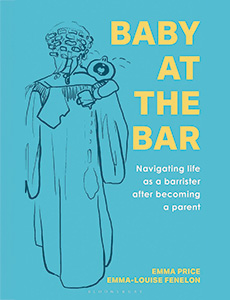
By Emma Price and Emma-Louise Fenelon
Reviewed by Adiba Bassam (Demir)
Bloomsbury Professional (February 2026); 160 pp; ISBN 978-1526535320
Baby at the Bar should come with an emotional rollercoaster warning. The book carries you through feelings of despair, anxiety, sympathy, camaraderie and – most importantly – hope.
What makes the book so affecting is its honesty. It does not try to smooth over the reality of pregnancy and parenthood at the Bar. Nor does it pretend that these experiences can be made neat or simple. Instead, Baby at the Bar meets them head on, and that is what makes the book feel so companionable.
No topic is shied away from. One might expect to read about navigating the announcement of your pregnancy to clerks or how to manage your finances (both of which are covered thoroughly). What I did not expect, however, was Chapter 3: ‘When things go wrong.’ There was something utterly healing and validating about reading: ‘As with all walks of life, miscarriages happen at the Bar. I very much hope it doesn’t happen to you. But if it does, I am so sorry.’ So simple and yet so poignant. I only wish I had had the comfort of these words a few months ago.
There is much bravery in these pages; not only from the authors but also from the men and women at the Bar who have contributed to the book. Their stories and anecdotes are so moving. I had not expected the book to be such a tearjerker.
It comes at a crucial time, reminding – one hopes – clerks, staff, barristers, professional clients, as well as those on the bench, that times are evolving and that barristers cannot be expected to live and breathe the job. One of the most valuable things about Baby at the Bar is that it pushes back against the old idea that complete professional commitment must always come at the expense of family life, health or dignity. It asks the profession to think more honestly about what it expects from people, and that feels both timely and necessary.
The target audience is not just those of us who have children or plan to have children, but everyone working within or connected to the profession. The book serves as a helpful compass for what to do and what not to do. At the end of each chapter is a section entitled ‘How the profession can help’. It should be the duty of every clerking room, and those in positions of power in chambers, to read those sections at the very least. These parts of the book are especially strong because they are practical, measured and difficult to dismiss. They make it clear that support does not have to be dramatic to be meaningful and to matter.
It was alarming to read how pregnant barristers were perceived and treated only 15 to 20 years ago. The anecdotes from senior women barristers stand in welcome contrast to the experiences of more junior women who have had children more recently, showing just how much attitudes have shifted – although the book makes clear that we are not quite there yet. That balance is one of the book’s strengths. It recognises real progress without pretending that the profession has fully caught up with the realities of modern working life.
Baby at the Bar also weaves in humour among the worrying parts. Stories of wardrobe mishaps or arriving at court only to find a toy in your bag, are all too familiar. This stops the book from becoming too heavy, and reflects the reality that much of parenthood is lived in precisely these small, chaotic and often funny moments.
It offers ample realism and does not, as the authors themselves put it, seek to gaslight. At the same time, it provides practical and, most importantly, doable recommendations.
Baby at the Bar may not transform the practice of barristers overnight, but it is a beacon of hope in encouraging the setting of boundaries and taking a meaningful step in the right direction. More than that, it gives language to experiences that are often minimised or left unspoken, and that is part of what makes it feel so necessary.

Bloomsbury Professional (February 2026); 160 pp; ISBN 978-1526535320
Baby at the Bar should come with an emotional rollercoaster warning. The book carries you through feelings of despair, anxiety, sympathy, camaraderie and – most importantly – hope.
What makes the book so affecting is its honesty. It does not try to smooth over the reality of pregnancy and parenthood at the Bar. Nor does it pretend that these experiences can be made neat or simple. Instead, Baby at the Bar meets them head on, and that is what makes the book feel so companionable.
No topic is shied away from. One might expect to read about navigating the announcement of your pregnancy to clerks or how to manage your finances (both of which are covered thoroughly). What I did not expect, however, was Chapter 3: ‘When things go wrong.’ There was something utterly healing and validating about reading: ‘As with all walks of life, miscarriages happen at the Bar. I very much hope it doesn’t happen to you. But if it does, I am so sorry.’ So simple and yet so poignant. I only wish I had had the comfort of these words a few months ago.
There is much bravery in these pages; not only from the authors but also from the men and women at the Bar who have contributed to the book. Their stories and anecdotes are so moving. I had not expected the book to be such a tearjerker.
It comes at a crucial time, reminding – one hopes – clerks, staff, barristers, professional clients, as well as those on the bench, that times are evolving and that barristers cannot be expected to live and breathe the job. One of the most valuable things about Baby at the Bar is that it pushes back against the old idea that complete professional commitment must always come at the expense of family life, health or dignity. It asks the profession to think more honestly about what it expects from people, and that feels both timely and necessary.
The target audience is not just those of us who have children or plan to have children, but everyone working within or connected to the profession. The book serves as a helpful compass for what to do and what not to do. At the end of each chapter is a section entitled ‘How the profession can help’. It should be the duty of every clerking room, and those in positions of power in chambers, to read those sections at the very least. These parts of the book are especially strong because they are practical, measured and difficult to dismiss. They make it clear that support does not have to be dramatic to be meaningful and to matter.
It was alarming to read how pregnant barristers were perceived and treated only 15 to 20 years ago. The anecdotes from senior women barristers stand in welcome contrast to the experiences of more junior women who have had children more recently, showing just how much attitudes have shifted – although the book makes clear that we are not quite there yet. That balance is one of the book’s strengths. It recognises real progress without pretending that the profession has fully caught up with the realities of modern working life.
Baby at the Bar also weaves in humour among the worrying parts. Stories of wardrobe mishaps or arriving at court only to find a toy in your bag, are all too familiar. This stops the book from becoming too heavy, and reflects the reality that much of parenthood is lived in precisely these small, chaotic and often funny moments.
It offers ample realism and does not, as the authors themselves put it, seek to gaslight. At the same time, it provides practical and, most importantly, doable recommendations.
Baby at the Bar may not transform the practice of barristers overnight, but it is a beacon of hope in encouraging the setting of boundaries and taking a meaningful step in the right direction. More than that, it gives language to experiences that are often minimised or left unspoken, and that is part of what makes it feel so necessary.
By Emma Price and Emma-Louise Fenelon
Reviewed by Adiba Bassam (Demir)

The Chair of the Bar reports back
Susie Griffin on the admin that keeps barristers from billable work
Clement Cowley, Partner at The Penny Group, explains how global events can influence the performance of pensions and ISAs, and why taking a long-term approach to investing is often the most effective strategy
Mário Barroso, Head of R&D and Method Development at AlphaBiolabs, discusses what family law professionals need to know about hallucinogens, from the main hallucinogenic drugs encountered in family proceedings, to their effects and the testing options available
Harmony Christian Ministries is the latest charity to benefit from a £500 donation from AlphaBiolabs via the company’s Giving Back initiative
By David Green

At the start of her term, Chair of the Bar 2026 Kirsty Brimelow KC set out a series of priorities for the year ahead. One of those priorities was children in the justice system
As the world becomes more digital, Barbara Vinagre Mota examines international research into the mental health consequences of judges’ exposure to graphic and immersive evidence, highlighting the importance of support systems
In an era of patient-centred care and growing concern over misconduct in medical settings, why do women still lack the right to choose women consultants for examination and treatment? Charles Davey investigates
Reviewed by Daniel Barnett
James McNeill Whistler at Tate Britain until 27 September Rothko in Florence at Palazzo Strozzi until 23 August Reviewed by Stephen Cragg KC