*/
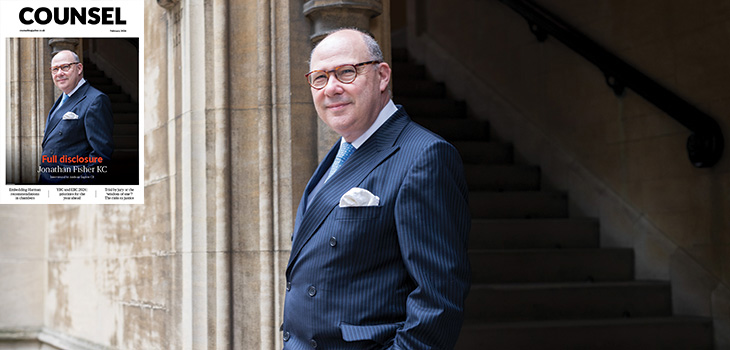
The white-collar criminal and civil silk Jonathan Fisher KC, Independent Reviewer of Disclosure and Fraud Offences, advocates modernising the disclosure regime and harnessing AI to reduce the court backlog. He tells Anthony Inglese CB about his career path and conclusions of his review
“Why on earth do you want to go to the Bar? We can’t afford it, and you are not from that sort of family!” This was my father’s immediate reaction. I was studying for my law degree at the time. He had hoped, and I had expected, that I would become a solicitor, the safer option. My maternal grandfather even used to take me around Ridley Road market and introduce me to his friends as “my solicitor”. But it was my newly found enjoyment of mooting, at which surprisingly I turned out to be tolerably good, that decided me on the Bar.’
This is Jonathan Fisher KC of Red Lion Chambers, top white-collar criminal and civil practitioner. ‘I must be one of the last Mohicans, an old-fashioned common lawyer doing bits of everything. The skills required for addressing a jury are different from those required of a civil lawyer when before the Court of Appeal or the Supreme Court. I enjoy being a bit of a chameleon – perhaps say ‘polymath’!’ That’s a good word. A Bencher of Gray’s Inn, he also lectures, researches, publishes, writes for the media and, at the time of our interview, is completing an Independent Review for the government on Disclosure and Fraud Offences. Throughout our conversation he expresses gratitude to the people who have helped him at every stage: family, school, university, chambers.
Fisher’s great grandparents arrived here from Eastern Europe in the late 19th/early 20th century. ‘They settled into the East End and worked their way out. They were hugely aspirational.’ His maternal grandfather worked in a clothing factory, a manager on the production line. Born in Russia, he fought in the British army in World War One and was injured in the neck at Gallipoli. ‘While convalescing there, he decided to go and fight for Lenin to create a new Russia. He did, until he saw how dreadful it was.’ He returned home and was later naturalised.
‘My father had a grocery business and was doing well. He gave it up to be a probation officer. Having had a difficult upbringing, he wanted to support youngsters who had crossed swords with the criminal law. His education and my mother’s had been disrupted by the Second World War. But when I came along – as their only child – they were financially secure. They sent me to day school at St Dunstan’s College, Catford. I was one year ahead of my age group, and I was always running to keep up, usually near the bottom of the class. And then I mucked up my A level Geography, after missing an important field trip.’ His focus during that time was more on looking after his mother, who was seriously ill at home.
‘I went to North London Poly [now London Metropolitan University] to study law – the vocational subject favoured by my family. Then I astonished myself. A mediocre first year – criminal law was my worst subject – was followed by stunning results in my second year. I was on track for a First and I worked more seriously than I had ever done in my life to get it, and I did.’
What followed was a State Scholarship to St Catharine’s College, Cambridge for the LLM. ‘I studied four public law subjects. They were Civil Liberties, Administrative Law, Tax and EC Law. I sat in on Glanville Williams’s challenging undergraduate lectures in criminal law – a real eye-opener.’
Successes in various mooting competitions led to offers of pupillage. ‘I went through school a year early, but it caught up with me when I went into crime. I realised that I would have benefited from greater life-experience beforehand. In a gap year between call and pupillage I started teaching English legal system and jurisprudence at the Chelmer Institute (now Anglian Ruskin University). I wasn’t kept on after pupillage in Chambers, who thought I was too young and more interested in academic work. But with their kind help I got a tenancy in another set and Chambers took me back five years later.
‘In my early years I was doing general common law, moving between Uxbridge magistrates and the Companies Court. It was a very intense period of my legal career. In 1991 the then Attorney General, Patrick Mayhew, appointed me Standing Counsel (Criminal) to the Inland Revenue at the Central Criminal Court and London Crown Courts. I didn’t want Revenue work to take over my practice. He told me it wouldn’t be more than 20%. Wrong! It turned out to be more than 80%! Before then, my fraud practice had taken off when I defended several VAT gold frauds. By then my interest in crime and civil law and the complex intersection between the two was marking me out as one of a tiny group of counsel who would be able to take on money laundering work when it arrived in the late 90s.
‘But the case I did just before taking silk – in 2002 – was the Millennium Champagne fraud for the Serious Fraud Office. Thousands of investors were fooled into bulk-buying inferior champagne which would then – it was said – be sold on their behalf to the highest bidders in the run-up to the millennium, when a champagne shortage was being predicted. It didn’t happen. I ended up prosecuting it as leader, not junior.’ His practice continued to develop to cover all types of financial crime. ‘People know I remain active in money laundering. I’ve had a staple diet of cases involving oligarchs and also other ultra-high net worth individuals elsewhere.’ He won’t name names.
‘From call onwards I have kept my finger in the academic pie. I could never decide between being an academic and a practitioner. I very much wanted to practise – for me it was life – but I always maintained the academic connection. These days it’s 80/20 in favour of practice. After a year at the Chelmer Institute, I went to City University to teach part-time in the evenings. I became a visiting professor. When I took silk, I was approached to transfer to LSE. I lectured postgraduates on the criminal justice course and developed an LLM module on corporate and financial crime. I was able to fulfil a long-held dream to study for a PhD. I can’t praise enough the support I received from my two supervisors.’
In 2024 he was approached by government to conduct an Independent Review into Disclosure and Fraud offences. ‘I was probably a good pick as a practitioner and academic, and someone who prosecutes and defends in the criminal and civil fields.’ The first part of the Review was published by the government in March of this year. He believes that the law around disclosure should be modernised, and administrative burdens reduced by using advanced technology; that there should be an upgraded disclosure regime for the criminal courts; and that disclosure quality should be improved by stronger education and training across law enforcement agencies.
‘It’s not possible to shortcut disclosure by ruling out examining large masses of documents. As I said in my Review, efficiency and the right to a fair trial need not be mutually exclusive. It’s incumbent on the prosecution to examine its documents. We can’t ask the defence to do it – that would just double the work. AI is developing all the time and is part of the solution. Large fraud trials are blamed for all this. But disclosure will be a problem irrespective of whether judge-only trials come in to replace jury trials. I want the disclosure process to work more efficiently. This in turn should lead to a reduction in court time and therefore in delays. The backlog in criminal cases is caused by other things: the reduction in both courts and judges following the pandemic; prisoners not produced on time; computer systems not working. It’s a miracle that a criminal case ever gets started! I emphasise that it’s my personal view that the backlog will not be sorted by judge-only trials.’
The government’s considered response on Part 1 of the Review, Disclosure in the Digital Age, is currently awaited.
Part 2 of the Report – Fraud in the Digital Age – has been delivered to the Home Secretary should be published shortly.
Advice to those starting out. ‘The Bar is a wonderful career, but you’ve got to work at it. If you don’t get something at first, try a second or third time. You’ve got to be pretty dedicated to do the job. The key is perseverance.’
An only child himself, Jonathan now has four children and eight grandchildren. Three of his children have become lawyers, two solicitors plus an employed barrister. ‘Our second son became a medic. We don’t know what happened! A few years ago he spotted that I was probably starting to suffer from Parkinson’s. I didn’t take any notice! But he was proved right.’
We end on a serious note. Can the self-employed pressures on barristers lead to the concealment of illness? ‘There is no point in going into denial. It’s important to share the information with your colleagues and others. If people know, they can be really kind and supportive. You go to put on your coat, someone sees you struggling with a sleeve and will come and help. It’s heartwarming. I am very lucky, my condition is stable and my Parkinson’s diagnosis hasn’t stopped me from leading life to the full and maintaining my practice and my academic work, here and abroad. I’m still ok, my brain is still functioning, I’m still open for business!’
‘Disclosure of unused material’, Jonathan Fisher KC, Counsel, April 2024
‘Disclosure: the full picture’, Jonathan Fisher KC, Counsel, July 2024
‘Disclosure for the digital age’, Jonathan Fisher KC, Counsel, June 2025

Anthony Inglese CB was head of legal in five Government Legal Departments over a 38-year career, most recently as General Counsel and Solicitor to HM Revenue & Customs. A Bencher of Gray’s Inn, he now trains and mentors lawyers.
“Why on earth do you want to go to the Bar? We can’t afford it, and you are not from that sort of family!” This was my father’s immediate reaction. I was studying for my law degree at the time. He had hoped, and I had expected, that I would become a solicitor, the safer option. My maternal grandfather even used to take me around Ridley Road market and introduce me to his friends as “my solicitor”. But it was my newly found enjoyment of mooting, at which surprisingly I turned out to be tolerably good, that decided me on the Bar.’
This is Jonathan Fisher KC of Red Lion Chambers, top white-collar criminal and civil practitioner. ‘I must be one of the last Mohicans, an old-fashioned common lawyer doing bits of everything. The skills required for addressing a jury are different from those required of a civil lawyer when before the Court of Appeal or the Supreme Court. I enjoy being a bit of a chameleon – perhaps say ‘polymath’!’ That’s a good word. A Bencher of Gray’s Inn, he also lectures, researches, publishes, writes for the media and, at the time of our interview, is completing an Independent Review for the government on Disclosure and Fraud Offences. Throughout our conversation he expresses gratitude to the people who have helped him at every stage: family, school, university, chambers.
Fisher’s great grandparents arrived here from Eastern Europe in the late 19th/early 20th century. ‘They settled into the East End and worked their way out. They were hugely aspirational.’ His maternal grandfather worked in a clothing factory, a manager on the production line. Born in Russia, he fought in the British army in World War One and was injured in the neck at Gallipoli. ‘While convalescing there, he decided to go and fight for Lenin to create a new Russia. He did, until he saw how dreadful it was.’ He returned home and was later naturalised.
‘My father had a grocery business and was doing well. He gave it up to be a probation officer. Having had a difficult upbringing, he wanted to support youngsters who had crossed swords with the criminal law. His education and my mother’s had been disrupted by the Second World War. But when I came along – as their only child – they were financially secure. They sent me to day school at St Dunstan’s College, Catford. I was one year ahead of my age group, and I was always running to keep up, usually near the bottom of the class. And then I mucked up my A level Geography, after missing an important field trip.’ His focus during that time was more on looking after his mother, who was seriously ill at home.
‘I went to North London Poly [now London Metropolitan University] to study law – the vocational subject favoured by my family. Then I astonished myself. A mediocre first year – criminal law was my worst subject – was followed by stunning results in my second year. I was on track for a First and I worked more seriously than I had ever done in my life to get it, and I did.’
What followed was a State Scholarship to St Catharine’s College, Cambridge for the LLM. ‘I studied four public law subjects. They were Civil Liberties, Administrative Law, Tax and EC Law. I sat in on Glanville Williams’s challenging undergraduate lectures in criminal law – a real eye-opener.’
Successes in various mooting competitions led to offers of pupillage. ‘I went through school a year early, but it caught up with me when I went into crime. I realised that I would have benefited from greater life-experience beforehand. In a gap year between call and pupillage I started teaching English legal system and jurisprudence at the Chelmer Institute (now Anglian Ruskin University). I wasn’t kept on after pupillage in Chambers, who thought I was too young and more interested in academic work. But with their kind help I got a tenancy in another set and Chambers took me back five years later.
‘In my early years I was doing general common law, moving between Uxbridge magistrates and the Companies Court. It was a very intense period of my legal career. In 1991 the then Attorney General, Patrick Mayhew, appointed me Standing Counsel (Criminal) to the Inland Revenue at the Central Criminal Court and London Crown Courts. I didn’t want Revenue work to take over my practice. He told me it wouldn’t be more than 20%. Wrong! It turned out to be more than 80%! Before then, my fraud practice had taken off when I defended several VAT gold frauds. By then my interest in crime and civil law and the complex intersection between the two was marking me out as one of a tiny group of counsel who would be able to take on money laundering work when it arrived in the late 90s.
‘But the case I did just before taking silk – in 2002 – was the Millennium Champagne fraud for the Serious Fraud Office. Thousands of investors were fooled into bulk-buying inferior champagne which would then – it was said – be sold on their behalf to the highest bidders in the run-up to the millennium, when a champagne shortage was being predicted. It didn’t happen. I ended up prosecuting it as leader, not junior.’ His practice continued to develop to cover all types of financial crime. ‘People know I remain active in money laundering. I’ve had a staple diet of cases involving oligarchs and also other ultra-high net worth individuals elsewhere.’ He won’t name names.
‘From call onwards I have kept my finger in the academic pie. I could never decide between being an academic and a practitioner. I very much wanted to practise – for me it was life – but I always maintained the academic connection. These days it’s 80/20 in favour of practice. After a year at the Chelmer Institute, I went to City University to teach part-time in the evenings. I became a visiting professor. When I took silk, I was approached to transfer to LSE. I lectured postgraduates on the criminal justice course and developed an LLM module on corporate and financial crime. I was able to fulfil a long-held dream to study for a PhD. I can’t praise enough the support I received from my two supervisors.’
In 2024 he was approached by government to conduct an Independent Review into Disclosure and Fraud offences. ‘I was probably a good pick as a practitioner and academic, and someone who prosecutes and defends in the criminal and civil fields.’ The first part of the Review was published by the government in March of this year. He believes that the law around disclosure should be modernised, and administrative burdens reduced by using advanced technology; that there should be an upgraded disclosure regime for the criminal courts; and that disclosure quality should be improved by stronger education and training across law enforcement agencies.
‘It’s not possible to shortcut disclosure by ruling out examining large masses of documents. As I said in my Review, efficiency and the right to a fair trial need not be mutually exclusive. It’s incumbent on the prosecution to examine its documents. We can’t ask the defence to do it – that would just double the work. AI is developing all the time and is part of the solution. Large fraud trials are blamed for all this. But disclosure will be a problem irrespective of whether judge-only trials come in to replace jury trials. I want the disclosure process to work more efficiently. This in turn should lead to a reduction in court time and therefore in delays. The backlog in criminal cases is caused by other things: the reduction in both courts and judges following the pandemic; prisoners not produced on time; computer systems not working. It’s a miracle that a criminal case ever gets started! I emphasise that it’s my personal view that the backlog will not be sorted by judge-only trials.’
The government’s considered response on Part 1 of the Review, Disclosure in the Digital Age, is currently awaited.
Part 2 of the Report – Fraud in the Digital Age – has been delivered to the Home Secretary should be published shortly.
Advice to those starting out. ‘The Bar is a wonderful career, but you’ve got to work at it. If you don’t get something at first, try a second or third time. You’ve got to be pretty dedicated to do the job. The key is perseverance.’
An only child himself, Jonathan now has four children and eight grandchildren. Three of his children have become lawyers, two solicitors plus an employed barrister. ‘Our second son became a medic. We don’t know what happened! A few years ago he spotted that I was probably starting to suffer from Parkinson’s. I didn’t take any notice! But he was proved right.’
We end on a serious note. Can the self-employed pressures on barristers lead to the concealment of illness? ‘There is no point in going into denial. It’s important to share the information with your colleagues and others. If people know, they can be really kind and supportive. You go to put on your coat, someone sees you struggling with a sleeve and will come and help. It’s heartwarming. I am very lucky, my condition is stable and my Parkinson’s diagnosis hasn’t stopped me from leading life to the full and maintaining my practice and my academic work, here and abroad. I’m still ok, my brain is still functioning, I’m still open for business!’
‘Disclosure of unused material’, Jonathan Fisher KC, Counsel, April 2024
‘Disclosure: the full picture’, Jonathan Fisher KC, Counsel, July 2024
‘Disclosure for the digital age’, Jonathan Fisher KC, Counsel, June 2025
The white-collar criminal and civil silk Jonathan Fisher KC, Independent Reviewer of Disclosure and Fraud Offences, advocates modernising the disclosure regime and harnessing AI to reduce the court backlog. He tells Anthony Inglese CB about his career path and conclusions of his review

The Chair of the Bar reports back
By BSK Financial Planning
Susie Griffin on the admin that keeps barristers from billable work
Clement Cowley, Partner at The Penny Group, explains how global events can influence the performance of pensions and ISAs, and why taking a long-term approach to investing is often the most effective strategy
Mário Barroso, Head of R&D and Method Development at AlphaBiolabs, discusses what family law professionals need to know about hallucinogens, from the main hallucinogenic drugs encountered in family proceedings, to their effects and the testing options available
Harmony Christian Ministries is the latest charity to benefit from a £500 donation from AlphaBiolabs via the company’s Giving Back initiative

Kick off your career at the Bar Council’s Pupillage Fair this October – it’s one of the most valuable opportunities for aspiring barristers, says Amelia Clegg
The golden age of advocacy? David Langwallner pays homage to the filmic if contentious barrister Sir Edward Carson and some of his contemporaries
Henry Fingerhut outlines what the Bar Standards Board AI guidance means for early career barristers
The Ministry of Justice will match-fund up to 100 criminal pupillages, with grants available to criminal chambers across England and Wales. Similar to the COIC scheme, the grants will match-fund pupillages additional to those otherwise offered without government funding
Not yet, says Jacob Turner. Regulation, unlike the technology itself, is a domain the legal profession can still control