*/

I came to the world of wellbeing when I came to understand that I wasn’t neutral in the face of the conflict around me as a family practitioner.
About 20 years ago, I did a case for a client who was asking to see his children more. They were bouncy happy little girls. The proceedings took around three years. By the end of those three years, those little girls were husks of their former selves. They were in therapy; their parents were in therapy.
I remember sitting with my client and senior team during the congratulation dinner. We had more than delivered to our client but I felt a hollowness inside me; I felt I had been part of the destruction and devastation of a family.
This led me to explore ways in which I could continue to be a family practitioner who was part of the solution. I was introduced to mediation and, frankly, I didn’t look back.
I worked with a professional practice consultant, a more experienced mediator, who provided a space for me to discuss difficult cases, ethical dilemmas and improve my mediation techniques.
Having someone to share my experience with improved my wellbeing – not just professionally but also personally.
So as Vice Chair of the Bar last year, I made it my business to ask people about their wellbeing. Here are just three of many similar stories.
‘I stopped being able to eat during COVID,’ one young practitioner told me. Through therapy, he was able to understand it was because his desk was also his kitchen table. His dinner table. He was doing a sexual abuse case, and he couldn’t both work and eat at that same table.
When I asked a criminal barrister in a robing room how was she doing that day, ‘Not very well,’ she said, through tears. She felt she was failing everybody. Her children missed her, and her work was suffering.
Another barrister, in commercial law, said he had been asked to step into a case for a more senior member of chambers. The advice he gave had caused the case to not go as well as it might have done. ‘I felt the wrath of my solicitor, my client, my senior barrister and my clerk. I nearly left the Bar,’ he said.
When I became Chair this year, it was perfectly obvious to me that I had to raise this issue. I wanted the Bar Council to lead on wellbeing and provide the profession with options.
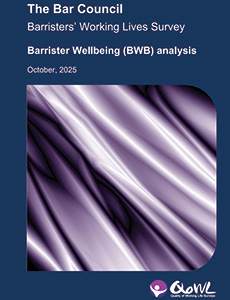
Our latest barristers’ wellbeing analysis, published in October, shows an increase in wellbeing. I want to acknowledge the work of so many across the Bar to promote barrister wellbeing – it is reaping rewards.
The wellbeing findings, which are drawn from data collected for the Barristers’ Working Lives survey, have improved year on year. But we must also keep an eye on those of our colleagues who have made less positive reports.
Interestingly, we asked for the first time in the survey what barristers were doing to support their wellbeing. Many told us that professional support, including therapy, counselling and reflective practice, is important.
Despite this, I still come across people who refuse to share publicly that this is what sustains them.
For example, a very good friend of mine, who is very accomplished, is a really positive advert for the benefits of therapy. I begged and implored him to join me on a stage to talk about it. Absolutely not, he said. Nobody in his chambers knows he has therapy and he does not wish to let his opponents know what keeps him upright.
However, recognising you need help, and going to get it, is a sign of strength in my view.
I want to see wellbeing treated as a core skill in our profession – not something you consider only when you’re in crisis. Wellbeing should be part of the fabric of our profession; it is a tool that needs to be elevated to a pillar of practice. In the same non-negotiable way as junior barristers are told to get an accountant and insurance, I look forward to the day when we will be told to get a concrete solid way in which to look after our wellbeing.
Last year, I asked Charlotte May KC to develop pilot programmes to help maintain and protect barrister wellbeing, and earlier this year we launched pilot programmes with Balint Legal, exploring group reflective practice.
We’ve been closely evaluating the feedback and the results that we’ve got so far are very encouraging. One person said hearing other barristers share similar issues has had a calming effect. Others said it has helped them to put issues and professional relationships into perspective.
This pilot has had real traction as several chambers are introducing their own Balint groups to support their members.
I would very much like the Bar Council to take the learning from this pilot to model further groups, including at the employed Bar.
The importance of trauma-informed work really came alive to me when I spoke to a senior judge who sits in crime. She was involved in a case where the evidence included video footage of the actual murder scene. She asked whether there was help for the jury, who would have to look at it repeatedly during the trial. She was told there wasn’t.
She availed herself of trauma-informed work and was able to share that learning with the jury. At the end of the proceedings everybody said what a difference it had made. That she had been truly aware enough to share that trauma-informed learning shows just how important it is.
I am pleased we have commissioned Trauma-Informed Law to provide trauma-informed training to both barristers and clerks, which will be held early next year. The training recognises that we operate in high pressured environments and will help us to address the effects of trauma and distress in all practice areas.
Brené Brown, the American academic and public speaker, defines a leader as ‘anyone who takes responsibility for finding the potential in people and has the courage to develop that potential’.
When I took on this task this year, I know that there were many naysayers who said the Bar doesn’t need this. I am glad I wasn’t deterred by them because of what the evidence and data shows, and the positive effect the work we’re doing is having on colleagues.
I hope going forward that this work continues to shine a light on what is an open secret – successful practitioners prioritise their wellbeing and get support to do so.

Barbara Mills KC is the 2025 Chair of the Bar. She is a specialist family practitioner at 4PB and former Co-Chair of the Bar Council’s Race Working Group.
I came to the world of wellbeing when I came to understand that I wasn’t neutral in the face of the conflict around me as a family practitioner.
About 20 years ago, I did a case for a client who was asking to see his children more. They were bouncy happy little girls. The proceedings took around three years. By the end of those three years, those little girls were husks of their former selves. They were in therapy; their parents were in therapy.
I remember sitting with my client and senior team during the congratulation dinner. We had more than delivered to our client but I felt a hollowness inside me; I felt I had been part of the destruction and devastation of a family.
This led me to explore ways in which I could continue to be a family practitioner who was part of the solution. I was introduced to mediation and, frankly, I didn’t look back.
I worked with a professional practice consultant, a more experienced mediator, who provided a space for me to discuss difficult cases, ethical dilemmas and improve my mediation techniques.
Having someone to share my experience with improved my wellbeing – not just professionally but also personally.
So as Vice Chair of the Bar last year, I made it my business to ask people about their wellbeing. Here are just three of many similar stories.
‘I stopped being able to eat during COVID,’ one young practitioner told me. Through therapy, he was able to understand it was because his desk was also his kitchen table. His dinner table. He was doing a sexual abuse case, and he couldn’t both work and eat at that same table.
When I asked a criminal barrister in a robing room how was she doing that day, ‘Not very well,’ she said, through tears. She felt she was failing everybody. Her children missed her, and her work was suffering.
Another barrister, in commercial law, said he had been asked to step into a case for a more senior member of chambers. The advice he gave had caused the case to not go as well as it might have done. ‘I felt the wrath of my solicitor, my client, my senior barrister and my clerk. I nearly left the Bar,’ he said.
When I became Chair this year, it was perfectly obvious to me that I had to raise this issue. I wanted the Bar Council to lead on wellbeing and provide the profession with options.
Our latest barristers’ wellbeing analysis, published in October, shows an increase in wellbeing. I want to acknowledge the work of so many across the Bar to promote barrister wellbeing – it is reaping rewards.
The wellbeing findings, which are drawn from data collected for the Barristers’ Working Lives survey, have improved year on year. But we must also keep an eye on those of our colleagues who have made less positive reports.
Interestingly, we asked for the first time in the survey what barristers were doing to support their wellbeing. Many told us that professional support, including therapy, counselling and reflective practice, is important.
Despite this, I still come across people who refuse to share publicly that this is what sustains them.
For example, a very good friend of mine, who is very accomplished, is a really positive advert for the benefits of therapy. I begged and implored him to join me on a stage to talk about it. Absolutely not, he said. Nobody in his chambers knows he has therapy and he does not wish to let his opponents know what keeps him upright.
However, recognising you need help, and going to get it, is a sign of strength in my view.
I want to see wellbeing treated as a core skill in our profession – not something you consider only when you’re in crisis. Wellbeing should be part of the fabric of our profession; it is a tool that needs to be elevated to a pillar of practice. In the same non-negotiable way as junior barristers are told to get an accountant and insurance, I look forward to the day when we will be told to get a concrete solid way in which to look after our wellbeing.
Last year, I asked Charlotte May KC to develop pilot programmes to help maintain and protect barrister wellbeing, and earlier this year we launched pilot programmes with Balint Legal, exploring group reflective practice.
We’ve been closely evaluating the feedback and the results that we’ve got so far are very encouraging. One person said hearing other barristers share similar issues has had a calming effect. Others said it has helped them to put issues and professional relationships into perspective.
This pilot has had real traction as several chambers are introducing their own Balint groups to support their members.
I would very much like the Bar Council to take the learning from this pilot to model further groups, including at the employed Bar.
The importance of trauma-informed work really came alive to me when I spoke to a senior judge who sits in crime. She was involved in a case where the evidence included video footage of the actual murder scene. She asked whether there was help for the jury, who would have to look at it repeatedly during the trial. She was told there wasn’t.
She availed herself of trauma-informed work and was able to share that learning with the jury. At the end of the proceedings everybody said what a difference it had made. That she had been truly aware enough to share that trauma-informed learning shows just how important it is.
I am pleased we have commissioned Trauma-Informed Law to provide trauma-informed training to both barristers and clerks, which will be held early next year. The training recognises that we operate in high pressured environments and will help us to address the effects of trauma and distress in all practice areas.
Brené Brown, the American academic and public speaker, defines a leader as ‘anyone who takes responsibility for finding the potential in people and has the courage to develop that potential’.
When I took on this task this year, I know that there were many naysayers who said the Bar doesn’t need this. I am glad I wasn’t deterred by them because of what the evidence and data shows, and the positive effect the work we’re doing is having on colleagues.
I hope going forward that this work continues to shine a light on what is an open secret – successful practitioners prioritise their wellbeing and get support to do so.

The Chair of the Bar reports back
Susie Griffin on the admin that keeps barristers from billable work
Clement Cowley, Partner at The Penny Group, explains how global events can influence the performance of pensions and ISAs, and why taking a long-term approach to investing is often the most effective strategy
Mário Barroso, Head of R&D and Method Development at AlphaBiolabs, discusses what family law professionals need to know about hallucinogens, from the main hallucinogenic drugs encountered in family proceedings, to their effects and the testing options available
Harmony Christian Ministries is the latest charity to benefit from a £500 donation from AlphaBiolabs via the company’s Giving Back initiative
By David Green

The golden age of advocacy? David Langwallner pays homage to the filmic if contentious barrister Sir Edward Carson and some of his contemporaries
Leah Arthur, a pupil, and her second seat supervisor, John Goss, share their perspectives on building a productive pupil-supervisor relationship
Henry Fingerhut outlines what the Bar Standards Board AI guidance means for early career barristers
The Ministry of Justice will match-fund up to 100 criminal pupillages, with grants available to criminal chambers across England and Wales. Similar to the COIC scheme, the grants will match-fund pupillages additional to those otherwise offered without government funding
Not yet, says Jacob Turner. Regulation, unlike the technology itself, is a domain the legal profession can still control