*/
Reviewed by David Wurtzel
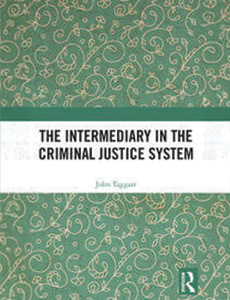
Intermediaries are the most innovative but at times controversial statutory special measure. At the simplest, the role of intermediaries is to assist police, judges and advocates when questioning vulnerable people. At the same time, they have effected a culture change in how vulnerable people are treated in the justice system: how they can give their best evidence, and in the case of defendants, how best they can participate in their own trial. Despite the expertise they bring from their professional lives (most are speech and language therapists), and the knowledge they gain of the vulnerable person through assessing them, intermediaries have not always been universally welcomed or their role understood. Having to adapt one’s questioning to take into account a witness or defendant’s disabilities, does not always come easily or willingly. Dr John Taggart has the advantage of having practised at both the English and Northern Irish Bars and having carried out extensive interviews before drawing on his experiences as practitioner and as an academic to produce this enquiring and challenging book.
Dr Taggart calls it a sociological study, but what clearly comes over are the practical questions of relevance to the criminal Bar. Is the intermediary’s role clear? Are they sufficiently empowered in court or are they treated as an outsider? Although they are neutral and independent, and there to be of help to both sides, how does neutrality interact with the task of enabling a vulnerable defendant to participate?
The book sets out the international context and the legal base in international conventions and in English statute law. Some important distinctions are highlighted. Section 29 of the Youth Justice and Criminal Evidence Act 1999 made intermediaries available to prosecution and defence witnesses only. The statutory provision which allows them to assist defendants has never been brought into effect. Involvement with the defence has thus been left to judicial case management, and guidance from the Criminal Practice Rules and Directions and case law. The latter has until very recently discouraged the use of intermediaries for defendants, either as unnecessary or because judges can assume that advocates would not accept a brief in a case with vulnerable people unless they already knew how to question them appropriately. A generic ability however is no guarantee of the ability to deal with a particular person’s disabilities. In England there has been a parallel system of Registered Intermediaries for witnesses under the Ministry of Justice and of non-registered intermediaries to assist defendants. Some of the former also act as the latter and the book quotes from interviews which in particular make clear the challenges in assisting defendants. In Northern Ireland intermediaries are trained both to help witnesses and defendants, the latter when giving evidence and further, at the police station. As Dr Taggart points out, if someone needs intermediary assistance when giving evidence in court, it makes no sense of them not to have it when being questioned by the police.
In the end the book calls for ‘earlier and better engagement with lawyers’ and for training on the work of intermediaries for police, barristers and judges. Can one hope that there could even be joint training? That there is a myth that intermediaries are a job creation scheme and make a lot of money sadly demonstrates how badly myth-busting training is needed for the Bar. ‘The importance of this book goes beyond understanding the day-to-day work of intermediaries,’ he writes. The use of intermediaries reminds us of broader issues about the criminal justice system which we have yet to explore.

David Wurtzel practised at the criminal Bar for 27 years and is a door tenant at 18 Red Lion Court. Prior to his retirement, he was a consultant in the CPD department at City Law School and consultant editor of Counsel. David is a member of the Counsel Editorial Board.
Intermediaries are the most innovative but at times controversial statutory special measure. At the simplest, the role of intermediaries is to assist police, judges and advocates when questioning vulnerable people. At the same time, they have effected a culture change in how vulnerable people are treated in the justice system: how they can give their best evidence, and in the case of defendants, how best they can participate in their own trial. Despite the expertise they bring from their professional lives (most are speech and language therapists), and the knowledge they gain of the vulnerable person through assessing them, intermediaries have not always been universally welcomed or their role understood. Having to adapt one’s questioning to take into account a witness or defendant’s disabilities, does not always come easily or willingly. Dr John Taggart has the advantage of having practised at both the English and Northern Irish Bars and having carried out extensive interviews before drawing on his experiences as practitioner and as an academic to produce this enquiring and challenging book.
Dr Taggart calls it a sociological study, but what clearly comes over are the practical questions of relevance to the criminal Bar. Is the intermediary’s role clear? Are they sufficiently empowered in court or are they treated as an outsider? Although they are neutral and independent, and there to be of help to both sides, how does neutrality interact with the task of enabling a vulnerable defendant to participate?
The book sets out the international context and the legal base in international conventions and in English statute law. Some important distinctions are highlighted. Section 29 of the Youth Justice and Criminal Evidence Act 1999 made intermediaries available to prosecution and defence witnesses only. The statutory provision which allows them to assist defendants has never been brought into effect. Involvement with the defence has thus been left to judicial case management, and guidance from the Criminal Practice Rules and Directions and case law. The latter has until very recently discouraged the use of intermediaries for defendants, either as unnecessary or because judges can assume that advocates would not accept a brief in a case with vulnerable people unless they already knew how to question them appropriately. A generic ability however is no guarantee of the ability to deal with a particular person’s disabilities. In England there has been a parallel system of Registered Intermediaries for witnesses under the Ministry of Justice and of non-registered intermediaries to assist defendants. Some of the former also act as the latter and the book quotes from interviews which in particular make clear the challenges in assisting defendants. In Northern Ireland intermediaries are trained both to help witnesses and defendants, the latter when giving evidence and further, at the police station. As Dr Taggart points out, if someone needs intermediary assistance when giving evidence in court, it makes no sense of them not to have it when being questioned by the police.
In the end the book calls for ‘earlier and better engagement with lawyers’ and for training on the work of intermediaries for police, barristers and judges. Can one hope that there could even be joint training? That there is a myth that intermediaries are a job creation scheme and make a lot of money sadly demonstrates how badly myth-busting training is needed for the Bar. ‘The importance of this book goes beyond understanding the day-to-day work of intermediaries,’ he writes. The use of intermediaries reminds us of broader issues about the criminal justice system which we have yet to explore.
Reviewed by David Wurtzel

The Chair of the Bar reports back
Susie Griffin on the admin that keeps barristers from billable work
Clement Cowley, Partner at The Penny Group, explains how global events can influence the performance of pensions and ISAs, and why taking a long-term approach to investing is often the most effective strategy
Mário Barroso, Head of R&D and Method Development at AlphaBiolabs, discusses what family law professionals need to know about hallucinogens, from the main hallucinogenic drugs encountered in family proceedings, to their effects and the testing options available
Harmony Christian Ministries is the latest charity to benefit from a £500 donation from AlphaBiolabs via the company’s Giving Back initiative
By David Green

The golden age of advocacy? David Langwallner pays homage to the filmic if contentious barrister Sir Edward Carson and some of his contemporaries
Leah Arthur, a pupil, and her second seat supervisor, John Goss, share their perspectives on building a productive pupil-supervisor relationship
Henry Fingerhut outlines what the Bar Standards Board AI guidance means for early career barristers
The Ministry of Justice will match-fund up to 100 criminal pupillages, with grants available to criminal chambers across England and Wales. Similar to the COIC scheme, the grants will match-fund pupillages additional to those otherwise offered without government funding
Not yet, says Jacob Turner. Regulation, unlike the technology itself, is a domain the legal profession can still control