*/

In the wake of the Harman Review, many chambers are asking what practical steps they should take now. Joanna Chatterton and David Murphy suggest how the recommendations can be weaved into the daily life of a modern set – in a credible, proportionate and effective way
The Harman Review exposed what many at the Bar had long recognised but rarely articulated openly: bullying, harassment and discrimination are not marginal problems, nor are they confined to just a few isolated incidents. They are risks that are exacerbated by the way the self-employed Bar operates; risks that are heightened by power-imbalances, informality and economic dependence.
The Bar Council has issued guidance on steps chambers can take now to address some of the concerns identified, acknowledging that further changes are under development. That guidance is necessary and welcome. But guidance alone does not change culture.
For those responsible for chambers governance, the challenge is a practical one: how should these recommendations be understood and implemented in day-to-day chambers life, in a way that is credible, proportionate and effective?
This article considers key strands of the Bar Council’s guidance and examines what they mean in practice for a forward-looking chambers.
The Bar Council recommends that chambers review their anti-harassment policies and has issued guidance on managing sexual harassment allegations, including model policies produced by the Bar Council and Bar Standards Board.
Most chambers already have policies of this kind. The Harman Report makes clear that the problem is not absence, but effectiveness. Too often policies exist on paper but are poorly understood, rarely used, or actively mistrusted.
The critical question for chambers is therefore not ‘do we have a policy?’, but ‘would someone feel able to rely on it?’
That requires a focus on how policies operate in practice. In particular:
A policy that is technically compliant but lacks credibility will not be used when it matters.
The Bar Council recommends refreshing training on bullying and harassment.
Experience across professions suggests that generic, one-off training has limited impact. Chambers that take this issue seriously tend to approach training strategically, asking who needs training, in what form, and for what purpose.
Effective approaches commonly include:
Perhaps most importantly, chambers leadership should be visibly engaged. The conduct and attitude of senior figures have a greater influence on culture than any formal training programme.
The Bar Council encourages chambers to ensure that everyone in chambers understands expected standards of behaviour and how to raise concerns.
The Harman Report identifies fear of retaliation as one of the most significant barriers to reporting, particularly where the alleged perpetrator controls work allocation, references or progression.
Chambers therefore need to consider not only what reporting routes exist, but whether they command confidence. That may involve:
‘Informal resolution’ has a legitimate place, but only where it expands choice for a complainant. Used uncritically, it risks becoming a mechanism for minimising or containing issues rather than addressing them.
The Harman Report highlights the prevalence and impact of sexual harassment experienced by students, mini-pupils and pupils, and emphasises that safeguarding is an institutional responsibility.
Those at the earliest stages of entry to the Bar are uniquely exposed. They are dependent on goodwill and references, and often unfamiliar with chambers’ culture or reporting routes. Safeguarding cannot therefore be left to individual judgement.
Practical implications include:
The underlying shift is from reliance on trust in individuals to institutional responsibility for safety.
The Harman Report describes in detail the obstacles faced by those who attempt to raise concerns within chambers. The Bar Council encourages chambers to adopt complaint-handling processes that are victim-centred while remaining fair.
A victim-centred process does not mean abandoning due process or failing to give due recognition to the interests of the accused, but recognising the professional, economic and psychological risks faced by complainants and designing procedures accordingly.
In practice, this may involve:
Support should not end when a process concludes. Ongoing management of working relationships is often required.
The Harman Report identifies constitutional and contractual barriers that frequently prevent chambers from imposing meaningful sanctions for serious misconduct, particularly where governance documents are inadequate.
Cultural change will not happen if serious misconduct does not have consequences in practice. Chambers should therefore review their constitutions and employment policies before problems arise, ensuring that they:
Without enforceable governance structures, stated standards lack authority.
The Bar Council encourages chambers to collect and review data relating to bullying, harassment and discrimination, including as part of risk assessment obligations.
Data should be used to identify risk, not to reassure. Useful indicators may include:
Chambers’ leadership should review the themes emerging from such data on a regular basis.
Low complaint numbers should not be taken as evidence of a healthy culture. The Harman Report makes clear that they may indicate the opposite.
The Bar Council places particular emphasis on leadership commitment and cultural change.
Culture is shaped by what chambers tolerates, rewards and ignores. Forward-looking chambers recognise that:
Leadership in this context is demonstrated through decisions and example, particularly when those decisions are uncomfortable.
The Harman Report provides a clear diagnosis. The Bar Council’s guidance offers a framework for taking action now, even though more will be needed. The task now for chambers is to translate recommendations into reality, and to demonstrate that professional standards at the Bar are not merely articulated, but enforced.
Dame Maria Miller DBE is Bar’s first Commissioner for Conduct

The former Women and Equalities Committee Chair and Cabinet Minister Dame Maria Miller DBE has been appointed as the Bar’s Commissioner for Conduct following Baroness Harriet Harman KC’s independent review of bullying, harassment and sexual harassment in and around the Bar.
Dame Maria – who is Chair of UK domestic abuse charity SafeLives and was awarded a damehood in 2022 for her work on equality matters – started her post in January and leads the Bar Council’s work to eradicate these behaviours.
Bar Chair Kirsty Brimelow KC said: ‘I’m very much looking forward to working with Dame Maria who brings her extensive experience to this role. She will provide authoritative guidance and be a trusted point of contact for all those working in and around the Bar.
‘There is no place for bullying, harassment and sexual harassment at the Bar and with Dame Maria overseeing this work, I am determined that we can stamp out these behaviours.’
Baroness Harman said: ‘I have full confidence that Dame Maria will lead the reform needed, having been a driving force in tackling the same issues in the House of Commons. This role is key to leading the change necessary to prevent misconduct and protect victims and the reputation of the Bar. Improving behaviour will no longer rest on the slight shoulders of the victims of misconduct.’
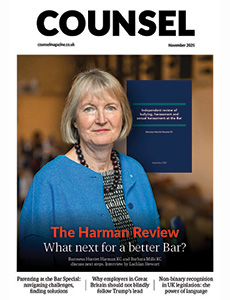
In the November 2025 issue of Counsel, Baroness Harman and Barbara Mills KC talked to Lachlan Stewart about the review’s impact, the challenges ahead and the crucial next steps. See also the Bar Council’s Taking action post Harman: quick guide for chambers; the Bar Council’s Action plan; and ‘Safeguarding aspiring barristers’, Sam Mercer and Rachel Krys, Counsel May 2025.

Joanna Chatterton is a partner at law firm Fox Williams LLP. She specialises in advising barristers chambers and professional services firms on employment and discrimination issues.

David Murphy is a partner at law firm Fox Williams LLP. He specialises in advising barristers chambers and professional services firms on employment and discrimination issues.
The Harman Review exposed what many at the Bar had long recognised but rarely articulated openly: bullying, harassment and discrimination are not marginal problems, nor are they confined to just a few isolated incidents. They are risks that are exacerbated by the way the self-employed Bar operates; risks that are heightened by power-imbalances, informality and economic dependence.
The Bar Council has issued guidance on steps chambers can take now to address some of the concerns identified, acknowledging that further changes are under development. That guidance is necessary and welcome. But guidance alone does not change culture.
For those responsible for chambers governance, the challenge is a practical one: how should these recommendations be understood and implemented in day-to-day chambers life, in a way that is credible, proportionate and effective?
This article considers key strands of the Bar Council’s guidance and examines what they mean in practice for a forward-looking chambers.
The Bar Council recommends that chambers review their anti-harassment policies and has issued guidance on managing sexual harassment allegations, including model policies produced by the Bar Council and Bar Standards Board.
Most chambers already have policies of this kind. The Harman Report makes clear that the problem is not absence, but effectiveness. Too often policies exist on paper but are poorly understood, rarely used, or actively mistrusted.
The critical question for chambers is therefore not ‘do we have a policy?’, but ‘would someone feel able to rely on it?’
That requires a focus on how policies operate in practice. In particular:
A policy that is technically compliant but lacks credibility will not be used when it matters.
The Bar Council recommends refreshing training on bullying and harassment.
Experience across professions suggests that generic, one-off training has limited impact. Chambers that take this issue seriously tend to approach training strategically, asking who needs training, in what form, and for what purpose.
Effective approaches commonly include:
Perhaps most importantly, chambers leadership should be visibly engaged. The conduct and attitude of senior figures have a greater influence on culture than any formal training programme.
The Bar Council encourages chambers to ensure that everyone in chambers understands expected standards of behaviour and how to raise concerns.
The Harman Report identifies fear of retaliation as one of the most significant barriers to reporting, particularly where the alleged perpetrator controls work allocation, references or progression.
Chambers therefore need to consider not only what reporting routes exist, but whether they command confidence. That may involve:
‘Informal resolution’ has a legitimate place, but only where it expands choice for a complainant. Used uncritically, it risks becoming a mechanism for minimising or containing issues rather than addressing them.
The Harman Report highlights the prevalence and impact of sexual harassment experienced by students, mini-pupils and pupils, and emphasises that safeguarding is an institutional responsibility.
Those at the earliest stages of entry to the Bar are uniquely exposed. They are dependent on goodwill and references, and often unfamiliar with chambers’ culture or reporting routes. Safeguarding cannot therefore be left to individual judgement.
Practical implications include:
The underlying shift is from reliance on trust in individuals to institutional responsibility for safety.
The Harman Report describes in detail the obstacles faced by those who attempt to raise concerns within chambers. The Bar Council encourages chambers to adopt complaint-handling processes that are victim-centred while remaining fair.
A victim-centred process does not mean abandoning due process or failing to give due recognition to the interests of the accused, but recognising the professional, economic and psychological risks faced by complainants and designing procedures accordingly.
In practice, this may involve:
Support should not end when a process concludes. Ongoing management of working relationships is often required.
The Harman Report identifies constitutional and contractual barriers that frequently prevent chambers from imposing meaningful sanctions for serious misconduct, particularly where governance documents are inadequate.
Cultural change will not happen if serious misconduct does not have consequences in practice. Chambers should therefore review their constitutions and employment policies before problems arise, ensuring that they:
Without enforceable governance structures, stated standards lack authority.
The Bar Council encourages chambers to collect and review data relating to bullying, harassment and discrimination, including as part of risk assessment obligations.
Data should be used to identify risk, not to reassure. Useful indicators may include:
Chambers’ leadership should review the themes emerging from such data on a regular basis.
Low complaint numbers should not be taken as evidence of a healthy culture. The Harman Report makes clear that they may indicate the opposite.
The Bar Council places particular emphasis on leadership commitment and cultural change.
Culture is shaped by what chambers tolerates, rewards and ignores. Forward-looking chambers recognise that:
Leadership in this context is demonstrated through decisions and example, particularly when those decisions are uncomfortable.
The Harman Report provides a clear diagnosis. The Bar Council’s guidance offers a framework for taking action now, even though more will be needed. The task now for chambers is to translate recommendations into reality, and to demonstrate that professional standards at the Bar are not merely articulated, but enforced.
Dame Maria Miller DBE is Bar’s first Commissioner for Conduct
The former Women and Equalities Committee Chair and Cabinet Minister Dame Maria Miller DBE has been appointed as the Bar’s Commissioner for Conduct following Baroness Harriet Harman KC’s independent review of bullying, harassment and sexual harassment in and around the Bar.
Dame Maria – who is Chair of UK domestic abuse charity SafeLives and was awarded a damehood in 2022 for her work on equality matters – started her post in January and leads the Bar Council’s work to eradicate these behaviours.
Bar Chair Kirsty Brimelow KC said: ‘I’m very much looking forward to working with Dame Maria who brings her extensive experience to this role. She will provide authoritative guidance and be a trusted point of contact for all those working in and around the Bar.
‘There is no place for bullying, harassment and sexual harassment at the Bar and with Dame Maria overseeing this work, I am determined that we can stamp out these behaviours.’
Baroness Harman said: ‘I have full confidence that Dame Maria will lead the reform needed, having been a driving force in tackling the same issues in the House of Commons. This role is key to leading the change necessary to prevent misconduct and protect victims and the reputation of the Bar. Improving behaviour will no longer rest on the slight shoulders of the victims of misconduct.’
In the November 2025 issue of Counsel, Baroness Harman and Barbara Mills KC talked to Lachlan Stewart about the review’s impact, the challenges ahead and the crucial next steps. See also the Bar Council’s Taking action post Harman: quick guide for chambers; the Bar Council’s Action plan; and ‘Safeguarding aspiring barristers’, Sam Mercer and Rachel Krys, Counsel May 2025.
In the wake of the Harman Review, many chambers are asking what practical steps they should take now. Joanna Chatterton and David Murphy suggest how the recommendations can be weaved into the daily life of a modern set – in a credible, proportionate and effective way

The Chair of the Bar reports back
By BSK Financial Planning
Susie Griffin on the admin that keeps barristers from billable work
Clement Cowley, Partner at The Penny Group, explains how global events can influence the performance of pensions and ISAs, and why taking a long-term approach to investing is often the most effective strategy
Mário Barroso, Head of R&D and Method Development at AlphaBiolabs, discusses what family law professionals need to know about hallucinogens, from the main hallucinogenic drugs encountered in family proceedings, to their effects and the testing options available
Harmony Christian Ministries is the latest charity to benefit from a £500 donation from AlphaBiolabs via the company’s Giving Back initiative

Kick off your career at the Bar Council’s Pupillage Fair this October – it’s one of the most valuable opportunities for aspiring barristers, says Amelia Clegg
The golden age of advocacy? David Langwallner pays homage to the filmic if contentious barrister Sir Edward Carson and some of his contemporaries
Henry Fingerhut outlines what the Bar Standards Board AI guidance means for early career barristers
The Ministry of Justice will match-fund up to 100 criminal pupillages, with grants available to criminal chambers across England and Wales. Similar to the COIC scheme, the grants will match-fund pupillages additional to those otherwise offered without government funding
Not yet, says Jacob Turner. Regulation, unlike the technology itself, is a domain the legal profession can still control