*/
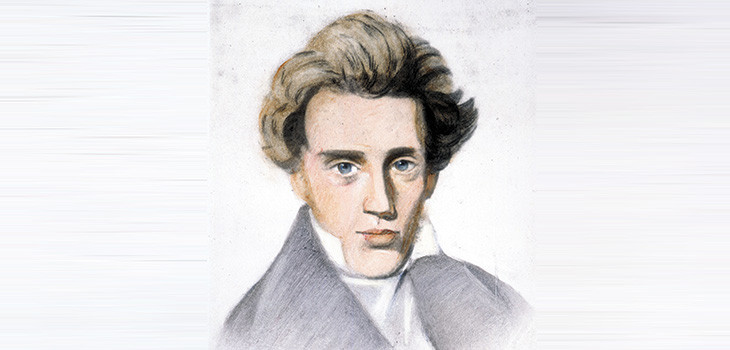
November 25, 2024 – Søren Kierkegaard
Julian Jaynes’ wrote a book in 1976 with, for the popular reader, the most daunting of titles: The Origin of Consciousness in the Breakdown of the Bicameral Mind. It is, however, a fascinating work which looks at the human ability to be introspective and consider its own condition. Jaynes questions whether this ability is useful, serving as it does, to distract us from our instinctive actions. He gives the example of how, for instance, walking downstairs does not require thought and that, in fact, if you think about it while you do it you are quite likely to fall. Similar examples cover almost everything we do. I once fell down a flight of stairs at a court testing the theory. Jaynes goes on to consider whether introspection is harmful and a rare evolutionary error meaning, as a species, that we may truly be alone in the universe.
We value this power to contemplate our own existence very highly indeed and spend much time thinking about how and why we do things or, indeed, whether we should do them at all. If Jaynes is correct, much of this thought is likely to produce a worse outcome than if we had just acted with our animal instincts.
I remembered the theory recently given the growing inability of politicians of all hues seemingly to understand how to run a country in the 21st century and, and because of public furore about the limits of free speech. This, while the world shuts its eyes to the planet-threatening problems of our age and instead occupies itself with (in comparison) more parochial concerns.
There is no doubt that the ability to say things publicly has changed greatly in recent years. I flicked through a social media site that sends you more of what you look at and examined some comedy sketches, all from this century. Most of them were harshly (but very amusingly) pointing up our prejudices and follies. I came to the conclusion, however, that most, if not all of them, could not be shown now on network television. The test today seems not so much the outlawing of bullying, harassing and denigrating comedy (which certainly existed and made me uncomfortable when I was much younger even when it was popularly acceptable) to forbidding anything which might upset someone else’s sensitivities – even if that reactivity is exceptionally subjective and abnormally heightened. Indeed, a reader or viewer is sometimes offended because the comedy itself is seen as literal instead of the reality of it demonstrating the stupidity of the behaviour being characterised. Warnings now proliferate on many, many television programmes, although, since they are given at the very beginning, they are predicated rather ludicrously on the viewer starting to watch at the very start.
Do we now all look for offence with a curious need? Have we entered another age of puritanism to which the British are strangely drawn periodically? Or is it that we are overloaded with too many opportunities to see each other’s views, not all of which will have been carefully considered prior to publication?
The ‘posting’ nightmare has erupted of course in a now infamous encounter between a well-known campaigning journalist and Essex police. Oscar Wilde’s aphorism about foxhunting comes to mind. So, on the one hand we have freedom of speech and, on the other, the potential fear of distress caused to those who see it as an attack on their existence and identity. In the middle we have the police, whose own identity seems to be becoming somewhat blurred.
This brings me back to the overarching problem: how, in any case, can a criminal justice system do anything about it when it resembles a person whose nose is just about to slip under the bog that is Grimpen Mire, as the politicians have now finally given up and no longer even pretend that they have any idea how to save it or its practitioners.
I went into Chambers to cheer myself up. Of course, I don’t say anything now when I go in; for fear of offending someone. I smile. Not so long a smile that this itself may seem offensive or downright strange; just brief and with a nod as I walk on. I went upstairs to my room and continued reading a new two-volume novel about the Emperor Nero. It presents him much more sympathetically than my classical history master did and although he did not in fact fiddle while Rome burned, I might now have forgiven him if he had.
William Byfield is the pseudonym of a senior member of the Bar. Gutteridge Chambers, and the events that happen there, are entirely fictitious.
November 25, 2024 – Søren Kierkegaard
Julian Jaynes’ wrote a book in 1976 with, for the popular reader, the most daunting of titles: The Origin of Consciousness in the Breakdown of the Bicameral Mind. It is, however, a fascinating work which looks at the human ability to be introspective and consider its own condition. Jaynes questions whether this ability is useful, serving as it does, to distract us from our instinctive actions. He gives the example of how, for instance, walking downstairs does not require thought and that, in fact, if you think about it while you do it you are quite likely to fall. Similar examples cover almost everything we do. I once fell down a flight of stairs at a court testing the theory. Jaynes goes on to consider whether introspection is harmful and a rare evolutionary error meaning, as a species, that we may truly be alone in the universe.
We value this power to contemplate our own existence very highly indeed and spend much time thinking about how and why we do things or, indeed, whether we should do them at all. If Jaynes is correct, much of this thought is likely to produce a worse outcome than if we had just acted with our animal instincts.
I remembered the theory recently given the growing inability of politicians of all hues seemingly to understand how to run a country in the 21st century and, and because of public furore about the limits of free speech. This, while the world shuts its eyes to the planet-threatening problems of our age and instead occupies itself with (in comparison) more parochial concerns.
There is no doubt that the ability to say things publicly has changed greatly in recent years. I flicked through a social media site that sends you more of what you look at and examined some comedy sketches, all from this century. Most of them were harshly (but very amusingly) pointing up our prejudices and follies. I came to the conclusion, however, that most, if not all of them, could not be shown now on network television. The test today seems not so much the outlawing of bullying, harassing and denigrating comedy (which certainly existed and made me uncomfortable when I was much younger even when it was popularly acceptable) to forbidding anything which might upset someone else’s sensitivities – even if that reactivity is exceptionally subjective and abnormally heightened. Indeed, a reader or viewer is sometimes offended because the comedy itself is seen as literal instead of the reality of it demonstrating the stupidity of the behaviour being characterised. Warnings now proliferate on many, many television programmes, although, since they are given at the very beginning, they are predicated rather ludicrously on the viewer starting to watch at the very start.
Do we now all look for offence with a curious need? Have we entered another age of puritanism to which the British are strangely drawn periodically? Or is it that we are overloaded with too many opportunities to see each other’s views, not all of which will have been carefully considered prior to publication?
The ‘posting’ nightmare has erupted of course in a now infamous encounter between a well-known campaigning journalist and Essex police. Oscar Wilde’s aphorism about foxhunting comes to mind. So, on the one hand we have freedom of speech and, on the other, the potential fear of distress caused to those who see it as an attack on their existence and identity. In the middle we have the police, whose own identity seems to be becoming somewhat blurred.
This brings me back to the overarching problem: how, in any case, can a criminal justice system do anything about it when it resembles a person whose nose is just about to slip under the bog that is Grimpen Mire, as the politicians have now finally given up and no longer even pretend that they have any idea how to save it or its practitioners.
I went into Chambers to cheer myself up. Of course, I don’t say anything now when I go in; for fear of offending someone. I smile. Not so long a smile that this itself may seem offensive or downright strange; just brief and with a nod as I walk on. I went upstairs to my room and continued reading a new two-volume novel about the Emperor Nero. It presents him much more sympathetically than my classical history master did and although he did not in fact fiddle while Rome burned, I might now have forgiven him if he had.

The Chair of the Bar reports back
Susie Griffin on the admin that keeps barristers from billable work
Clement Cowley, Partner at The Penny Group, explains how global events can influence the performance of pensions and ISAs, and why taking a long-term approach to investing is often the most effective strategy
Mário Barroso, Head of R&D and Method Development at AlphaBiolabs, discusses what family law professionals need to know about hallucinogens, from the main hallucinogenic drugs encountered in family proceedings, to their effects and the testing options available
Harmony Christian Ministries is the latest charity to benefit from a £500 donation from AlphaBiolabs via the company’s Giving Back initiative
By David Green

The golden age of advocacy? David Langwallner pays homage to the filmic if contentious barrister Sir Edward Carson and some of his contemporaries
Leah Arthur, a pupil, and her second seat supervisor, John Goss, share their perspectives on building a productive pupil-supervisor relationship
Henry Fingerhut outlines what the Bar Standards Board AI guidance means for early career barristers
The Ministry of Justice will match-fund up to 100 criminal pupillages, with grants available to criminal chambers across England and Wales. Similar to the COIC scheme, the grants will match-fund pupillages additional to those otherwise offered without government funding
Not yet, says Jacob Turner. Regulation, unlike the technology itself, is a domain the legal profession can still control