*/
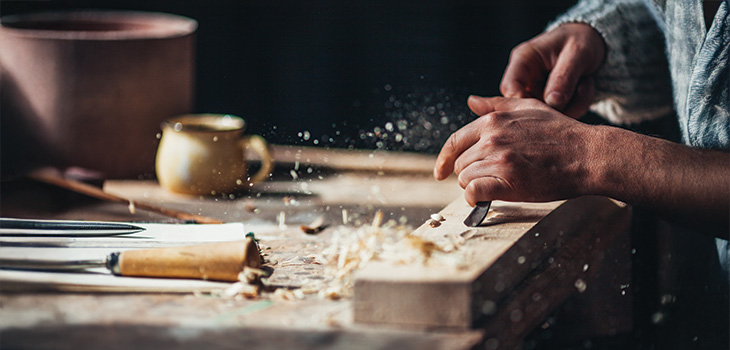
There is some irony in the fact that I am writing about carpentry in a magazine for barristers. In the very early stages of my journey to the Bar, I felt that carpentry was a remnant of my past that deserved no mention in a professional setting. At times, I even felt it better not to discuss it at all, out of fear that I would be seen as too attached to my wooden roots, having initially trained to be a carpenter. Firm in that belief, I only gave it the briefest of mentions within my early applications, hoping it wouldn’t be noticed, let alone discussed.
Yet, as time went on, I realised how pursuits such as carpentry and another of my passions –cycling (much to the dismay of all other road users) – are vital for longevity in what is a notoriously demanding, and at times, all-consuming life choice.
The Bar is far more than a mere career. Pursuits that force us to turn away from the laptop, even for a few hours, give us a means of placating the invisible critic that sits on our shoulders, removing ourselves from its dizzying gaze and constant demands for more output, with ever broadening standards of excellence. The balance those pursuits provide, in my view, is a core ingredient of a sustainable practice, and an inimitable weapon in the battle against burnout. They are also a window into the outside world, a world filled with magic and wonder – and one we often forget to take notice of when being sent to locations only the junior Bar seems to be able to locate.
The limited woodworking skills I now turn to are the result of my decision to train as a carpenter after leaving school at 16, on the advice of my wonderfully supportive parents. In their view, there was always a shortage of ‘good tradespeople’. After working on disrepair cases relatively frequently, I can see they weren’t wrong. If only I’d been any good at carpentry…
I realised quite quickly that carpentry wasn’t my calling, though. I needed something that I found to be more intellectually stimulating – and something which didn’t risk regular injury when foolishly trying to cut corners. The main issue was the speed at which we had to work. For me, working at such velocity removed the enjoyment and the craftsmanship that I had been attracted to. The abundance of ‘crazy (expanding) foam’ only added to my disillusionment. At that time, I also found wood to be a near endless source of frustration. It was always imperfect, with its twists, turns and knots, and much to my dismay, I found those individualities to be impervious to even prolonged periods of effort.
As time went on, though, I began to see that when you work with the twists and the turns, rather than against them, everything gets a lot easier. There is also a profound and lasting beauty to be found in those twists and turns, whether they are found in wood, when careering down country lanes vacuum packed in Lycra, or indeed, anywhere else.
So I found myself drawn back to the tools. When I was on my own time, undertaking projects I wanted to do, there were enormous benefits that came with closing my laptop and retreating to the dimly lit shed at the end of the garden. I find a lot of joy in being able to fix things or design something that has a practical use. Past projects have been varied and without going on, I have built a summer house I now use as a study, a chicken coop (pictured left) where I often consider retreating to, and several shoe stands for my ever-growing trainer collection.
Those more holistic benefits I find with carpentry, I have also found to be present with cycling. Perhaps it is the fact that there is a shared risk; lose concentration for a moment and the consequences can be devastating. Both pursuits force you to be in the moment, and if you aren’t, you risk catastrophe.
That, for me, is where the greatest benefits are – when forced to direct my concentration elsewhere, I am able to forget the standoff I have been in with my work (often with a factually complex, multifaceted piece of written work) where hours have seemingly evaporated, with little progress being made. It is within that cerebral interlude that I am able to see the answers I couldn’t see previously. It feels as if both activities act as a metaphorical mine sweeper, removing the obstructions and allowing the grey matter to reset. In doing so, they enable me to stop, and to take stock, before I can then proceed, leaving the whimsy of Neverland, where deadlines don’t exist.
With the conclusion of this piece – and of every project – I realise how fortunate I am to be at the Bar, doing something I genuinely enjoy, every day. But I also remember, there is a world outside of the machinations of the courtroom; one which we must strive to enjoy.
As for my own journey, I still find myself deeply frustrated with wood, but every time that frustration begins to overcome the enjoyment, I remind myself that the beauty is within those twists and turns.

There is some irony in the fact that I am writing about carpentry in a magazine for barristers. In the very early stages of my journey to the Bar, I felt that carpentry was a remnant of my past that deserved no mention in a professional setting. At times, I even felt it better not to discuss it at all, out of fear that I would be seen as too attached to my wooden roots, having initially trained to be a carpenter. Firm in that belief, I only gave it the briefest of mentions within my early applications, hoping it wouldn’t be noticed, let alone discussed.
Yet, as time went on, I realised how pursuits such as carpentry and another of my passions –cycling (much to the dismay of all other road users) – are vital for longevity in what is a notoriously demanding, and at times, all-consuming life choice.
The Bar is far more than a mere career. Pursuits that force us to turn away from the laptop, even for a few hours, give us a means of placating the invisible critic that sits on our shoulders, removing ourselves from its dizzying gaze and constant demands for more output, with ever broadening standards of excellence. The balance those pursuits provide, in my view, is a core ingredient of a sustainable practice, and an inimitable weapon in the battle against burnout. They are also a window into the outside world, a world filled with magic and wonder – and one we often forget to take notice of when being sent to locations only the junior Bar seems to be able to locate.
The limited woodworking skills I now turn to are the result of my decision to train as a carpenter after leaving school at 16, on the advice of my wonderfully supportive parents. In their view, there was always a shortage of ‘good tradespeople’. After working on disrepair cases relatively frequently, I can see they weren’t wrong. If only I’d been any good at carpentry…
I realised quite quickly that carpentry wasn’t my calling, though. I needed something that I found to be more intellectually stimulating – and something which didn’t risk regular injury when foolishly trying to cut corners. The main issue was the speed at which we had to work. For me, working at such velocity removed the enjoyment and the craftsmanship that I had been attracted to. The abundance of ‘crazy (expanding) foam’ only added to my disillusionment. At that time, I also found wood to be a near endless source of frustration. It was always imperfect, with its twists, turns and knots, and much to my dismay, I found those individualities to be impervious to even prolonged periods of effort.
As time went on, though, I began to see that when you work with the twists and the turns, rather than against them, everything gets a lot easier. There is also a profound and lasting beauty to be found in those twists and turns, whether they are found in wood, when careering down country lanes vacuum packed in Lycra, or indeed, anywhere else.
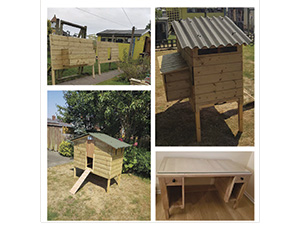
So I found myself drawn back to the tools. When I was on my own time, undertaking projects I wanted to do, there were enormous benefits that came with closing my laptop and retreating to the dimly lit shed at the end of the garden. I find a lot of joy in being able to fix things or design something that has a practical use. Past projects have been varied and without going on, I have built a summer house I now use as a study, a chicken coop (pictured left) where I often consider retreating to, and several shoe stands for my ever-growing trainer collection.
Those more holistic benefits I find with carpentry, I have also found to be present with cycling. Perhaps it is the fact that there is a shared risk; lose concentration for a moment and the consequences can be devastating. Both pursuits force you to be in the moment, and if you aren’t, you risk catastrophe.
That, for me, is where the greatest benefits are – when forced to direct my concentration elsewhere, I am able to forget the standoff I have been in with my work (often with a factually complex, multifaceted piece of written work) where hours have seemingly evaporated, with little progress being made. It is within that cerebral interlude that I am able to see the answers I couldn’t see previously. It feels as if both activities act as a metaphorical mine sweeper, removing the obstructions and allowing the grey matter to reset. In doing so, they enable me to stop, and to take stock, before I can then proceed, leaving the whimsy of Neverland, where deadlines don’t exist.
With the conclusion of this piece – and of every project – I realise how fortunate I am to be at the Bar, doing something I genuinely enjoy, every day. But I also remember, there is a world outside of the machinations of the courtroom; one which we must strive to enjoy.
As for my own journey, I still find myself deeply frustrated with wood, but every time that frustration begins to overcome the enjoyment, I remind myself that the beauty is within those twists and turns.


The Chair of the Bar reports back
Susie Griffin on the admin that keeps barristers from billable work
Clement Cowley, Partner at The Penny Group, explains how global events can influence the performance of pensions and ISAs, and why taking a long-term approach to investing is often the most effective strategy
Mário Barroso, Head of R&D and Method Development at AlphaBiolabs, discusses what family law professionals need to know about hallucinogens, from the main hallucinogenic drugs encountered in family proceedings, to their effects and the testing options available
Harmony Christian Ministries is the latest charity to benefit from a £500 donation from AlphaBiolabs via the company’s Giving Back initiative
By David Green
At the start of her term, Chair of the Bar 2026 Kirsty Brimelow KC set out a series of priorities for the year ahead. One of those priorities was children in the justice system
As the world becomes more digital, Barbara Vinagre Mota examines international research into the mental health consequences of judges’ exposure to graphic and immersive evidence, highlighting the importance of support systems
In an era of patient-centred care and growing concern over misconduct in medical settings, why do women still lack the right to choose women consultants for examination and treatment? Charles Davey investigates
Reviewed by Daniel Barnett
James McNeill Whistler at Tate Britain until 27 September Rothko in Florence at Palazzo Strozzi until 23 August Reviewed by Stephen Cragg KC