*/
Secondment: 2-3 days a week, 12 months duration starting February/March 2009 (daily rate payable, dependent on seniority/experience) The Bar Standards Board is currently considering the impact of the Legal Services Act 2007 on the provision of legal services. In particular, the Board is focussing on how barristers who wish to work in the new business arrangements proposed under the Act should be regulated.
The Board has a comprehensive programme of work over the next 12 months and wishes to ensure that it has available the right resources and expertise for the effective completion of this important work. The Board therefore seeks expressions of interest from senior practice managers/chambers’ directors or equivalent who would be interested in contributing to the Board’s development of policy and a new regulatory framework in the light of the Act.
It is anticipated that the right candidates will have the following attributes:
The secondment role (1 post) will involve working with the staff of the Board and primarily its Legal Services Act Working Group, but also on other Legal Services Act issues, and will provide an unrivalled opportunity for the right individual to be at the forefront of the development of strategy and to influence the emerging regulatory policy in this area. The work is likely to require a commitment of an average of 2- 3 days a week over the next 12 months. This work will involve confidential policy formulation and engagement with stakeholders.
It is anticipated that the right candidates will have the following attributes:
The secondment role (1 post) will involve working with the staff of the Board and primarily its Legal Services Act Working Group, but also on other Legal Services Act issues, and will provide an unrivalled opportunity for the right individual to be at the forefront of the development of strategy and to influence the emerging regulatory policy in this area. The work is likely to require a commitment of an average of 2- 3 days a week over the next 12 months. This work will involve confidential policy formulation and engagement with stakeholders.
Secondment: 2-3 days a week, 12 months duration starting February/March 2009 (daily rate payable, dependent on seniority/experience) The Bar Standards Board is currently considering the impact of the Legal Services Act 2007 on the provision of legal services. In particular, the Board is focussing on how barristers who wish to work in the new business arrangements proposed under the Act should be regulated.
The Board has a comprehensive programme of work over the next 12 months and wishes to ensure that it has available the right resources and expertise for the effective completion of this important work. The Board therefore seeks expressions of interest from senior practice managers/chambers’ directors or equivalent who would be interested in contributing to the Board’s development of policy and a new regulatory framework in the light of the Act.
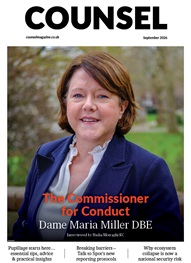

The Chair of the Bar reports back
Susie Griffin on the admin that keeps barristers from billable work
Clement Cowley, Partner at The Penny Group, explains how global events can influence the performance of pensions and ISAs, and why taking a long-term approach to investing is often the most effective strategy
Mário Barroso, Head of R&D and Method Development at AlphaBiolabs, discusses what family law professionals need to know about hallucinogens, from the main hallucinogenic drugs encountered in family proceedings, to their effects and the testing options available
Harmony Christian Ministries is the latest charity to benefit from a £500 donation from AlphaBiolabs via the company’s Giving Back initiative
By David Green
At the start of her term, Chair of the Bar 2026 Kirsty Brimelow KC set out a series of priorities for the year ahead. One of those priorities was children in the justice system
As the world becomes more digital, Barbara Vinagre Mota examines international research into the mental health consequences of judges’ exposure to graphic and immersive evidence, highlighting the importance of support systems
In an era of patient-centred care and growing concern over misconduct in medical settings, why do women still lack the right to choose women consultants for examination and treatment? Charles Davey investigates
Reviewed by Daniel Barnett
James McNeill Whistler at Tate Britain until 27 September Rothko in Florence at Palazzo Strozzi until 23 August Reviewed by Stephen Cragg KC