*/
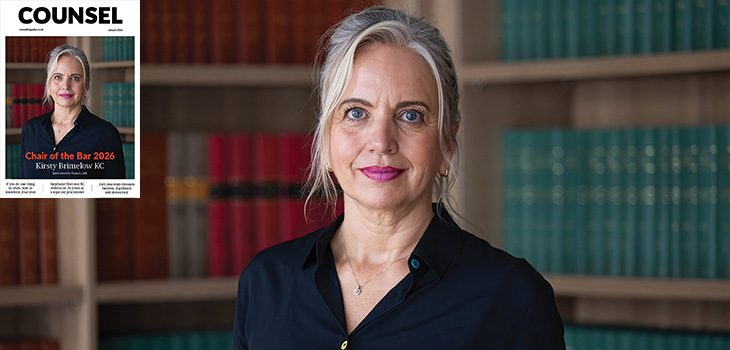
In conversation with Frances Gibb, Kirsty Brimelow KC outlines an ambitious reform agenda for her term, spanning issues from child justice to Bar culture. Yet she leaves no doubt about her immediate priorities: protecting jury trials and securing urgent funding for the justice system
Barristers are lining up with judges to fight for the justice system. Kirsty Brimelow KC, who took over at the helm of the 18,000-strong barristers’ profession on 1 January, acknowledges that the criminal courts in particular are ‘certainly in crisis’ with unprecedented delays: the current backlog stands at almost 80,000 cases and some trials, including rape, are fixed for as late as 2029.
But Brimelow, and the Bar Council of which she is Chair this year, are also explicitly against Justice Secretary David Lammy’s proposal to curtail jury trials – as a means, he argues, to scythe through the backlog.
The move, she says, would amount to ripping up ‘a deep-rooted and trusted constitutional principle’.
‘There needs to be public funding of the justice system and that’s across civil, family and crime. If you want the law to work and the courts to work, you need to invest. It’s as basic as that.’
Everyone, she says – in the judiciary and Bar Council – shares the aim of sorting out the crisis in the criminal courts. But jury-less trials are not a quick fix. ‘We’d rather let efficiencies work through – and those changes must include investment, resources in the system – and see what difference that makes first.
‘Juries are not the cause of the backlog; nor is there evidence that removing them would reduce it. A single judge will need time to write a judgment; and will still face the daily issue of delays with defendants being brought to court, technology failures and lack of sufficient barristers to prosecute or defend.’
‘The criminal justice system used to be one of which we were proud,’ she adds. ‘Reverse financial cuts to it before seeking to pull up a deeply rooted constitutional principle.’
Cases are being adjourned because there is no prosecutor or defence barrister. ‘If you’re working in a court where the roofs are falling in and there are no facilities, it hits morale.’ People, she adds, ‘are getting tired, pushed to burn out… it’s a real concern.’
To that end, Brimelow backs increased legal aid fees for barristers to attract and retain them. Lammy has promised an increase which is a much-needed start, she says – but the pledge of up to £34 million will need to have effect ‘urgently and consistently’. It is an issue close to her heart. Brimelow was both Vice Chair and Chair of the Criminal Bar Association over 2021-23 during negotiations – and then strike action – over fees.
Does she support a renewal of strike action? ‘All I can say is… it was very, very difficult for barristers to do, completely contrary to every instinct you have as a barrister which is to be in court representing your client. And I know that myself, because I had a trial ongoing, and I was having to explain to my very young client, who was charged with very serious offences, that I was not going to be at court the next day because of the barristers’ action.’
She clearly does not wish to be faced with the dilemma again. ‘People made lots of sacrifices in taking the action. It was an absolute last resort and I truly hope we don’t hit being in a position of an absolute last resort. We don’t want to be back there again.’
Rather, she is urging efficiencies and measures such as having a senior prosecutor to review older cases, weeding out those that could be resolved through lesser charges or that are likely guilty pleas or likely to result in offering no evidence; and a lifting of the cap on judge-sitting days. ‘You’d avoid a listing officer finding out they’ve used their allocation at the end of the year and then having the situation we’ve had up and down the country, of courts remaining closed. So they’re not running at full capacity.’
It is familiar territory. Brimelow has been a criminal, public law and international human rights barrister for some 30 years, practising from Doughty Street Chambers for over half that time and at the forefront of Bar politics for most of her career. She was Bar Vice Chair last year, and has been Vice Chair and (for six years) Chair of the Bar Human Rights Committee, the first woman in that role. Her tenure as leader of the barristers’ profession also happens to coincide with the first Lady Chief Justice in history; and, for the first time, all Bar Council leaders being women: Vice Chair is Heidi Stonecliffe KC, Lucinda Orr is Treasurer and Amelia Clegg is Chair of the Young Barristers’ Committee.
In her rise to the top, does Brimelow perceive change in a traditionally male-dominated profession? There was plenty of sexism, she says, when she was called in 1991. ‘Bad behaviour from men. Lots of challenges, as a junior and as a pupil. I don’t think it would happen now in the same way as there are better systems in chambers. People at least have accessible reporting through Talk to Spot [the Bar’s online tool]. But we need consistently safe and inclusive working environments that are supportive of barristers.’ She herself recalls intervening to protect a young woman barrister from being bullied by a senior colleague in court. She has spent many years mentoring juniors. And despite an improved culture, a report published in September 2025 by Baroness Harman KC found widespread sexual harassment and bullying: the Bar Council has adopted its recommendations and will continue to implement them under Brimelow’s tenure.
There is also the ongoing gender earnings gap: a Bar Council report published in November found women earning less than men across all levels at the self-employed Bar. Junior women were earning 76% of junior men’s earnings; women silks were earning 72% of their male colleagues’ median gross earnings. And the gap persists across all levels and every area of practice. ‘People say – oh well, it’s to do with women taking time off, working part-time and so on. But that’s factored in. The gaps are from the first few years of practice.’ The widest gaps are in commercial and Chancery work, where women of 11-15 years’ call are earning 63% of their male colleagues’ median fee income.
Brimelow will oversee ongoing work with chambers to tackle this and hopes to partner with the Law Society to look at the point when solicitors instruct chambers and clerks hand out briefs.
The new Bar chief is not from a conventional barrister’s background. Her family worked in factories – her mother as a sewist and her father on the factory floor as an apprentice in engineering. ‘But as an adult, my father studied at night school and attained many degree equivalents,’ she adds. She was state educated (Balshaw’s Church of England High School, Leyland in Lancashire); then A levels on an assisted place (Queen Elizabeth’s Grammar School, Blackburn). Education was valued as a step into a profession – medicine or law were the careers advice. She opted for law and went to the University of Birmingham.
So, unsurprisingly, Brimelow is interested in fostering social mobility. She also wants to improve access to the Bar for people with disabilities. She has a personal interest, arising from her nephew who went blind aged 15, during the time of his GCSEs. ‘We had to find a whole different way of working for him because he very quickly couldn’t see to write anything.’ His passion also was football. ‘It felt like everything he loved doing was being taken away from him by his blindness.’ But he has been able to return to football and has got his first cap playing blind football for England. Brimelow wants ‘to ensure that we’re just more aware, and more conscious of those around us who have these struggles. That’s what I bring – I suppose I come from a not-necessarily traditional background at the Bar.’
With her strong human rights credentials, Brimelow is a typical target of right-wing politicians when they warn of ‘lefty lawyers’ scuppering government policy measures to tackle illegal immigration. She resents the label: ‘I’ve never seen myself as a lefty human rights lawyer. And that’s partly because it’s used as a slur.’ The European Convention, she says, was drafted by Conservative politicians to enable citizens to have a stake in how they were governed: ‘To suggest that it is “lefty” doesn’t make any logical sense.’ The Convention is a living instrument, is complex and can be examined but it is regrettable that debate over the protection of rights and people’s remedies has become polarised. That, and ‘the toxicity and the politics around it, is really, really unfortunate’.
Increasing hostility towards judges and lawyers is ‘irresponsible and dangerous’, she adds. In Colombia, where she has worked, lawyers travel in bullet proof cars, judges have armed guards with them. ‘We absolutely do not want to slide down into this insecurity,’ she says. ‘Once down there, it’s hard to clamber back.’
For her year of office, she identifies several areas of reform: first, children in the justice system, where she favours raising the 10-year-old age of criminal responsibility. She has set up a working group on child justice which will report in March. There is now more awareness of how children in the Crown Court are treated: ‘I had a case representing a 15-year-old a few years ago charged with murder. He sat outside the dock next to his mother. It was a very stark change. But the age of criminal responsibility has not moved – it’s the lowest in Europe. Scotland is 12.’
Her interest stems partly from early criminal cases in the youth court; child rights work with UNICEF in Nigeria – and general views on how children are treated in society: ‘If there’s an emphasis on criminalising children rather than on prevention of crimes, diversion from crimes, resources into broken care systems, it means that we are looking at our kids in a way which perhaps isn’t very helpful for us as a whole. And it often feels slightly Dickensian, how we have these very young children in our justice system, where it would have been better if they’d been diverted out at a much earlier stage.’
Another issue is violence against women and girls – a focus throughout her career. She has trained barristers in India on special measures and questioning vulnerable witnesses: she helped with the screening of India’s Daughter ten years ago, about the brutal gang rape and murder of a young student. She successfully partnered with Amnesty Denmark to change Denmark’s rape law, shifting the focus to absence of consent. She also helped draft and bring into force FGM protection orders. Beyond the courts, Brimelow wants action on stalking and safer streets: she represented the family of Shana Grice, a 19-year-old murdered by her ex-boyfriend, whom Grice had reported to the police five times for stalking her – on one occasion receiving a fixed penalty.
Brimelow is bubbling with enthusiasm for action on other fronts but only has one year in office. She mentions expanding arbitration, alternative dispute resolution and commercial work, with more women appointed arbitrators. Brimelow herself is an accredited mediator and acts in conflict resolution – she worked on the Colombian peace process and in 2013 negotiated a historic apology from the then president for a massacre of Cacao farmers who resisted displacement. Conflict resolution, she notes, is ‘very male dominated – would more women in there make for fewer wars or resolving wars more quickly?’ Then there is climate change: she is a trustee of the World Wildlife Fund. She wants training for lawyers to increase expertise in advising corporate clients on climate change, risk management and allied issues. ‘I unashamedly say you can’t ignore the planet we live on.’
Above all, though, there is a crucial need for funding across the justice system. A deputy High Court Judge and Recorder, she enjoys sitting and does not rule out a future move to the bench full-time. But for now, she has found her metier. She had no ambition for the top Bar job: she fought for each post she has filled in contested elections and, she insists, ‘only after somebody asked me to stand’. But to her surprise, she found that the positions played to her strengths. ‘I love being in court and I’m a tenacious lawyer but I also really like the policy, the wider societal change that you can achieve through getting involved in legislation, influencing politicians, writing, expressing opinions beyond drafting pleadings and skeleton arguments. At the core lies an opposition to injustice and harm. And perhaps along the way, what I’ve discovered, what I’ve worked out [through her various Bar roles], is what I’m good at.’
Born in Chorley, Lancashire, England
Educated at Balshaw’s C of E High School, Leyland; Queen Elizabeth’s Grammar School, Blackburn; Birmingham University (LLB Honours)
Called to the Bar (Gray’s Inn) in 1991; began practice after pupillage in 1993
Queen’s (now King’s) Counsel, 2011
Vice-Chair (2008-12) then Chair of the Bar Human Rights Committee (2012-18)
Vice-Chair, then Chair, of the Criminal Bar Association 2021-23
Appointed Deputy High Court Judge 2021; Recorder 2022
Vice Chair of the Bar of England and Wales 2025; Chair of the Bar of England and Wales 2026
Justice needs juries: Write to your MP – and read more about what the Bar Council is doing in response to the Leveson Review
The Harman Report: Independent review of bullying, harassment and sexual harassment at the Bar, September 2025
Gross earnings by sex and practice area at the Bar, Bar Council, November 2025
Bar Leaders’ statement on government’s response to Leveson’s Review of Criminal Courts
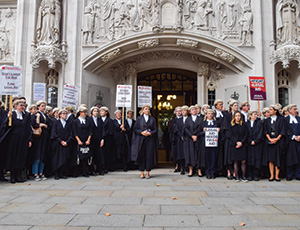
Kirsty, pictured as Chair of the Criminal Bar Association 2022-23, with criminal barristers outside the Supreme Court as they began their days of action on 6 September 2022.


Barristers are lining up with judges to fight for the justice system. Kirsty Brimelow KC, who took over at the helm of the 18,000-strong barristers’ profession on 1 January, acknowledges that the criminal courts in particular are ‘certainly in crisis’ with unprecedented delays: the current backlog stands at almost 80,000 cases and some trials, including rape, are fixed for as late as 2029.
But Brimelow, and the Bar Council of which she is Chair this year, are also explicitly against Justice Secretary David Lammy’s proposal to curtail jury trials – as a means, he argues, to scythe through the backlog.
The move, she says, would amount to ripping up ‘a deep-rooted and trusted constitutional principle’.
‘There needs to be public funding of the justice system and that’s across civil, family and crime. If you want the law to work and the courts to work, you need to invest. It’s as basic as that.’
Everyone, she says – in the judiciary and Bar Council – shares the aim of sorting out the crisis in the criminal courts. But jury-less trials are not a quick fix. ‘We’d rather let efficiencies work through – and those changes must include investment, resources in the system – and see what difference that makes first.
‘Juries are not the cause of the backlog; nor is there evidence that removing them would reduce it. A single judge will need time to write a judgment; and will still face the daily issue of delays with defendants being brought to court, technology failures and lack of sufficient barristers to prosecute or defend.’
‘The criminal justice system used to be one of which we were proud,’ she adds. ‘Reverse financial cuts to it before seeking to pull up a deeply rooted constitutional principle.’
Cases are being adjourned because there is no prosecutor or defence barrister. ‘If you’re working in a court where the roofs are falling in and there are no facilities, it hits morale.’ People, she adds, ‘are getting tired, pushed to burn out… it’s a real concern.’
To that end, Brimelow backs increased legal aid fees for barristers to attract and retain them. Lammy has promised an increase which is a much-needed start, she says – but the pledge of up to £34 million will need to have effect ‘urgently and consistently’. It is an issue close to her heart. Brimelow was both Vice Chair and Chair of the Criminal Bar Association over 2021-23 during negotiations – and then strike action – over fees.
Does she support a renewal of strike action? ‘All I can say is… it was very, very difficult for barristers to do, completely contrary to every instinct you have as a barrister which is to be in court representing your client. And I know that myself, because I had a trial ongoing, and I was having to explain to my very young client, who was charged with very serious offences, that I was not going to be at court the next day because of the barristers’ action.’
She clearly does not wish to be faced with the dilemma again. ‘People made lots of sacrifices in taking the action. It was an absolute last resort and I truly hope we don’t hit being in a position of an absolute last resort. We don’t want to be back there again.’
Rather, she is urging efficiencies and measures such as having a senior prosecutor to review older cases, weeding out those that could be resolved through lesser charges or that are likely guilty pleas or likely to result in offering no evidence; and a lifting of the cap on judge-sitting days. ‘You’d avoid a listing officer finding out they’ve used their allocation at the end of the year and then having the situation we’ve had up and down the country, of courts remaining closed. So they’re not running at full capacity.’
It is familiar territory. Brimelow has been a criminal, public law and international human rights barrister for some 30 years, practising from Doughty Street Chambers for over half that time and at the forefront of Bar politics for most of her career. She was Bar Vice Chair last year, and has been Vice Chair and (for six years) Chair of the Bar Human Rights Committee, the first woman in that role. Her tenure as leader of the barristers’ profession also happens to coincide with the first Lady Chief Justice in history; and, for the first time, all Bar Council leaders being women: Vice Chair is Heidi Stonecliffe KC, Lucinda Orr is Treasurer and Amelia Clegg is Chair of the Young Barristers’ Committee.
In her rise to the top, does Brimelow perceive change in a traditionally male-dominated profession? There was plenty of sexism, she says, when she was called in 1991. ‘Bad behaviour from men. Lots of challenges, as a junior and as a pupil. I don’t think it would happen now in the same way as there are better systems in chambers. People at least have accessible reporting through Talk to Spot [the Bar’s online tool]. But we need consistently safe and inclusive working environments that are supportive of barristers.’ She herself recalls intervening to protect a young woman barrister from being bullied by a senior colleague in court. She has spent many years mentoring juniors. And despite an improved culture, a report published in September 2025 by Baroness Harman KC found widespread sexual harassment and bullying: the Bar Council has adopted its recommendations and will continue to implement them under Brimelow’s tenure.
There is also the ongoing gender earnings gap: a Bar Council report published in November found women earning less than men across all levels at the self-employed Bar. Junior women were earning 76% of junior men’s earnings; women silks were earning 72% of their male colleagues’ median gross earnings. And the gap persists across all levels and every area of practice. ‘People say – oh well, it’s to do with women taking time off, working part-time and so on. But that’s factored in. The gaps are from the first few years of practice.’ The widest gaps are in commercial and Chancery work, where women of 11-15 years’ call are earning 63% of their male colleagues’ median fee income.
Brimelow will oversee ongoing work with chambers to tackle this and hopes to partner with the Law Society to look at the point when solicitors instruct chambers and clerks hand out briefs.
The new Bar chief is not from a conventional barrister’s background. Her family worked in factories – her mother as a sewist and her father on the factory floor as an apprentice in engineering. ‘But as an adult, my father studied at night school and attained many degree equivalents,’ she adds. She was state educated (Balshaw’s Church of England High School, Leyland in Lancashire); then A levels on an assisted place (Queen Elizabeth’s Grammar School, Blackburn). Education was valued as a step into a profession – medicine or law were the careers advice. She opted for law and went to the University of Birmingham.
So, unsurprisingly, Brimelow is interested in fostering social mobility. She also wants to improve access to the Bar for people with disabilities. She has a personal interest, arising from her nephew who went blind aged 15, during the time of his GCSEs. ‘We had to find a whole different way of working for him because he very quickly couldn’t see to write anything.’ His passion also was football. ‘It felt like everything he loved doing was being taken away from him by his blindness.’ But he has been able to return to football and has got his first cap playing blind football for England. Brimelow wants ‘to ensure that we’re just more aware, and more conscious of those around us who have these struggles. That’s what I bring – I suppose I come from a not-necessarily traditional background at the Bar.’
With her strong human rights credentials, Brimelow is a typical target of right-wing politicians when they warn of ‘lefty lawyers’ scuppering government policy measures to tackle illegal immigration. She resents the label: ‘I’ve never seen myself as a lefty human rights lawyer. And that’s partly because it’s used as a slur.’ The European Convention, she says, was drafted by Conservative politicians to enable citizens to have a stake in how they were governed: ‘To suggest that it is “lefty” doesn’t make any logical sense.’ The Convention is a living instrument, is complex and can be examined but it is regrettable that debate over the protection of rights and people’s remedies has become polarised. That, and ‘the toxicity and the politics around it, is really, really unfortunate’.
Increasing hostility towards judges and lawyers is ‘irresponsible and dangerous’, she adds. In Colombia, where she has worked, lawyers travel in bullet proof cars, judges have armed guards with them. ‘We absolutely do not want to slide down into this insecurity,’ she says. ‘Once down there, it’s hard to clamber back.’
For her year of office, she identifies several areas of reform: first, children in the justice system, where she favours raising the 10-year-old age of criminal responsibility. She has set up a working group on child justice which will report in March. There is now more awareness of how children in the Crown Court are treated: ‘I had a case representing a 15-year-old a few years ago charged with murder. He sat outside the dock next to his mother. It was a very stark change. But the age of criminal responsibility has not moved – it’s the lowest in Europe. Scotland is 12.’
Her interest stems partly from early criminal cases in the youth court; child rights work with UNICEF in Nigeria – and general views on how children are treated in society: ‘If there’s an emphasis on criminalising children rather than on prevention of crimes, diversion from crimes, resources into broken care systems, it means that we are looking at our kids in a way which perhaps isn’t very helpful for us as a whole. And it often feels slightly Dickensian, how we have these very young children in our justice system, where it would have been better if they’d been diverted out at a much earlier stage.’
Another issue is violence against women and girls – a focus throughout her career. She has trained barristers in India on special measures and questioning vulnerable witnesses: she helped with the screening of India’s Daughter ten years ago, about the brutal gang rape and murder of a young student. She successfully partnered with Amnesty Denmark to change Denmark’s rape law, shifting the focus to absence of consent. She also helped draft and bring into force FGM protection orders. Beyond the courts, Brimelow wants action on stalking and safer streets: she represented the family of Shana Grice, a 19-year-old murdered by her ex-boyfriend, whom Grice had reported to the police five times for stalking her – on one occasion receiving a fixed penalty.
Brimelow is bubbling with enthusiasm for action on other fronts but only has one year in office. She mentions expanding arbitration, alternative dispute resolution and commercial work, with more women appointed arbitrators. Brimelow herself is an accredited mediator and acts in conflict resolution – she worked on the Colombian peace process and in 2013 negotiated a historic apology from the then president for a massacre of Cacao farmers who resisted displacement. Conflict resolution, she notes, is ‘very male dominated – would more women in there make for fewer wars or resolving wars more quickly?’ Then there is climate change: she is a trustee of the World Wildlife Fund. She wants training for lawyers to increase expertise in advising corporate clients on climate change, risk management and allied issues. ‘I unashamedly say you can’t ignore the planet we live on.’
Above all, though, there is a crucial need for funding across the justice system. A deputy High Court Judge and Recorder, she enjoys sitting and does not rule out a future move to the bench full-time. But for now, she has found her metier. She had no ambition for the top Bar job: she fought for each post she has filled in contested elections and, she insists, ‘only after somebody asked me to stand’. But to her surprise, she found that the positions played to her strengths. ‘I love being in court and I’m a tenacious lawyer but I also really like the policy, the wider societal change that you can achieve through getting involved in legislation, influencing politicians, writing, expressing opinions beyond drafting pleadings and skeleton arguments. At the core lies an opposition to injustice and harm. And perhaps along the way, what I’ve discovered, what I’ve worked out [through her various Bar roles], is what I’m good at.’
Born in Chorley, Lancashire, England
Educated at Balshaw’s C of E High School, Leyland; Queen Elizabeth’s Grammar School, Blackburn; Birmingham University (LLB Honours)
Called to the Bar (Gray’s Inn) in 1991; began practice after pupillage in 1993
Queen’s (now King’s) Counsel, 2011
Vice-Chair (2008-12) then Chair of the Bar Human Rights Committee (2012-18)
Vice-Chair, then Chair, of the Criminal Bar Association 2021-23
Appointed Deputy High Court Judge 2021; Recorder 2022
Vice Chair of the Bar of England and Wales 2025; Chair of the Bar of England and Wales 2026
Justice needs juries: Write to your MP – and read more about what the Bar Council is doing in response to the Leveson Review
The Harman Report: Independent review of bullying, harassment and sexual harassment at the Bar, September 2025
Gross earnings by sex and practice area at the Bar, Bar Council, November 2025
Bar Leaders’ statement on government’s response to Leveson’s Review of Criminal Courts
Kirsty, pictured as Chair of the Criminal Bar Association 2022-23, with criminal barristers outside the Supreme Court as they began their days of action on 6 September 2022.
In conversation with Frances Gibb, Kirsty Brimelow KC outlines an ambitious reform agenda for her term, spanning issues from child justice to Bar culture. Yet she leaves no doubt about her immediate priorities: protecting jury trials and securing urgent funding for the justice system

The Chair of the Bar reports back
By Kem Kemal, CEO, Henry Dannell
By BSK Financial Planning
Mário Barroso, Head of R&D and Method Development at AlphaBiolabs
Susie Griffin on the admin that keeps barristers from billable work
Clement Cowley, Partner at The Penny Group, explains how global events can influence the performance of pensions and ISAs, and why taking a long-term approach to investing is often the most effective strategy

Kick off your career at the Bar Council’s Pupillage Fair this October – it’s one of the most valuable opportunities for aspiring barristers, says Amelia Clegg
Join us on Saturday 21 November 2026 at Leeds Beckett University and see for yourself why the North continues to be an exceptional place to build a career at the Bar
The golden age of advocacy? David Langwallner pays homage to the filmic if contentious barrister Sir Edward Carson and some of his contemporaries
Henry Fingerhut outlines what the Bar Standards Board AI guidance means for early career barristers
Not yet, says Jacob Turner. Regulation, unlike the technology itself, is a domain the legal profession can still control