*/
Blogging artist Isobel Williams on her work in the highest court in the land.
Since July 2012 I have been an occasional blogger-with-a-difference in the Supreme Court, with the court’s permission. The difference is that I illustrate my blog with drawings which I do on the spot; I rarely embellish them afterwards.
As far as the words go, there are plenty of lawyers who produce technical analyses of the proceedings. Being a non-lawyer, I riff on the general theme of the case, such as terrorism (R v Gul), harassment (Hayes v Willoughby) or pensions (Nortel and Lehman). Sometimes I go off on a tangent, as when drawing itself became my story in Bull v Hall.
Concerning the pictures, there are practicalities. I can’t use some of my favourite drawing materials – bamboo pens, wooden coffee stirrers, quills, sheep’s wool tufts – as they need to be dipped in ink. Splashing a bottle of that onto the multi-coloured carpet designed by Sir Peter Blake would not endear me to the authorities. Similarly, I have to avoid the noisy friction of extravagant sweeps across textured paper.
Like the Derby, the Supreme Court is on the flat – no elevated jury, no witness box – so from the public seats it’s about the backs of heads and chairs, with the justices far away across the howling tundra. How do you deal with that? Sometimes I experiment with transparent outlines. In the drawing of R v Hughes (opposite), the justices are pink ectoplasm, the staff and judicial assistants orange. Opera glasses are an option I am yet to explore.
In each courtroom, discreet amplification emphasises every breath, every rustle, every moment of nervous tension. In the stark white box of Court 2, the plushy floral curtains aren’t enough to insulate counsel from the relentless scrape of the minute hand on the slate clock or the finality of the omega on the court emblem. It’s all right for me – I can just sit here scribbling and ingerpainting with compressed charcoal while fine minds deal in cool abstractions.
So which is more important, the art or the text? The answer is neither: it’s the Supreme Court itself. One day when I noted some choice aperçus from the bench, a tweeter put me in my place by recommending my blog post ‘not for the drawings, but brilliant comments from Baroness Hale’.
Isobel Williams, Blogging Artist
Posts are on www.isobelwilliams.blogspot.com (click on the ‘Supreme Court’ label) and on www. ukscblog.com, the independent blog about the Supreme Court run by Matrix and Olswang.
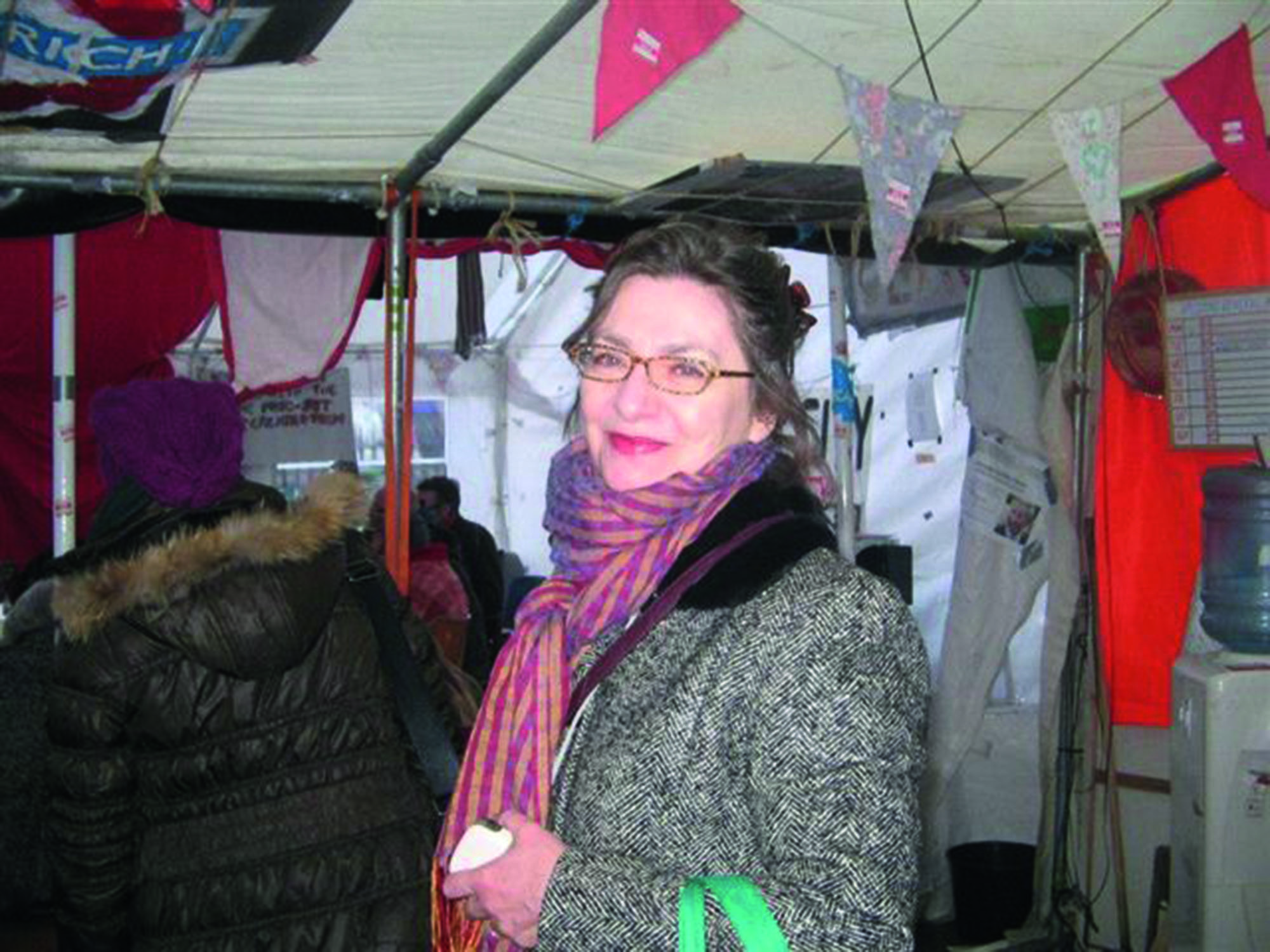
Isobel is an artist, blogger and PR consultant. She draws at the Supreme Court and other
challenging locations, including the Occupy camp outside St Paul’s.
As far as the words go, there are plenty of lawyers who produce technical analyses of the proceedings. Being a non-lawyer, I riff on the general theme of the case, such as terrorism (R v Gul), harassment (Hayes v Willoughby) or pensions (Nortel and Lehman). Sometimes I go off on a tangent, as when drawing itself became my story in Bull v Hall.
Concerning the pictures, there are practicalities. I can’t use some of my favourite drawing materials – bamboo pens, wooden coffee stirrers, quills, sheep’s wool tufts – as they need to be dipped in ink. Splashing a bottle of that onto the multi-coloured carpet designed by Sir Peter Blake would not endear me to the authorities. Similarly, I have to avoid the noisy friction of extravagant sweeps across textured paper.
Like the Derby, the Supreme Court is on the flat – no elevated jury, no witness box – so from the public seats it’s about the backs of heads and chairs, with the justices far away across the howling tundra. How do you deal with that? Sometimes I experiment with transparent outlines. In the drawing of R v Hughes (opposite), the justices are pink ectoplasm, the staff and judicial assistants orange. Opera glasses are an option I am yet to explore.
In each courtroom, discreet amplification emphasises every breath, every rustle, every moment of nervous tension. In the stark white box of Court 2, the plushy floral curtains aren’t enough to insulate counsel from the relentless scrape of the minute hand on the slate clock or the finality of the omega on the court emblem. It’s all right for me – I can just sit here scribbling and ingerpainting with compressed charcoal while fine minds deal in cool abstractions.
So which is more important, the art or the text? The answer is neither: it’s the Supreme Court itself. One day when I noted some choice aperçus from the bench, a tweeter put me in my place by recommending my blog post ‘not for the drawings, but brilliant comments from Baroness Hale’.
Isobel Williams, Blogging Artist
Posts are on www.isobelwilliams.blogspot.com (click on the ‘Supreme Court’ label) and on www. ukscblog.com, the independent blog about the Supreme Court run by Matrix and Olswang.
Blogging artist Isobel Williams on her work in the highest court in the land.
Since July 2012 I have been an occasional blogger-with-a-difference in the Supreme Court, with the court’s permission. The difference is that I illustrate my blog with drawings which I do on the spot; I rarely embellish them afterwards.

The Chair of the Bar reports back
Susie Griffin on the admin that keeps barristers from billable work
Clement Cowley, Partner at The Penny Group, explains how global events can influence the performance of pensions and ISAs, and why taking a long-term approach to investing is often the most effective strategy
Mário Barroso, Head of R&D and Method Development at AlphaBiolabs, discusses what family law professionals need to know about hallucinogens, from the main hallucinogenic drugs encountered in family proceedings, to their effects and the testing options available
Harmony Christian Ministries is the latest charity to benefit from a £500 donation from AlphaBiolabs via the company’s Giving Back initiative
By David Green
At the start of her term, Chair of the Bar 2026 Kirsty Brimelow KC set out a series of priorities for the year ahead. One of those priorities was children in the justice system
As the world becomes more digital, Barbara Vinagre Mota examines international research into the mental health consequences of judges’ exposure to graphic and immersive evidence, highlighting the importance of support systems
In an era of patient-centred care and growing concern over misconduct in medical settings, why do women still lack the right to choose women consultants for examination and treatment? Charles Davey investigates
Reviewed by Daniel Barnett
James McNeill Whistler at Tate Britain until 27 September Rothko in Florence at Palazzo Strozzi until 23 August Reviewed by Stephen Cragg KC