*/
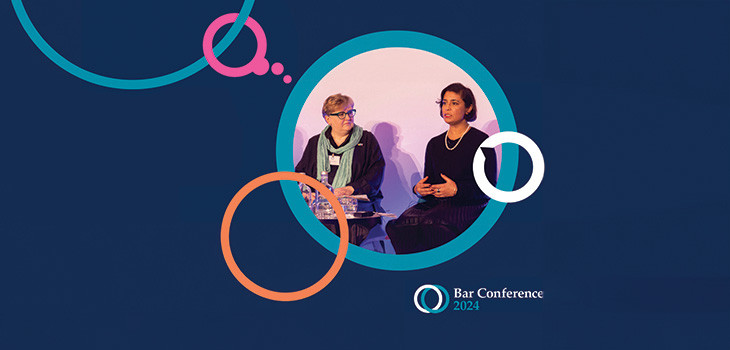
After a break last year, Bar Conference is back with a new format and packed agenda. Join colleagues in person on Saturday 8 June in London, with welcome drinks on the Friday evening
Bar Conference is a unique event in the Bar’s calendar that you will not want to miss. In a likely general election year, the event will debate the big issues facing the justice sector and hear from those who will shape our future.
Chair of the Bar, Sam Townend KC, says: ‘Bar Conference offers something for everyone. It’s a chance for the whole Bar to come together to grapple with the biggest challenges facing the justice sector. In a general election year it’s more important than ever that barristers have the chance to hear from those who have the power to shape the justice system – and that they get to hear views from the Bar.’ The three headline speakers for the event are the Lady Chief Justice Baroness Carr, the Lord Chancellor Rt Hon Alex Chalk KC MP, and Shadow Lord Chancellor Shabana Mahmood MP.
All three speakers will consider ‘what next for justice’ in England and Wales and take part in a Q&A discussion chaired by Sam Townend KC (Lord Chancellor session), Lord Macdonald KC (Shadow LC session), and Amrit Kaur Dhanoa (LCJ session).
Amrit Kaur Dhanoa, Chair of the Young Barristers’ Committee, says: ‘Bar Conference brings the profession together which can be hugely rewarding for those starting out in their careers at the Bar. It’s an invaluable opportunity to meet new people, exchange ideas, and engage in discussions over a new policy or practice area. Working at the Bar can be intense and the Bar Conference offers a welcoming environment for learning in a relaxed and enjoyable setting.’
The international panel debate will discuss the effectiveness of international courts and consider what the future holds. The panel, chaired by Baroness Kennedy KC, will include ICC Judge Joanna Korner CMG KC, Lord Neuberger, and the journalist Chris Stephen.
With the rapid growth of ChatGPT and other generative AI, the panel debate on technology will ask what place artificial intelligence could – and should – have in the justice sector. The debate, chaired by David O’Mahony (7BR), will hear from speakers including Sir Robert Buckland KC MP and Shobana Iyer (Swan Chambers).
In the wake of the Post Office scandal, the Bar Council has joined calls for private prosecutions to be reformed. But how? The debate, chaired by Adrian Darbishire KC (QEB Hollis Whiteman), will hear from Ari Alibhai (QEB Hollis Whiteman), Flora Page (23ES) and Polly Sprenger (Addleshaw Goddard).
The programme also includes practical sessions on earnings and work allocation, futureproofing practice through ADR and navigating ethical dilemmas at the Bar (with a particular focus on the employed Bar). Dr Paul Redmond, University of Liverpool, will deliver a thought-provoking session on navigating intergenerational differences between the four generations currently working at the Bar: Baby boomers, Generation X, Millennials, and Gen Z. The conference will also be hosting the Lifetime Achievement in Pro Bono, the Sydney Elland Goldsmith Award, presented by the Lord Chancellor.
Full price tickets are £150 (+VAT) and 20% discounts are available for Bar Representation Fee subscribers, barristers with a primary practising address outside the South Eastern Circuit and barristers in income band 1. The discounts can be combined up to a maximum of 50% off.
91767d2f-d2b8-4ead-9f82-08d02de56932.jpg?sfvrsn=8c2c0d49_1)
Bar Conference is a unique event in the Bar’s calendar that you will not want to miss. In a likely general election year, the event will debate the big issues facing the justice sector and hear from those who will shape our future.
Chair of the Bar, Sam Townend KC, says: ‘Bar Conference offers something for everyone. It’s a chance for the whole Bar to come together to grapple with the biggest challenges facing the justice sector. In a general election year it’s more important than ever that barristers have the chance to hear from those who have the power to shape the justice system – and that they get to hear views from the Bar.’ The three headline speakers for the event are the Lady Chief Justice Baroness Carr, the Lord Chancellor Rt Hon Alex Chalk KC MP, and Shadow Lord Chancellor Shabana Mahmood MP.
All three speakers will consider ‘what next for justice’ in England and Wales and take part in a Q&A discussion chaired by Sam Townend KC (Lord Chancellor session), Lord Macdonald KC (Shadow LC session), and Amrit Kaur Dhanoa (LCJ session).
Amrit Kaur Dhanoa, Chair of the Young Barristers’ Committee, says: ‘Bar Conference brings the profession together which can be hugely rewarding for those starting out in their careers at the Bar. It’s an invaluable opportunity to meet new people, exchange ideas, and engage in discussions over a new policy or practice area. Working at the Bar can be intense and the Bar Conference offers a welcoming environment for learning in a relaxed and enjoyable setting.’
The international panel debate will discuss the effectiveness of international courts and consider what the future holds. The panel, chaired by Baroness Kennedy KC, will include ICC Judge Joanna Korner CMG KC, Lord Neuberger, and the journalist Chris Stephen.
With the rapid growth of ChatGPT and other generative AI, the panel debate on technology will ask what place artificial intelligence could – and should – have in the justice sector. The debate, chaired by David O’Mahony (7BR), will hear from speakers including Sir Robert Buckland KC MP and Shobana Iyer (Swan Chambers).
In the wake of the Post Office scandal, the Bar Council has joined calls for private prosecutions to be reformed. But how? The debate, chaired by Adrian Darbishire KC (QEB Hollis Whiteman), will hear from Ari Alibhai (QEB Hollis Whiteman), Flora Page (23ES) and Polly Sprenger (Addleshaw Goddard).
The programme also includes practical sessions on earnings and work allocation, futureproofing practice through ADR and navigating ethical dilemmas at the Bar (with a particular focus on the employed Bar). Dr Paul Redmond, University of Liverpool, will deliver a thought-provoking session on navigating intergenerational differences between the four generations currently working at the Bar: Baby boomers, Generation X, Millennials, and Gen Z. The conference will also be hosting the Lifetime Achievement in Pro Bono, the Sydney Elland Goldsmith Award, presented by the Lord Chancellor.
Full price tickets are £150 (+VAT) and 20% discounts are available for Bar Representation Fee subscribers, barristers with a primary practising address outside the South Eastern Circuit and barristers in income band 1. The discounts can be combined up to a maximum of 50% off.
After a break last year, Bar Conference is back with a new format and packed agenda. Join colleagues in person on Saturday 8 June in London, with welcome drinks on the Friday evening

The Chair of the Bar reports back
By Kem Kemal, CEO, Henry Dannell
By BSK Financial Planning
Mário Barroso, Head of R&D and Method Development at AlphaBiolabs
Susie Griffin on the admin that keeps barristers from billable work
Clement Cowley, Partner at The Penny Group, explains how global events can influence the performance of pensions and ISAs, and why taking a long-term approach to investing is often the most effective strategy

Kick off your career at the Bar Council’s Pupillage Fair this October – it’s one of the most valuable opportunities for aspiring barristers, says Amelia Clegg
Join us on Saturday 21 November 2026 at Leeds Beckett University and see for yourself why the North continues to be an exceptional place to build a career at the Bar
The golden age of advocacy? David Langwallner pays homage to the filmic if contentious barrister Sir Edward Carson and some of his contemporaries
Henry Fingerhut outlines what the Bar Standards Board AI guidance means for early career barristers
Not yet, says Jacob Turner. Regulation, unlike the technology itself, is a domain the legal profession can still control