*/
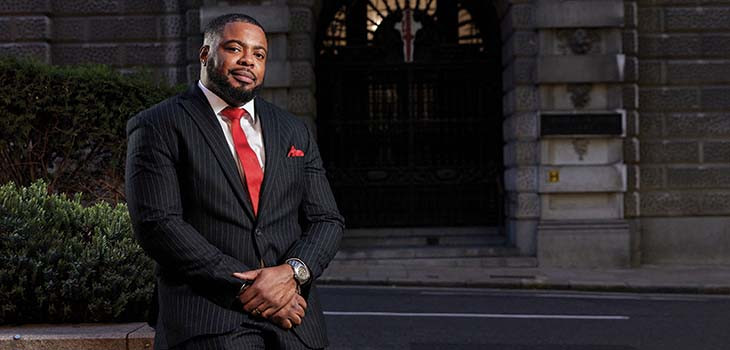
In my short time practising as a criminal barrister (only being called to the Bar in 2020), I often draw on comparisons with my previous career as a professional DJ, producer, and BBC Radio 1Xtra presenter. My work in music spanned nearly three decades and, despite eventually wanting to move on from the industry, one thing being a self-employed DJ equipped me with was the ability to hit the ground running at the self-employed Criminal Bar.
For me, advocacy is an art form and the best way to demonstrate it is in front of an audience. Thinking back to when I used to DJ, and the crowds which would vary from city to city, an essential skill was reading one’s audience. I now rely upon the same skill set, but these days my audience is 12 members of a jury in a courtroom rather than a club heaving with 1,200 plus ravers. Performing at various gigs across the UK prepared me for the travel that is often required when I am briefed outside of London.
My transition to the Bar was relatively smooth. As a DJ I had an agent, whose role was to manage my diary, collect booking fees and source me work from new promoters. Today, that is the job of my clerks! However, I was still hesitant when I switched careers as I had heard horror stories, which ranged from condescending judges, whose sole purpose was to bully and humiliate the junior Bar, to being worked to death by a clerks’ room that showed no mercy to its junior members. Thankfully, in my case, none of the above turned out to be true.
Apart from appearing in front of a few grumpy judges, I have thus far not experienced any bullying and have always been made to feel welcome by other members of the profession. Although work is exceptionally busy at the moment, I am fortunate enough to have found a harmonious work-life balance.
Great clerking = great practice. Although I am able to generate a lot of my own work, I have learnt that the key to a good practice is a great clerks’ room that supports, and to some extent nurtures, its junior members of chambers. I am very fortunate to have a fantastic clerking team at Great James Street. My diary is kept full of the kind of complex work with which a barrister ten years over my call would be delighted.
I am also lucky to be in a set that prioritises the wellbeing of its members. An example of this is that there is no expectation of pupils and new junior tenants to attend Saturday court. Regular breaks are actively encouraged and those members that wish to catch up on some admin or case preparation are always accommodated.
Young people may feel that the Bar is not for them (as I once did) because they perceive barristers to be a certain way. I am working very hard to break that perception. I regularly talk to students in schools and have launched my own project ‘Lawyers at Large’ with my wife who is a secondary school teacher. We invite two state-school educated barristers, who share their story about their journey into the profession and the obstacles they had to overcome along the way. The students then participate in a mock trial, where they are taught the basics in advocacy techniques. The project has been very successful with schools across London keen for us to attend. In addition to this, I am currently filming a documentary with BBC 2, focusing on state-school educated students who are seeking to enter the profession.
I see my support of various projects outside my day-to-day work as a barrister as being equally important. It’s great to see so many of my colleagues, especially at the junior end, involved in a wide range of social mobility projects, diversity initiatives and charity work. I think this represents the true spirit of the Bar, where we as lawyers do not just try to deliver justice, but many of us also work within the community to deliver positive change.
Having grown up in foster care, being of Caribbean heritage, state-school educated and having a learning disability (dyspraxia) I assumed that I would be out of place in a public-school educated, Oxbridge, middle-class profession; I was relieved to be proven wrong. The four Inns of Court are really doing some amazing, groundbreaking work and demonstrating that the Bar is an inclusive profession, and not beyond the reach of somebody like myself. It was the public perception of barristers that led me to do the ‘What Lawyers Look Like’ challenge, where I posted a picture of myself on social media in my favourite non-work clothes; a track suit and baseball cap. The post received a lot of attention from several journalists, but the most important thing was the number of solicitors and barristers who took part in the challenge and posted pictures of themselves in everyday clothes.
I still find it amusing when people ask me what I do for a living and are shocked when I say I am a ‘barrister’; maybe I should wear a pinstripe suit and tie when I go to the supermarket or perhaps wear my robes (I jest), but the point of the ‘What Lawyers Look Like’ challenge was to highlight the fact that we, as lawyers, are normal everyday people from all walks of life, and the law is not the preserve of one particular section of society.
The Criminal Bar has embarked on its action, including ‘no returns’ and ‘no new instructions’, as we feel that we have, yet again, been sidelined by the government. Much of the preparation work, such as written advice and conferences with clients we simply do not get paid for and the consensus is that our good will has been taken for granted for far too long. Nonetheless, I remain incredibly optimistic for the future, and I hope to see parity with other publicly funded areas of law such as the Family Bar.
The Bar feels like home for me. My hope is that in the future terms such as ‘non-traditional background’ will become obsolete, and the Bar will become an eclectic mix of people from all backgrounds.

Criminal barrister, Mark Robinson had a truly unconventional path into the legal profession and is now in practice at Great James Street where he is regularly instructed for matters in the Crown Court, Magistrates’ Court and Youth Court. An experienced gangs practitioner, he accepts instructions for serious youth violence and drug-related offences.
In my short time practising as a criminal barrister (only being called to the Bar in 2020), I often draw on comparisons with my previous career as a professional DJ, producer, and BBC Radio 1Xtra presenter. My work in music spanned nearly three decades and, despite eventually wanting to move on from the industry, one thing being a self-employed DJ equipped me with was the ability to hit the ground running at the self-employed Criminal Bar.
For me, advocacy is an art form and the best way to demonstrate it is in front of an audience. Thinking back to when I used to DJ, and the crowds which would vary from city to city, an essential skill was reading one’s audience. I now rely upon the same skill set, but these days my audience is 12 members of a jury in a courtroom rather than a club heaving with 1,200 plus ravers. Performing at various gigs across the UK prepared me for the travel that is often required when I am briefed outside of London.
My transition to the Bar was relatively smooth. As a DJ I had an agent, whose role was to manage my diary, collect booking fees and source me work from new promoters. Today, that is the job of my clerks! However, I was still hesitant when I switched careers as I had heard horror stories, which ranged from condescending judges, whose sole purpose was to bully and humiliate the junior Bar, to being worked to death by a clerks’ room that showed no mercy to its junior members. Thankfully, in my case, none of the above turned out to be true.
Apart from appearing in front of a few grumpy judges, I have thus far not experienced any bullying and have always been made to feel welcome by other members of the profession. Although work is exceptionally busy at the moment, I am fortunate enough to have found a harmonious work-life balance.
Great clerking = great practice. Although I am able to generate a lot of my own work, I have learnt that the key to a good practice is a great clerks’ room that supports, and to some extent nurtures, its junior members of chambers. I am very fortunate to have a fantastic clerking team at Great James Street. My diary is kept full of the kind of complex work with which a barrister ten years over my call would be delighted.
I am also lucky to be in a set that prioritises the wellbeing of its members. An example of this is that there is no expectation of pupils and new junior tenants to attend Saturday court. Regular breaks are actively encouraged and those members that wish to catch up on some admin or case preparation are always accommodated.
Young people may feel that the Bar is not for them (as I once did) because they perceive barristers to be a certain way. I am working very hard to break that perception. I regularly talk to students in schools and have launched my own project ‘Lawyers at Large’ with my wife who is a secondary school teacher. We invite two state-school educated barristers, who share their story about their journey into the profession and the obstacles they had to overcome along the way. The students then participate in a mock trial, where they are taught the basics in advocacy techniques. The project has been very successful with schools across London keen for us to attend. In addition to this, I am currently filming a documentary with BBC 2, focusing on state-school educated students who are seeking to enter the profession.
I see my support of various projects outside my day-to-day work as a barrister as being equally important. It’s great to see so many of my colleagues, especially at the junior end, involved in a wide range of social mobility projects, diversity initiatives and charity work. I think this represents the true spirit of the Bar, where we as lawyers do not just try to deliver justice, but many of us also work within the community to deliver positive change.
Having grown up in foster care, being of Caribbean heritage, state-school educated and having a learning disability (dyspraxia) I assumed that I would be out of place in a public-school educated, Oxbridge, middle-class profession; I was relieved to be proven wrong. The four Inns of Court are really doing some amazing, groundbreaking work and demonstrating that the Bar is an inclusive profession, and not beyond the reach of somebody like myself. It was the public perception of barristers that led me to do the ‘What Lawyers Look Like’ challenge, where I posted a picture of myself on social media in my favourite non-work clothes; a track suit and baseball cap. The post received a lot of attention from several journalists, but the most important thing was the number of solicitors and barristers who took part in the challenge and posted pictures of themselves in everyday clothes.
I still find it amusing when people ask me what I do for a living and are shocked when I say I am a ‘barrister’; maybe I should wear a pinstripe suit and tie when I go to the supermarket or perhaps wear my robes (I jest), but the point of the ‘What Lawyers Look Like’ challenge was to highlight the fact that we, as lawyers, are normal everyday people from all walks of life, and the law is not the preserve of one particular section of society.
The Criminal Bar has embarked on its action, including ‘no returns’ and ‘no new instructions’, as we feel that we have, yet again, been sidelined by the government. Much of the preparation work, such as written advice and conferences with clients we simply do not get paid for and the consensus is that our good will has been taken for granted for far too long. Nonetheless, I remain incredibly optimistic for the future, and I hope to see parity with other publicly funded areas of law such as the Family Bar.
The Bar feels like home for me. My hope is that in the future terms such as ‘non-traditional background’ will become obsolete, and the Bar will become an eclectic mix of people from all backgrounds.

The Chair of the Bar reports back
By Kem Kemal, CEO, Henry Dannell
By BSK Financial Planning
Mário Barroso, Head of R&D and Method Development at AlphaBiolabs
Susie Griffin on the admin that keeps barristers from billable work
Clement Cowley, Partner at The Penny Group, explains how global events can influence the performance of pensions and ISAs, and why taking a long-term approach to investing is often the most effective strategy

Kick off your career at the Bar Council’s Pupillage Fair this October – it’s one of the most valuable opportunities for aspiring barristers, says Amelia Clegg
The golden age of advocacy? David Langwallner pays homage to the filmic if contentious barrister Sir Edward Carson and some of his contemporaries
Henry Fingerhut outlines what the Bar Standards Board AI guidance means for early career barristers
The Ministry of Justice will match-fund up to 100 criminal pupillages, with grants available to criminal chambers across England and Wales. Similar to the COIC scheme, the grants will match-fund pupillages additional to those otherwise offered without government funding
Not yet, says Jacob Turner. Regulation, unlike the technology itself, is a domain the legal profession can still control