*/
The Chairman of the Bar is responsible for appointing the two barrister members of the QC Selection Panel. Roy Amlot QC was appointed to the Panel in 2005 as a founder member of the new Selection Process. He has par ticipated in three demanding and highly
successful selection Rounds, with the results of the third Round expected to be announced shor tly. Roy will be leaving the Panel at the end of the third Round, and the purpose of this note is to seek nominations for his successor. The second barrister member, Jean Ritchie QC, will continue to serve on the Panel.
A number of other changes to the Panel are imminent. The Directors of QCA Ltd will soon be interviewing to select a new Chair of the Panel, to succeed Dame Elizabeth Butler-Sloss GBE. One of the first tasks of the new Chair will be to select by open competition two new lay members for the Panel. At the same time, the President of the Law Society will be selecting a new solicitor member for the Panel. Taken together, there will be four new members of the nine-person Panel required for the next selection Round, which we hope will be open for applications in March 2009.
Desmond Browne QC is keen to ensure that he has as diverse a selection of candidates as possible for the barrister vacancy. He is therefore seeking applications from barristers, and suggestions from the Bar of individual barristers who will carry the confidence both of the profession and of the other high-calibre members of the Panel. Individuals should be Queen’s Counsel who are universally respected as outstanding practitioners in their field, or senior employed barristers who have reached the highest level.
The successful candidate will be expected to serve for at least two annual Rounds, and will receive appropriate daily remuneration for what will continue to be a demanding and fascinating task. The commitment will be for some 30 days’ work for each Round (with the bulk of the work falling either side of the summer recess), and we hope that each future Round will fit within an annual cycle from April to March. Fur ther details of the Selection Process can be found
at www.qcapplications.org.uk
If you wish to apply, or know of individuals who are suitable and likely to be willing to commit the time, please contact Desmond Browne QC, either by writing to him at the Bar Council (289-293 High Holborn, London, WC1V 7HZ), or by email to
Chairman@barcouncil.org.uk, by 6 March 2009
Desmond Browne QC is keen to ensure that he has as diverse a selection of candidates as possible for the barrister vacancy. He is therefore seeking applications from barristers, and suggestions from the Bar of individual barristers who will carry the confidence both of the profession and of the other high-calibre members of the Panel. Individuals should be Queen’s Counsel who are universally respected as outstanding practitioners in their field, or senior employed barristers who have reached the highest level.
The successful candidate will be expected to serve for at least two annual Rounds, and will receive appropriate daily remuneration for what will continue to be a demanding and fascinating task. The commitment will be for some 30 days’ work for each Round (with the bulk of the work falling either side of the summer recess), and we hope that each future Round will fit within an annual cycle from April to March. Fur ther details of the Selection Process can be found
at www.qcapplications.org.uk
If you wish to apply, or know of individuals who are suitable and likely to be willing to commit the time, please contact Desmond Browne QC, either by writing to him at the Bar Council (289-293 High Holborn, London, WC1V 7HZ), or by email to
Chairman@barcouncil.org.uk, by 6 March 2009
The Chairman of the Bar is responsible for appointing the two barrister members of the QC Selection Panel. Roy Amlot QC was appointed to the Panel in 2005 as a founder member of the new Selection Process. He has par ticipated in three demanding and highly
successful selection Rounds, with the results of the third Round expected to be announced shor tly. Roy will be leaving the Panel at the end of the third Round, and the purpose of this note is to seek nominations for his successor. The second barrister member, Jean Ritchie QC, will continue to serve on the Panel.
A number of other changes to the Panel are imminent. The Directors of QCA Ltd will soon be interviewing to select a new Chair of the Panel, to succeed Dame Elizabeth Butler-Sloss GBE. One of the first tasks of the new Chair will be to select by open competition two new lay members for the Panel. At the same time, the President of the Law Society will be selecting a new solicitor member for the Panel. Taken together, there will be four new members of the nine-person Panel required for the next selection Round, which we hope will be open for applications in March 2009.
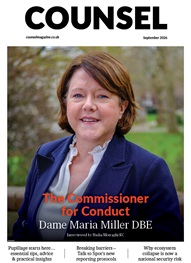

The Chair of the Bar reports back
Susie Griffin on the admin that keeps barristers from billable work
Clement Cowley, Partner at The Penny Group, explains how global events can influence the performance of pensions and ISAs, and why taking a long-term approach to investing is often the most effective strategy
Mário Barroso, Head of R&D and Method Development at AlphaBiolabs, discusses what family law professionals need to know about hallucinogens, from the main hallucinogenic drugs encountered in family proceedings, to their effects and the testing options available
Harmony Christian Ministries is the latest charity to benefit from a £500 donation from AlphaBiolabs via the company’s Giving Back initiative
By David Green
At the start of her term, Chair of the Bar 2026 Kirsty Brimelow KC set out a series of priorities for the year ahead. One of those priorities was children in the justice system
As the world becomes more digital, Barbara Vinagre Mota examines international research into the mental health consequences of judges’ exposure to graphic and immersive evidence, highlighting the importance of support systems
In an era of patient-centred care and growing concern over misconduct in medical settings, why do women still lack the right to choose women consultants for examination and treatment? Charles Davey investigates
Reviewed by Daniel Barnett
James McNeill Whistler at Tate Britain until 27 September Rothko in Florence at Palazzo Strozzi until 23 August Reviewed by Stephen Cragg KC