*/
NICHOLAS Green QC, the Chairman of the Bar Council, which represents barristers in England and Wales, has said the Bar Council is
willing to lend its support to the Secretary of State for Justice, Ken Clarke QC MP, as he makes tough and potentially unpopular decisions regarding the prison system, though they must lead to a better and more efficient administration of justice.
Responding to news reports that Ken Clarke was to address rising prison numbers, Nicholas Green QC said:
“The public needs protection from dangerous offenders; but far too often short sentences are just a costly ticket to a life of crime. “Our current approach to sentencing and imprisonment is failing. Prisons are expensive, and do not reduce recidivism. It makes no sense to pay so much for a system which does little more for the public than provide a security blanket, which all too frequently is pulled away by sky-high reoffending rates.
“The way forward is to depoliticise sentencing policy, allowing Judges greater freedom to impose the appropriate sentence, whatever
that might be. This will have a deflationary effect on prison numbers, save a huge amount of money and focus attention on tough and effective non-custodial sentences, which will include a valuable element of payback to society. We also need to consider other measures to prevent crime, which may well have a greater effect on offending than punishing after the event.
“The Bar Council has no political axe to grind. We represent barristers on all sides of the justice system. Barristers prosecute, defend and sit as Judges. The urgent need to reduce debt is actually a rare opportunity for bold reform and we will support Ken Clarke as hemakes these tough decisions based on rationality and not on what just sounds good."
Responding to news reports that Ken Clarke was to address rising prison numbers, Nicholas Green QC said:
“The public needs protection from dangerous offenders; but far too often short sentences are just a costly ticket to a life of crime. “Our current approach to sentencing and imprisonment is failing. Prisons are expensive, and do not reduce recidivism. It makes no sense to pay so much for a system which does little more for the public than provide a security blanket, which all too frequently is pulled away by sky-high reoffending rates.
“The way forward is to depoliticise sentencing policy, allowing Judges greater freedom to impose the appropriate sentence, whatever
that might be. This will have a deflationary effect on prison numbers, save a huge amount of money and focus attention on tough and effective non-custodial sentences, which will include a valuable element of payback to society. We also need to consider other measures to prevent crime, which may well have a greater effect on offending than punishing after the event.
“The Bar Council has no political axe to grind. We represent barristers on all sides of the justice system. Barristers prosecute, defend and sit as Judges. The urgent need to reduce debt is actually a rare opportunity for bold reform and we will support Ken Clarke as hemakes these tough decisions based on rationality and not on what just sounds good."
NICHOLAS Green QC, the Chairman of the Bar Council, which represents barristers in England and Wales, has said the Bar Council is
willing to lend its support to the Secretary of State for Justice, Ken Clarke QC MP, as he makes tough and potentially unpopular decisions regarding the prison system, though they must lead to a better and more efficient administration of justice.
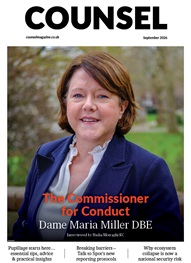

The Chair of the Bar reports back
Susie Griffin on the admin that keeps barristers from billable work
Clement Cowley, Partner at The Penny Group, explains how global events can influence the performance of pensions and ISAs, and why taking a long-term approach to investing is often the most effective strategy
Mário Barroso, Head of R&D and Method Development at AlphaBiolabs, discusses what family law professionals need to know about hallucinogens, from the main hallucinogenic drugs encountered in family proceedings, to their effects and the testing options available
Harmony Christian Ministries is the latest charity to benefit from a £500 donation from AlphaBiolabs via the company’s Giving Back initiative
By David Green
At the start of her term, Chair of the Bar 2026 Kirsty Brimelow KC set out a series of priorities for the year ahead. One of those priorities was children in the justice system
As the world becomes more digital, Barbara Vinagre Mota examines international research into the mental health consequences of judges’ exposure to graphic and immersive evidence, highlighting the importance of support systems
In an era of patient-centred care and growing concern over misconduct in medical settings, why do women still lack the right to choose women consultants for examination and treatment? Charles Davey investigates
Reviewed by Daniel Barnett
James McNeill Whistler at Tate Britain until 27 September Rothko in Florence at Palazzo Strozzi until 23 August Reviewed by Stephen Cragg KC